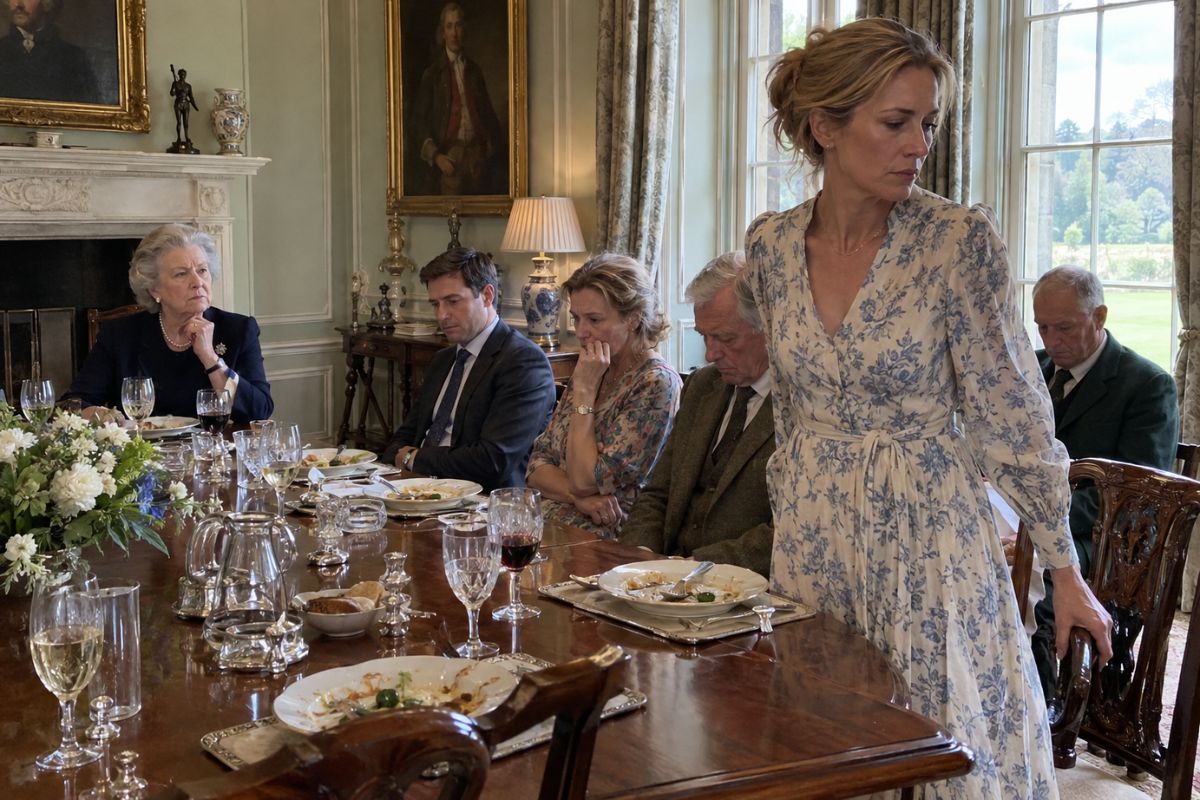
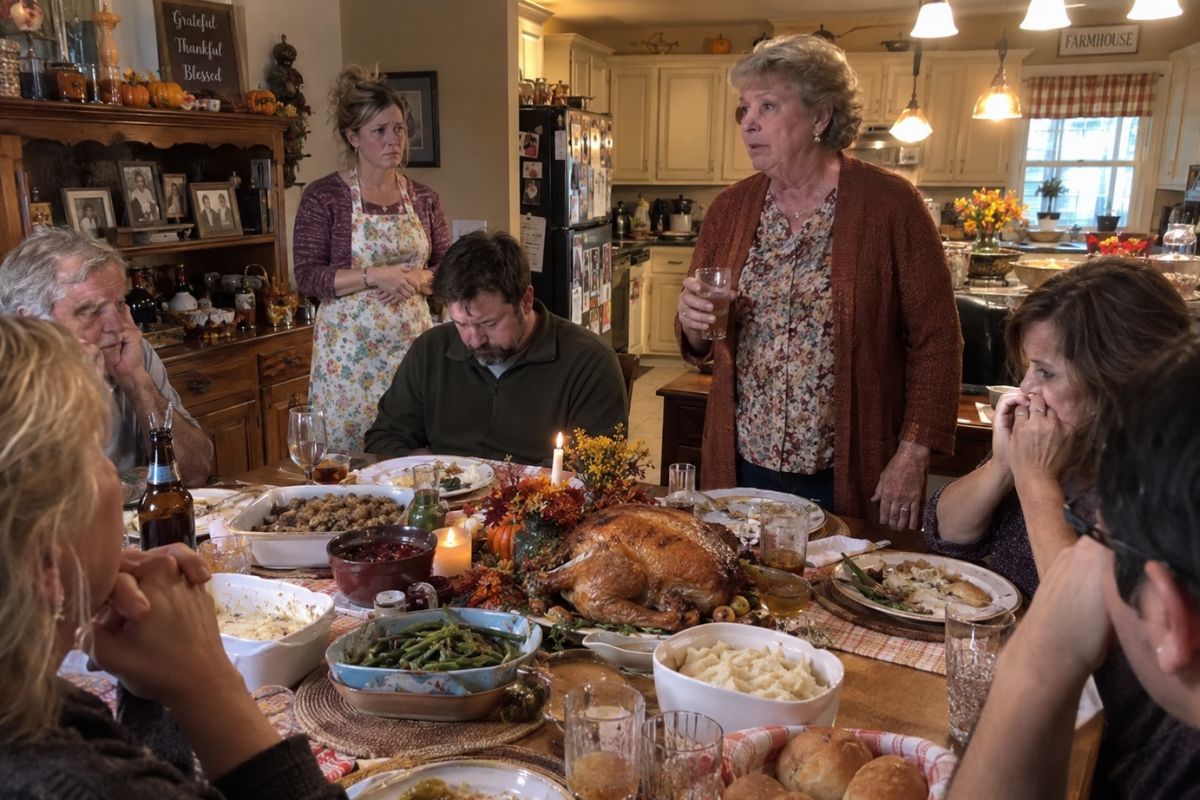
Diane Bennett waited until everybody had a plate before she announced that I would never inherit a piece of her family property.
There were fourteen people around the Thanksgiving table that afternoon, counting the twins at the folding card table by the bay window.
The turkey had been carved.
The sweet potatoes were cooling.
My husband, Mark, had just reached for the gravy when his mother tapped a spoon against her water glass.
“Before everyone scatters,” Diane said, “I have something I want to make clear.”
I was standing beside the sideboard because there weren’t enough chairs and because, for the previous four hours, I had been cooking in a kitchen that technically belonged to her but had somehow become my responsibility.
Diane looked directly at me.
Then she smiled.
Not warmly.
“I met with my attorney last month,” she said. “The farm stays in the Bennett family. I’ve made sure Rachel has no claim to it if something happens to Mark.”
Nobody moved.
Mark’s cousin Ellen lowered her fork.
Uncle Roy stopped chewing.
Even eight-year-old Noah seemed to notice that something in the room had changed.
I stared at Diane.
I had never asked about her will.
Not once in eight years of marriage.
I had never asked for the farm.
I had never asked for her money.
In fact, she didn’t know I had paid $2,860 three summers earlier to replace the farmhouse well pump when she told Mark she “could manage another month” without reliable water.
She didn’t know I had paid the electrician who fixed the failing panel in the mudroom.
She didn’t know because I had asked the contractors not to tell her.
I thought preserving her pride was a form of kindness.
Diane lifted her glass.
“Some women marry into families,” she said. “That doesn’t make them family.”
I remember the refrigerator humming.
I remember the smell of sage.
I remember that the gravy spoon in Mark’s hand stopped halfway between the bowl and his plate.
And I remember looking at my husband.
Not because I needed him to fight with his mother.
I didn’t need shouting.
I didn’t need a scene.
I needed one sentence.
That’s my wife, Mom.
Don’t speak to her that way.
Anything.
Mark looked at me for half a second.
Then he lowered his eyes to his plate.
That hurt more than Diane’s words.
I untied the apron around my waist.
I folded it once and set it beside the biscuits.
“Happy Thanksgiving,” I said.
Then I walked out.
Behind me, someone said, “Rachel—”
I didn’t stop.
The November air was sharp enough to sting my face.
I got into my Subaru, started the engine, and sat with both hands on the steering wheel.
Our house was twelve miles east.
I turned west.
I was not going home.
I was going to see the one person Diane Bennett had refused to speak to for seventeen years.
Her sister.
Carol.
Maple Ridge Assisted Living sat behind a row of bare sycamores on the edge of Millhaven, Missouri, forty minutes from Diane’s farmhouse.
The lobby had paper turkeys taped to the reception desk and a fake fireplace playing a digital flame beneath a television nobody was watching.
A nursing aide named Tasha recognized me.
“She’s awake,” she said quietly.
I must have looked strange because she glanced at my coat, then my face.
“You okay?”
“I’m fine.”
It came out too quickly.
Tasha didn’t challenge me.
People who work around old age and grief learn when not to.
Carol Hayes was sitting in her recliner beside the window.
She was seventy-one, four years older than Diane, but illness had widened the distance between them. Her shoulders had narrowed over the previous months. Her silver hair was cropped short because long hair tired her arms to brush.
On the tray beside her sat half a cup of tea and three puzzle pieces she had been sorting for twenty minutes.
She looked at me and frowned.
“Aren’t you supposed to be eating turkey?”
“I did.”
“You’re a terrible liar.”
“I barely did.”
“That sounds more believable.”
She pushed the puzzle aside.
Then she studied me.
“What happened?”
For months, I had avoided telling Carol much about Diane.
Their history was complicated enough without me dragging my marriage into it.
But something in me had changed in that dining room.
Not broken exactly.
Broken things can sometimes be glued back where they were.
This felt more like finally seeing a crack that had been there all along.
I sat beside her.
“Diane announced that she changed her will.”
Carol raised an eyebrow.
“She changes that thing every time somebody disappoints her. Mark was removed once for buying a motorcycle.”
“He was twenty-two.”
“Exactly.”
I almost laughed.
Almost.
“She said she made sure I wouldn’t get the farm.”
Carol’s expression changed.
“She said that at dinner?”
“In front of everybody.”
Carol turned her face toward the darkening window.
I hadn’t told her the worst part.
I didn’t have to.
“What else?” she asked.
I looked down at my hands.
“She said marrying into a family doesn’t make you family.”
Carol went very still.
Not dramatically.
She simply stopped moving.
Even her fingers, which were usually restless, became quiet on the blanket.
“What?”
I repeated it.
Her eyes closed.
“Carol?”
She opened them again.
For several seconds, she didn’t seem to be looking at me.
She was looking through me.
Back decades.
“I heard that sentence before,” she said.
“From Diane?”
“No.”
She looked toward the dresser.
On top of it sat a small plastic envelope filled with photographs and old cards.
“My mother.”
That was the first thing that did not make sense.
I had heard Diane talk about her mother, Evelyn, dozens of times.
Never fondly.
According to Diane, Evelyn Hayes had been critical, controlling, impossible to please.
Diane had once told me, while we were canning peaches, “My mother could turn a compliment into a bruise without raising her voice.”
I remembered the line because it had been so precise.
At the time, I had wondered how someone who understood cruelty so well could practice smaller versions of it so casually.
Carol pointed toward the plastic envelope.
“Bring me that.”
Inside were old photographs, a church bulletin from 1978, a funeral card, and a stained index card.
The card was written in blue ink.
Apple Butter Cake
Underneath the ingredients, in smaller handwriting, someone had written:
Carol likes extra cinnamon. Don’t forget the walnuts for Diane.
I turned it over.
On the back was one sentence.
A table is only good if everyone has a place at it. —Dad
I looked at Carol.
“My father wrote that,” she said. “The recipe was Mama’s. The note was his.”
“Why do you have it?”
“Because I stole it.”
I blinked.
Carol smiled faintly.
“Finally got your attention.”
“You stole a recipe card?”
“Seventeen years ago.”
“The year you and Diane stopped speaking?”
Carol looked at me.
“That’s the year everybody thinks we stopped speaking.”
There was more beneath that sentence.
I could hear it.
But Carol’s breathing had become shallow.
She leaned back and closed her eyes.
“Not tonight,” she said.
“Carol—”
“Rachel.”
Her tone was gentle.
“I’ve been waiting seventeen years. I can wait one more day.”
I wanted to push.
Instead, I tucked the card back into its sleeve.
Then Carol caught my wrist.
“There is one thing.”
“What?”
“If Diane says that sentence again…”
“What sentence?”
“About who counts as family.”
Her grip tightened.
“Ask her who taught it to her.”
I met Carol because of library books.
That was all.
No dramatic letter.
No secret inheritance.
No mysterious stranger.
I worked as the adult services librarian at the Millhaven Public Library, a small brick building across from the county courthouse.
Twice a month, I drove boxes of large-print books to three senior communities.
Eight months before that Thanksgiving, I had wheeled a cart into Maple Ridge and found Carol sitting near the lobby shelves arguing with another resident about whether the movie was better than the book.
“It never is,” Carol had insisted.
“That is statistically impossible,” I told her.
She looked at my name badge.
RACHEL BENNETT
Her expression changed.
“Bennett?”
“Yes.”
“Are you married to Mark Bennett?”
I had been cautious.
“Do you know Mark?”
“I held him when he was six hours old.”
That was how I discovered my husband had an aunt he had not mentioned in years.
Later that night, I asked him.
He kept his eyes on the television.
“Aunt Carol and Mom had a falling-out.”
“What kind?”
“Family stuff.”
“What does that mean?”
“It means family stuff.”
I should have pushed harder.
Instead, I accepted the phrase because that was what I had been doing throughout our marriage.
Accepting phrases in place of answers.
Mom’s complicated.
She didn’t mean it like that.
That’s just her way.
Let it go.
Keep the peace.
Carol never asked me to intervene.
That mattered.
She never said, “Tell Diane I’m sick.”
She never said, “Make your husband visit me.”
She simply asked about Mark.
What did he do for work?
Did he still hate tomatoes?
Did he still rub the back of his neck when he was nervous?
That last question surprised me.
“Yes,” I said.
“He’s done that since he was little.”
Over the months, I learned pieces.
Carol had been married once to a gentle man named Frank Hayes, who died twelve years earlier.
They never had children.
She had worked for thirty-six years as an elementary school secretary.
She kept birthday cards.
She hated canned peas.
She loved crossword puzzles but cheated at them shamelessly.
She had advanced heart failure, and the conversation around her care had gradually shifted from fixing things to keeping her comfortable.
The first time I asked whether Diane knew she was ill, Carol said, “Diane knows how old I am.”
“That isn’t what I asked.”
“It’s the answer I have.”
So I started visiting.
At first monthly.
Then weekly.
I told myself I was doing it because Carol was lonely.
That was only partly true.
I also went because Carol was the first Bennett woman who never made me prove I deserved a chair.
My relationship with Diane had not started badly.
That was important.
Cruel people are easier to understand when they are cruel on the first day.
Diane wasn’t.
The first time Mark took me to the farmhouse, she served roast beef and lemon pie.
She asked about my job.
She showed me photographs of Mark as a child.
When I admired the old oak table in her kitchen, she told me Mark’s father, Howard, had refinished it by hand.
“He believed good wood ought to outlive whoever bought it,” she said.
Howard had died of a sudden heart attack the year before I met Mark.
His absence lived in every room.
His coat still hung in the mudroom that first winter.
Diane was fifty-nine then.
Newly widowed.
Proud.
Lonely.
Mark was her only child.
I understood why she held tightly to him.
At first.
Then little things started.
When Mark told her we were engaged, she smiled and asked whether I had finished paying off my student loans.
At my bridal shower, she gave me a cookbook and said, “Mark grew up with real meals, so you’ll have a lot to learn.”
When we bought our modest three-bedroom house, she walked through it and said, “Small, but easier for Rachel to manage.”
If I reacted, I was sensitive.
If I stayed quiet, the comments grew bolder.
Once, at Christmas, she told Mark’s cousin that his high school girlfriend had “understood country life better.”
I said, “Then I’m lucky Mark wasn’t looking for farm labor when he got married.”
Everyone laughed.
Except Diane.
For a while after that, she behaved better.
I mistook temporary caution for change.
I also kept helping her.
Partly because that was how I had been raised.
My mother was a nurse’s aide. My father fixed heating systems until his knees gave out. In our house, if someone was sick, you brought food. If someone’s porch light was out, you replaced the bulb.
You didn’t hold a committee meeting about whether they deserved it.
So when Diane’s arthritis worsened, I drove her to appointments whenever Mark couldn’t.
When a spring storm tore shingles off the barn roof, I spent Saturday calling contractors.
When the well pump failed, Diane told Mark she would “figure it out.”
Mark was in Omaha on a three-week insurance assignment.
I wrote the check.
I never told him the amount.
That part was my mistake.
I thought kindness was most pure when nobody knew about it.
Sometimes secrecy protects another person’s dignity.
Sometimes it only hides a pattern everybody needs to see.
Mark came home at 9:14 Thanksgiving night.
I know the time because I was sitting at the kitchen table staring at the digital clock above the stove.
He stepped inside carrying my casserole dish.
That somehow made me angrier.
The stupid blue casserole dish.
As if he had gone back into that dining room after I left and carefully collected my property while leaving my dignity on the table.
“Rachel.”
I didn’t answer.
He set the dish by the sink.
“Mom shouldn’t have said that.”
I looked at him.
“No.”
“I talked to her.”
“When?”
“After dinner.”
“After dinner.”
He rubbed the back of his neck.
Carol was right.
I had seen that gesture a thousand times.
I had never wondered where it came from.
“What did you say?” I asked.
“I told her she upset you.”
“Did you tell her she was wrong?”
“She knows she was wrong.”
“That isn’t what I asked.”
His jaw tightened.
“I’m not defending her.”
“You didn’t defend me either.”
“That’s not fair.”
I actually laughed then.
One short sound.
“Fourteen people watched your mother tell me I’m not family.”
“She was talking about the property.”
“No, Mark. She used the property to talk about me.”
He pulled out the chair opposite mine.
I stood.
I couldn’t sit across from him yet.
“You looked at your plate.”
“I froze.”
“You always freeze.”
“That’s not true.”
“Christmas two years ago when she compared me to Jenna?”
“Rachel—”
“My mother’s funeral when she complained that we stayed in Illinois three days instead of two?”
“She apologized for that.”
“To you.”
He stopped.
I waited.
“Did she ever apologize to me?”
He looked away.
“No.”
I nodded.
There it was.
A tiny answer.
A terrible one.
“Where did you go?” he asked.
The question startled me.
“What?”
“You didn’t come home. I called you.”
“My phone was in my purse.”
“Where were you?”
I thought of Carol.
Of the index card.
Of her thin hand gripping my wrist.
Ask her who taught it to her.
“I needed somewhere quiet.”
“Rachel.”
“I’m not talking about that yet.”
Mark stood.
“Are you leaving me?”
“No.”
His face changed anyway.
“I’m going upstairs,” I said. “You can sleep in the guest room.”
“For how long?”
“I don’t know.”
He opened his mouth.
I stopped him.
“And Mark?”
He looked at me.
“Do not call your mother and tell her I’m being dramatic.”
His expression told me I had guessed correctly.
“I wasn’t going to say dramatic.”
“What were you going to say?”
He looked toward the blue casserole dish.
“That you were upset.”
I went upstairs.
Two days later, Diane fell in her kitchen.
It was not a dramatic fall.
No ambulance sirens screaming down a highway.
No grave injury.
She had been reaching for a container on the upper pantry shelf, lost her balance, and landed hard enough to frighten herself and bruise her hip.
A neighbor, Mr. Lawson, found her sitting on the floor because she had called him instead of Mark.
Mark was two hours away handling a storm-damage claim.
Fox Creek Community Hospital checked Diane, took images, and confirmed nothing was broken.
She could go home.
She needed someone to drive her.
I found out because Mark called.
“I know you don’t want to deal with Mom right now.”
“You’re right.”
He was silent.
“Can you get there?”
I closed my eyes.
There are moments when a person’s values become inconvenient.
That is when you find out whether they are values or decoration.
“I’ll pick her up.”
“You don’t have to.”
“No. I don’t.”
I let that sit between us.
“Send me the discharge entrance.”
Diane was sitting in a wheelchair when I arrived.
She wore gray sweatpants, a quilted jacket, and an expression suggesting the hospital had personally offended her.
When she saw me, she looked past me.
“Where’s Mark?”
“Working.”
“I could call Ellen.”
“Ellen’s in St. Louis.”
“Roy?”
“His daughter’s visiting.”
Diane pressed her lips together.
“You didn’t need to come.”
“No.”
That was all I said.
The nurse helped her into my car.
The first twenty minutes passed in silence.
Outside, harvested cornfields stretched pale under a flat November sky.
Diane kept both hands folded over her purse.
Finally she said, “You’re angry with me.”
“Yes.”
She looked surprised by the simplicity of the answer.
“I suppose you think I owe you an apology.”
“Yes.”
Another mile.
“I was trying to make things clear.”
“You succeeded.”
“The farm belonged to Howard’s family.”
“I know.”
“Mark is my son.”
“I know.”
“I don’t understand why you’re acting like I accused you of stealing something.”
I pulled into a gas station parking area.
Not because I was shouting.
Because I didn’t want to have the conversation at fifty-five miles an hour.
I put the car in park.
“Diane, I don’t care about your farm.”
“Well—”
“No. You need to hear me for once.”
She stared ahead.
“I have never asked for your property. I have never asked what you have in the bank. I have never asked what’s in your will.”
“You and Mark are married. These things matter.”
“Then discuss them privately with Mark.”
Her hands tightened around her purse.
“You announced in front of fourteen people that I wasn’t family.”
“That isn’t exactly—”
“It is exactly what you said.”
She turned toward the passenger window.
Then, after a moment, she asked the strangest question.
“If I’m so terrible, why did you come get me?”
I looked at her.
She still didn’t face me.
There are speeches people imagine giving for years.
Perfect speeches.
Devastating speeches.
I had none.
What came out was quieter.
“Because how you treat me tells me who you are. How I treat you tells me who I am.”
Diane’s face changed slightly.
Not softened.
More like something had knocked against a locked door.
I reached into my purse.
Carol had given me permission that morning.
Inside was a small digital voice recorder.
No convenient secret surveillance.
No hidden confession.
Just an old woman who was running out of time and wanted her sister to hear her voice.
I placed it on the console.
“What’s that?” Diane asked.
“A message.”
“From who?”
“Carol.”
Diane’s head turned so quickly she winced.
“No.”
“You don’t have to listen.”
“Why are you seeing Carol?”
“Because I met her through work.”
“You had no business involving yourself.”
“I didn’t involve myself in your argument. I visited a lonely woman.”
Diane’s color rose.
“You don’t know what she did.”
“You’re right.”
“She always has a version.”
“So do you.”
Her eyes narrowed.
I picked up the recorder.
“I won’t play it.”
“Good.”
“I’ll leave it with you.”
“I don’t want it.”
“Then throw it away.”
She stared at the device.
I set it in the cup holder.
Then I pulled back onto the highway.
Diane said nothing for the remaining sixteen miles.
When we reached the farmhouse, I helped her to the porch.
At the door, she turned.
“You really don’t want the farm?”
I almost smiled.
“No, Diane.”
“What if Mark—”
“No.”
She studied me.
For the first time in eight years, she seemed less suspicious than confused.
As if she had been defending a fortress nobody was attacking.
I left the recorder in her coat pocket.
Diane listened to Carol’s message at 2:30 the following morning.
She told me that later.
At the time, all I knew was that Mark received a call from her just before sunrise.
He went into the hallway to answer.
I was awake.
I heard his voice.
“Mom?”
Then silence.
Then:
“What did she say?”
Another silence.
Then:
“No. I didn’t know that.”
He came back into the bedroom wearing the same T-shirt he had slept in.
I sat against the headboard.
“What happened?”
He looked at me.
“Mom wants to know why you gave her Aunt Carol’s recorder.”
“Did she listen?”
“Yes.”
He sat on the edge of the bed.
“What was on it?”
“I didn’t listen to the final recording.”
That was true.
Carol had recorded it after I left Maple Ridge.
She told me she needed to speak without watching my face.
Mark rubbed his neck.
“Mom’s crying.”
I had known Diane eight years.
I had seen her cry once, at Howard’s memorial service.
Even then, she had apologized and walked into the restroom.
“What did Carol say?”
Mark swallowed.
“She said Grandma Evelyn used to say things to her that Mom says to you.”
I waited.
“She said Grandma made Aunt Carol feel like she was always… visiting her own family.”
The words landed heavily.
Mark stared at the carpet.
“Mom says Carol is lying.”
“Do you believe that?”
“I don’t know.”
But I could tell he did.
Or at least believed enough to be afraid.
Later that afternoon, Diane called me.
She did not say hello.
“Did Carol tell you I hated my mother?”
“She said you had a difficult relationship.”
“My mother was cruel to Carol.”
Diane’s voice was rigid.
“I defended Carol.”
“Sometimes,” I said.
“What does that mean?”
“It means you should talk to your sister.”
“I’m talking to you.”
“That’s the problem.”
She went quiet.
I expected her to hang up.
Instead she said, “Did Carol tell you what happened after our mother died?”
“No.”
“Of course she didn’t.”
The line went dead.
Three days passed.
Then Carol finally told me.
I found her in the activity room with the old recipe card beside her.
“You gave Diane the recording,” she said.
“You asked me to.”
“I know.”
“She says you left something out.”
Carol smiled without humor.
“I left twenty years out. The recorder only holds so much.”
I pulled up a chair.
“Tell me.”
Carol turned the recipe card over.
“My mother believed affection was something you earned.”
She spoke slowly.
Not because she was uncertain.
Because memory cost energy.
“When we were girls, if I got a B, she asked why it wasn’t an A. If Diane got a B, Mama said at least she tried.”
“Why?”
“I was older.”
Carol shrugged.
“That was always the excuse. I should know better because I was older. I should sacrifice because I was older. I should apologize because I was older.”
“Did Diane notice?”
“Oh, yes.”
That surprised me.
Carol saw it.
“She hated it.”
“What did she do?”
“When she was little? She’d sneak into my room and bring me cookies.”
Carol smiled.
“At thirteen, she told Mama to stop comparing us.”
“What happened?”
“Mama stopped speaking to her.”
I felt something shift in the room.
“For how long?”
“Four days.”
I thought of Mark.
Carol continued.
“Diane lasted two. Then she apologized for being disrespectful.”
“Even though she was defending you.”
“Yes.”
Carol looked at me.
“You see it, don’t you?”
I did.
I didn’t want to.
But I did.
“When we got older, Diane learned a safer way. She’d defend me in private. Tell me Mama was wrong. But in front of Mama…”
“She stayed quiet.”
Carol nodded.
“Silence kept Mama loving her.”
The sentence hurt because I could replace every name in it.
Silence kept Diane loving Mark.
Carol picked up the recipe card.
“Daddy was different. He tried to soften things. This was his handwriting.”
I read the line again.
A table is only good if everyone has a place at it.
“When he died, Mama got worse.”
Carol’s voice thinned.
“She decided Diane was the dependable daughter and I was the difficult one.”
“Were you?”
“Oh, absolutely.”
That caught me off guard.
Carol laughed.
“I was stubborn. I moved to Kansas City. I married Frank even though Mama didn’t like him. I once went eleven months without calling.”
“Why didn’t she like Frank?”
“He didn’t flatter her.”
That sounded familiar too.
“When Mama got sick, Diane moved back to the farmhouse to care for her. I came every weekend.”
Carol looked toward the window.
“It was never enough.”
“What happened after she died?”
“Mama left the farmhouse to Diane.”
“Is that why you stopped speaking?”
“No.”
Carol’s answer was immediate.
“I didn’t want the farm.”
“Diane thinks you did.”
“I wanted this.”
She held up the recipe card.
I frowned.
“One card?”
“One box.”
Then I understood.
“The recipe box.”
Carol nodded.
I had seen it dozens of times on Diane’s kitchen shelf.
Dark maple wood.
A painted yellow daisy on the lid.
Diane guarded it like a legal document.
“It had Daddy’s notes inside,” Carol said. “Not just recipes. Little things. ‘Diane likes the end piece.’ ‘Carol hates onions.’ ‘Save some for Howard.’”
Her eyes went wet, but she didn’t cry.
“I asked Diane if we could split the cards.”
“What did she say?”
“That Mama left the contents of the house to her.”
“That’s what caused seventeen years of silence?”
“No.”
Carol paused.
“This did.”
From the plastic envelope, she removed a folded piece of paper.
The paper had been opened and closed so many times the creases were white.
“I found this inside the recipe box the day after the funeral.”
“Inside?”
“Mama wrote it near the end of her life.”
Carol handed it to me.
The handwriting shook across the page.
It was not a legal document.
Just a note.
Diane,
I know Carol will ask for the cards. She always wants what belongs here. Don’t let guilt make you weak. Some people share your blood and still spend their lives acting like outsiders.
I stopped reading.
Carol pointed lower.
There was one more sentence.
You stayed. That makes you the daughter who belongs.
I looked up.
“Diane saw this?”
“Yes.”
“What did she do?”
“She said Mama was sick when she wrote it.”
“That sounds reasonable.”
“It was.”
Carol folded her hands.
“Then I told Diane something I shouldn’t have said.”
“What?”
“I said, ‘You always hated the way she treated me until it benefited you.’”
I winced.
Carol did too.
“It was cruel.”
“Was it true?”
“Partly.”
That answer mattered.
“I was grieving. Diane had spent four years caring for Mama. She was exhausted. I was angry. Instead of recognizing that we had both been hurt differently, I made her the villain.”
“What did she say?”
“She accused me of wanting the farm.”
“And then?”
“I took this card.”
“The apple cake recipe.”
“Yes.”
“She told me never to come back.”
Carol stared at the card.
“I told her I wouldn’t.”
Seventeen years.
Over a farmhouse neither sister really wanted to discuss.
A recipe box full of a dead father’s handwriting.
A mother’s final act of division.
And two women who had each been waiting for the other to admit she had been hurt.
“Why didn’t you tell Diane all this in the recording?” I asked.
“I did.”
My eyes widened.
Carol smiled.
“You think she called Mark at five in the morning because I told her she criticizes your gravy?”
Mark avoided the subject for two more days.
Then, on a Wednesday night, I found him in our garage sitting on an overturned bucket.
It was twenty-eight degrees outside.
He was wearing a sweatshirt but no coat.
I opened the door.
“You planning to freeze?”
“I wanted quiet.”
I leaned against the frame.
“That line runs in your family.”
He looked up.
“I deserve that.”
That was new.
I sat on the old workbench.
For a while, neither of us spoke.
Then Mark said, “I remember Aunt Carol.”
“I know.”
“No. I mean I remember the last fight.”
I waited.
“I was fifteen.”
He stared at the concrete floor.
“Grandma had died that week. Everybody was at the farmhouse. Aunt Carol was in the kitchen. Mom was yelling about some recipe card.”
“The apple butter cake.”
His head lifted.
“How do you know?”
“Carol showed me.”
He nodded slowly.
“I remember Aunt Carol saying Grandma had spent her whole life making people compete. Mom told her to leave.”
His mouth tightened.
“I said Mom was being unfair.”
“What happened?”
“She didn’t speak to me for four days.”
I felt cold despite the garage.
“Four?”
“She cooked. She did laundry. She drove me to school.”
He gave a small, bitter laugh.
“She just acted like I wasn’t there.”
“Mark…”
“Dad told me to apologize.”
“For defending Carol?”
“For upsetting Mom.”
There it was again.
Not cruelty in the form most people imagine.
No screaming.
No locked doors.
No bruises.
Just absence.
Withdrawal.
A child learning that love could disappear from a room without anybody leaving it.
“What happened after you apologized?”
Mark rubbed his palms together.
“She made pancakes.”
The simplicity of it nearly broke me.
He continued.
“There were other times. If I argued too hard, she went quiet. If Dad challenged her, she’d sleep in the spare room and barely speak at dinner.”
“Did your dad ever stand up to her?”
“Sometimes.”
Mark’s voice softened.
“Mostly he tried to keep everybody calm.”
The phrase carried another inheritance.
Keep everybody calm.
Keep the peace.
Don’t stir things.
Don’t make Mom angry.
I looked at my husband.
For years, I had interpreted his silence as weakness.
Now I could see the shape beneath it.
Fear.
Old fear.
Childhood fear wearing adult clothes.
Understanding it did not make the Thanksgiving table hurt less.
And it did not erase responsibility.
“Why didn’t you tell me?”
He shrugged.
“I didn’t know there was anything to tell.”
“That’s not true.”
He looked at me.
I held his gaze.
“You knew you were afraid of upsetting her.”
“Yes.”
“You knew you left me alone when she did it.”
He looked down again.
“Yes.”
I walked toward him.
“I need you to hear something.”
He stood.
“You don’t have to choose between your wife and your mother.”
His eyes met mine.
“But you do have to choose what kind of husband you’re going to be.”
He closed his eyes.
I could see his jaw working.
“I know.”
“No, Mark. Knowing is the easy part.”
He opened his eyes.
“What do you want me to do?”
That question frustrated me more than I expected.
“I want you to stop asking me to write your lines.”
He flinched.
“I can’t tell you how to become brave with your mother.”
“I’m trying.”
“I know.”
My voice softened.
“But trying quietly has looked exactly like doing nothing for eight years.”
He nodded.
That was the night he moved back into our bedroom.
Nothing was fixed.
But for the first time, something was named.
The next Saturday, Diane invited us to the farmhouse.
I almost refused.
Then Mark said, “I need to go whether you do or not.”
That made me reconsider.
We arrived at three.
Diane had put coffee on.
There were three cups on the table.
The old recipe box sat on the counter.
For years, it had been background furniture.
That afternoon, it felt like another person in the room.
Diane looked smaller than she had on Thanksgiving.
Not physically.
Certainty has a way of making people look taller.
Some of hers was gone.
She pointed toward the table.
“Sit.”
I did.
Mark remained standing.
Diane frowned.
“Aren’t you going to sit down?”
“No.”
She looked at him.
“What’s wrong with you?”
He inhaled.
“Mom, what you said to Rachel on Thanksgiving was cruel.”
Diane’s face hardened.
I saw Mark’s hand move toward the back of his neck.
He stopped himself before touching it.
“Mark—”
“No.”
The word came out quietly.
Diane blinked.
He continued.
“She didn’t ask for the farm. She didn’t ask about your will. You wanted to make a point, and you used my wife to make it.”
“I was protecting—”
“From what?”
Diane looked at me.
Then at him.
“I don’t know what Rachel has told you about Carol.”
“Don’t do that.”
“What?”
“Make Rachel the problem.”
Silence.
I watched Mark’s shoulders.
They were rigid.
His voice stayed calm.
“You’ve said things to her for years that you wouldn’t let anybody say to me.”
Diane looked wounded.
“I have done everything for you.”
“I know.”
“I was there every day after your father died.”
“I know.”
“I never asked you for anything.”
Mark almost laughed.
“Yes, you did.”
Diane’s face changed.
“You asked me to keep you comfortable.”
“That’s what children do for their mothers now?”
“Adult children are not responsible for making sure their parents never feel challenged.”
Diane pushed her chair back.
“I don’t have to sit here and be lectured in my own house.”
Mark went pale.
I recognized the moment.
The old pattern had opened its door.
She would retreat.
He would panic.
He would apologize.
Pancakes would come tomorrow.
Instead, Mark said, “You’re right.”
Diane stopped.
He continued.
“You don’t have to stay.”
He swallowed.
“But I’m not apologizing for saying it.”
Something passed across Diane’s face.
Not anger.
Fear.
The same fear, perhaps, that Mark had lived with.
The fear that if she couldn’t control the silence, she didn’t know what came next.
She sat back down.
Then, unexpectedly, she looked at me.
“Did you know he paid off your student loans?”
I stared at her.
“What?”
Mark’s head snapped toward his mother.
“Mom.”
“What is she talking about?”
Mark looked cornered.
“Part of them.”
“How much?”
“Rachel—”
“How much?”
He exhaled.
“Eleven thousand.”
I stood.
“When?”
“Before we got married.”
I stared at him.
My remaining loan balance when we married had been roughly eleven thousand dollars.
I had believed the final payment came from a combination of my savings and a consolidation error corrected in my favor.
“You told me the lender recalculated.”
“They did recalculate part of it.”
“Mark.”
He looked ashamed.
“Dad gave me money before he died.”
Diane interrupted.
“Howard gave you money for a down payment.”
“It was mine.”
“He intended it for your future.”
“She was my future.”
The words hung there.
Diane looked as if he had struck the table.
He hadn’t raised his voice.
He simply said the sentence.
She was my future.
I sat again.
For years, Diane had referred to me as the woman who arrived with student debt.
Mark had let her.
Why?
“I didn’t want her thinking you married me for money,” he said.
“Money?” I stared at him. “You were driving a ten-year-old truck.”
“I know.”
Despite myself, I laughed.
He almost did too.
Diane didn’t.
Then another thought came.
“The well pump.”
Mark looked confused.
“What about it?”
“I paid for it.”
Diane’s head turned.
“What?”
“The well pump. Three summers ago.”
Diane stared at me.
“You told me Mark handled that.”
“I told you it was handled.”
“Why?”
“Because you said you couldn’t afford it until the fall.”
“I had savings.”
“I know.”
“Then why would you—”
“Because you needed water.”
Diane looked offended.
“I could have paid you back.”
“That’s why I didn’t tell you.”
She opened her mouth.
Closed it.
“The electrical panel too,” I said.
Mark stared at me now.
“You paid Fred?”
“Yes.”
“How much?”
“Enough.”
“Rachel.”
“$1,340.”
Diane’s eyes moved between us.
The woman she had publicly warned everyone might take her property had quietly spent thousands maintaining it.
I wish I could say the irony transformed her instantly.
It did not.
People rarely change at the speed a good story wants them to.
Instead Diane stood and walked to the counter.
She put both hands on the recipe box.
“My mother used money like that,” she said.
None of us spoke.
“If she gave you something, you owed her.”
She ran one thumb across the faded yellow flower.
“I promised myself I would never owe anybody.”
“That’s not why I helped,” I said.
“I know.”
Her voice was almost inaudible.
That was the first apology she gave me.
Not with the word sorry.
With the words I know.
It meant she had finally stopped accusing my kindness of hiding a motive.
But we were not finished.
Diane opened the box.
Inside were dozens of stained cards organized by handwritten dividers.
Breads.
Vegetables.
Christmas.
Howard’s favorites.
Mark stepped closer.
Diane pulled out a card.
Then another.
On nearly every one, a second handwriting appeared.
Her father’s.
Diane hates raisins.
Carol says more nutmeg.
Save the crispy piece for Evie.
Tiny evidence of a man paying attention.
Diane sat.
“I thought Carol wanted these because Mama left them to me.”
“She wanted them because your father wrote on them,” I said.
Diane nodded.
“I know that now.”
“Didn’t you know then?”
She looked at me.
“Yes.”
The answer surprised me.
“I knew.”
Her fingers pressed the edge of one card.
“I just wanted something that was mine.”
Nobody interrupted.
“For four years I fed Mama. Bathed her. Took her to appointments. Carol came weekends and got criticized for coming too late. Then she’d leave, and I’d stay.”
Diane’s voice tightened.
“When Mama died, everyone said I had been such a good daughter.”
She laughed once.
“I didn’t feel good. I felt empty.”
She picked up another card.
“When Carol asked for the box, all I heard was one more person wanting something from the house I had spent years holding together.”
“That doesn’t excuse what happened,” Mark said.
“No.”
Diane looked at him.
“No. It doesn’t.”
Another first.
Then she turned toward me.
“Carol said something on that recording.”
“What?”
“She said I became Mama.”
The sentence seemed to cost her.
“She said I spent my whole life telling myself I was different because I hated what Mama did to her.”
Diane’s hand trembled slightly.
“But I learned every rule.”
She looked at Mark.
“Who gets rewarded.”
At me.
“Who gets judged.”
Then at the recipe box.
“Who belongs.”
Mark finally sat down.
Diane’s eyes filled, but she wiped them quickly.
“I don’t know when I became this person.”
Carol had told me something similar two days earlier.
Family patterns rarely arrive wearing the clothes of the people who created them.
They change vocabulary.
They change houses.
They change reasons.
But somehow the same wound keeps finding new people.
I looked at Diane.
“You don’t have to know when.”
She looked at me.
“You have to decide whether you’re going to keep being her.”
Diane’s face tightened.
For a second I thought I had gone too far.
Then she nodded.
Diane did not call Carol that day.
Or the next.
For two weeks, nothing happened.
That was when I learned another uncomfortable truth.
You can open a door for someone.
You cannot drag them through it and call that healing.
Carol’s health worsened.
She tired more easily.
One afternoon I found her asleep with the crossword folded over her chest.
When she woke, she asked, “Did Diane listen?”
“Yes.”
“That’s something.”
“She hasn’t called.”
Carol nodded.
“I know.”
“You know?”
“I still have a telephone.”
There was no self-pity in it.
That somehow made it worse.
“She may need time.”
“I’ve given her seventeen years.”
I didn’t know what to say.
Carol looked at me.
“Don’t make excuses for her because you understand her.”
That sentence stayed with me.
Understanding can become another form of surrender if you are not careful.
I had done that with Mark.
She’s grieving.
She’s lonely.
She lost Howard.
She’s proud.
She’s scared.
All true.
None sufficient.
Carol reached for the recipe card.
“I’m not angry anymore.”
“Really?”
“Oh, I’m still annoyed.”
I smiled.
“That sounds more like you.”
She handed me the card.
“If she comes, give her this.”
“I think you should.”
“I might.”
“Then keep it.”
Carol considered that.
Then tucked the card beneath her book.
“Bossy.”
“Difficult.”
“Your mother-in-law warned me.”
For the first time in weeks, we both laughed.
Diane came on a Monday.
December 21.
Four days before Christmas.
She called me at the library at 10:17 in the morning.
“I want to see Carol.”
I stood behind the circulation desk with a stack of large-print mysteries in my arms.
“Okay.”
Silence.
Then:
“Will you take me?”
I almost said yes automatically.
That was my habit.
Then I stopped.
“No.”
Diane said nothing.
“I’ll drive you there,” I continued. “But I’m not going into her room with you.”
“Why?”
“Because this isn’t mine.”
“You started it.”
“No. I carried a message.”
“That’s starting it.”
“Then consider this me stopping.”
She exhaled.
“What if she won’t see me?”
“Then you respect that.”
“What if she’s angry?”
“She probably is.”
“What am I supposed to say?”
I thought of Mark asking me almost the same question in the garage.
“I don’t know.”
Another pause.
Then Diane said, “All right.”
I picked her up at noon.
She wore her best wool coat and carried the recipe box on her lap.
The entire box.
I noticed but didn’t comment.
Halfway to Maple Ridge she said, “I’m not giving it to her.”
“I didn’t ask.”
“I thought we could split the cards.”
“That sounds reasonable.”
“What if she doesn’t want them anymore?”
“That’s possible.”
Diane looked alarmed by the idea.
For seventeen years she had imagined Carol wanting the box.
It had never occurred to her that time might change the value of victory.
When we arrived, Diane didn’t move.
People came and went through the sliding doors.
A volunteer carried in poinsettias.
A man wheeled his wife toward a waiting van.
Diane stared at the entrance.
“I don’t think I can do this.”
I looked ahead.
“You can go home.”
She turned toward me.
“That’s it?”
“What do you want me to say?”
“I don’t know. That I’ll regret it?”
“You already regret seventeen years.”
Her mouth tightened.
I softened my voice.
“Diane, if you go inside, Carol may forgive you. She may not. She may say things you don’t want to hear.”
Diane looked down at the box.
“I know.”
“You’re not going in there to get a certain ending.”
She looked at me.
“You’re going in because she deserves the truth while you both still have time to speak it.”
Diane opened the car door.
Then she stopped.
“Are you coming?”
“No.”
Her eyes held mine.
For once, I didn’t rescue her from discomfort.
She took the recipe box and went inside alone.
I waited in the parking lot.
Forty minutes passed.
Then an hour.
Then ninety minutes.
I drank bad vending-machine coffee.
I answered library emails from my phone.
I watched clouds move over bare trees.
At one point I wondered if I should check on her.
I didn’t.
Some apologies need witnesses.
Others need privacy.
After nearly two hours, Diane came through the doors carrying the recipe box.
She got into the car.
Her eyes were swollen.
I didn’t ask what happened.
For several miles she said nothing.
Then she opened the box.
Half the cards were gone.
“She kept Dad’s apple cake,” Diane said.
I smiled.
“She should.”
Diane looked out the window.
“She said she forgave me.”
“That’s good.”
“She also said she doesn’t trust me yet.”
“That’s fair.”
Diane nodded.
A few minutes later she said, “I apologized to her for Mama.”
I glanced over.
“For what your mother did?”
“No.”
Diane looked down.
“For letting her do it.”
That was different.
More honest.
“She told me I was a child too.”
Diane’s voice broke slightly.
“I didn’t know I needed to hear that.”
I kept driving.
Then she said, “But she also told me being a child then doesn’t excuse being cruel now.”
I almost laughed.
“That sounds like Carol.”
“She likes you too much.”
“I agree.”
Diane looked at me.
For a moment I saw the woman Mark must have known before grief and fear and habit hardened around her.
Then she said, “Your left taillight is dirty.”
And just like that, she was Diane again.
Healing, apparently, still came with criticism.
Christmas was awkward.
That was progress.
We did not pretend Thanksgiving had never happened.
Diane did not make a public apology because I asked her not to.
I didn’t want another family performance.
She did something smaller.
When Ellen complimented the dressing and asked who made it, Diane said, “Rachel.”
Then she added, “She makes it better than I do.”
Everybody looked startled.
I said, “Let’s not get reckless.”
Even Diane smiled.
Mark changed too, though not smoothly.
The first time his mother criticized our plan to replace our old car, he said, “We’ve decided, Mom.”
When she continued, he repeated it.
Not louder.
Just again.
“We’ve decided.”
Diane went quiet for ten minutes.
I watched panic rise in Mark’s face.
Then he kept eating.
Ten minutes later, Diane asked whether anybody wanted pie.
The world did not end.
That mattered more than it sounds.
Fear survives partly because we stop testing whether the danger is still real.
In January, Mark started seeing a counselor in Columbia twice a month.
He didn’t announce it to Diane.
He didn’t ask permission.
One evening he came home and said, “I thought keeping the peace made me a good son.”
I was chopping carrots.
“What does it make you?”
“Sometimes?”
He leaned against the counter.
“Just quiet.”
I set down the knife.
“And quiet isn’t always peaceful.”
“No.”
He looked toward me.
“Sometimes it’s just abandonment without leaving the room.”
That sentence belonged to him.
Not his counselor.
Not me.
Him.
I walked over and kissed his cheek.
We still argued.
I still didn’t entirely trust him to speak up.
Trust does not return because somebody finally understands the assignment.
It returns through repetition.
Little choices.
The next dinner.
The next comment.
The next moment when silence would be easier.
Diane visited Carol every Thursday.
For six weeks.
They did not recover seventeen years.
That deserves to be said.
They did not suddenly become inseparable sisters exchanging daily phone calls and finishing each other’s sentences.
They argued.
Of course they did.
Carol accused Diane of reorganizing her drawers without permission.
Diane accused Carol of pretending to forget her medication schedule because “people fuss more.”
Carol called Diane bossy.
Diane called Carol impossible.
Tasha told me, “They sound like sisters.”
One afternoon Diane brought the remaining recipe cards.
They spent three hours sorting them.
Dad’s notes.
Mama’s recipes.
Holiday meals.
Church suppers.
Their childhood divided into categories and stained with butter.
Carol returned one card to Diane.
The apple butter cake.
On the back, beneath their father’s old sentence, she had written:
There was always room. We just forgot how to move the chairs. —Carol
Diane showed it to me but did not let me hold it.
Some objects remain private even after their meaning changes.
By February, Carol could no longer make it to the lobby.
By March, she slept more than she was awake.
One Sunday afternoon, Diane called us.
“Come if you can.”
We drove to Maple Ridge.
Carol was awake.
Barely.
Diane sat on one side of her bed.
I sat on the other.
Mark stood by the window.
Carol looked at him.
“You got old.”
Mark laughed through his nose.
“So did you.”
“I had a head start.”
He took her hand.
“Aunt Carol…”
“Don’t make a speech.”
“I wasn’t.”
“You were thinking one.”
Mark smiled.
She always knew.
Carol turned toward Diane.
“Did you bring it?”
Diane reached into her purse.
The apple butter cake recipe.
Carol tapped it weakly.
“Make sure Rachel gets a copy.”
Diane looked offended.
“She can have the original eventually.”
Carol’s eyes opened wider.
“Eventually?”
“I’m not dead yet.”
“You’re exhausting.”
“So are you.”
They looked at each other.
Then Carol smiled.
Diane did too.
No violins.
No grand confession.
No seventeen lost years restored.
Just two elderly sisters finally allowed to tease each other again before time closed the door.
Carol died five days later.
Peacefully, according to the staff.
Diane was with her.
Mark and I were not.
That felt right.
At Carol’s memorial service, Diane stood near the back.
She did not speak publicly.
Afterward, she handed me an envelope.
Inside was a note in Carol’s handwriting.
Rachel,
Kindness is not the same as volunteering to be mistreated. Learn that sooner than Diane and I did.
You can open a door for people. You cannot walk through it for them.
Thank you for opening ours.
Love,
Carol
I read it twice.
Then I folded it carefully.
Diane watched me.
“She left me one too,” she said.
“What did yours say?”
“That’s none of your business.”
I smiled.
“Fair.”
She almost walked away.
Then she stopped.
“She said I still make terrible gravy.”
“That sounds legitimate.”
Diane gave me a look.
We both laughed.
My thirty-ninth birthday fell in May.
I did not want a party.
Mark ignored me.
So did Diane.
They invited eleven relatives to the farmhouse.
Not fourteen.
Uncle Roy was in Florida.
The twins had a softball tournament.
I noticed the smaller number because Thanksgiving still lived in my memory as a table full of faces pretending not to hear.
This time, I did not cook.
That was Diane’s idea.
“You’re the birthday person.”
“That has never stopped you from putting me to work.”
“I am trying to improve.”
“You could start by letting me make the gravy.”
“No.”
Some boundaries survived redemption.
After dinner, Mark brought out a chocolate cake from the bakery downtown.
Diane complained that store-bought frosting was too sweet.
Ellen told her to eat around it.
I nearly choked laughing.
Then Diane stood.
My body reacted before my mind did.
There are humiliations that teach your muscles to remember.
A woman stands.
A spoon touches a glass.
A room waits.
I felt my shoulders tighten.
Mark noticed.
His hand found mine beneath the table.
Not to restrain me.
Just to say: I’m here.
Diane did not tap her glass.
She walked to the counter.
The recipe box was there.
Dark wood.
Faded yellow flower.
For the first time, I noticed the scratches near the latch.
Evidence of decades of hands.
She carried it toward me.
“This belonged to my mother,” she said.
Nobody spoke.
“Then it belonged to me.”
She placed it in front of me.
“For a long time I thought that meant I got to decide who deserved what was inside.”
I looked at her.
“Diane—”
“Let me finish before I lose my nerve.”
A few people smiled.
She took a folded note from the box.
“I was wrong about something on Thanksgiving.”
The room became very still.
Not the dramatic silence of fourteen people enjoying a scandal.
A different silence.
People making room.
Diane looked at me.
“I thought family was something I had the authority to protect from outsiders.”
She paused.
“Rachel wasn’t trying to get in.”
Her voice softened.
“She was already here.”
I looked at Mark.
His eyes were wet.
He did not look away.
Diane pushed the box toward me.
“I want you to have it.”
I shook my head immediately.
“No.”
Diane blinked.
“What?”
“I don’t want you giving me something because you feel guilty.”
Her expression tightened.
Old Diane might have taken offense.
New Diane still took offense.
She just did something different with it.
She paused.
Then asked, “Why don’t you want it?”
“I didn’t say I don’t want it.”
“You literally said no.”
“I said I don’t want guilt.”
Diane looked down at the box.
After a moment she nodded.
“Fair.”
She pulled it back toward herself.
Everybody looked confused.
Including me.
Then Diane opened the lid and removed the cards one stack at a time.
At the bottom was a new divider.
Blank white cardstock.
Across the tab, in Diane’s handwriting, was one word.
Rachel
Behind it were six recipe cards.
My mother’s chicken soup.
My father’s Sunday biscuits.
The dressing I had made at Thanksgiving.
My lemon bars.
A casserole Mark loved.
And Carol’s apple butter cake.
A copy.
I touched the card.
On the back was the sentence Carol’s father had written decades earlier.
A table is only good if everyone has a place at it.
Beneath it, Carol’s later addition:
There was always room. We just forgot how to move the chairs.
And beneath that, Diane had written something else.
Family isn’t the person whose name appears in a will. It’s the person who keeps showing up when you’ve given them every reason to leave.
I looked up.
Diane’s hands were shaking.
“That’s not the only reason you’re family,” she said quickly.
“I know.”
“I don’t want you thinking you have to earn it by doing things for me.”
That mattered.
More than the box.
More than the public apology.
More than the will.
Because she finally understood the danger hidden inside praise for endurance.
If Rachel is kind enough, useful enough, patient enough, maybe Diane will love her.
That was just Evelyn’s old system in prettier clothes.
I closed the lid.
“I’ll take it.”
Diane nodded.
“But.”
Her eyes narrowed.
“There’s always a but with you now.”
“I’m learning.”
I rested my hand on the box.
“If you ever announce my inheritance status at dinner again, I’m keeping every dessert recipe and giving you nothing.”
Uncle Roy’s wife laughed first.
Then Mark.
Then Ellen.
Even Diane.
Nobody applauded.
Nobody needed to.
Diane did change her will again that summer.
I know because she told Mark privately.
Not me.
The farm would pass to him with instructions allowing him to sell if keeping it became impractical.
There was no clause punishing me.
No dramatic inheritance.
No fortune.
Just thirty-eight acres, an aging farmhouse, equipment worth less than Diane believed, and property taxes that would eventually become our problem.
Life is rarely improved by mysterious millions.
Sometimes the real inheritance is realizing what you do not want to pass down.
Diane still criticized my gravy.
I still told her when she was being rude.
Mark still occasionally froze when conflict arrived too quickly.
Now he noticed.
Sometimes he would stop mid-sentence and say, “I’m doing it again.”
That was enough to start.
Not finish.
Start.
On the first Thanksgiving after Carol died, we ate at our house.
That was my boundary.
Diane complained that our dining room was too small.
She arrived anyway.
I set Carol’s apple butter cake near the center of the table.
There were twelve people.
Mark carved the turkey.
Ellen brought sweet potatoes.
Diane made the gravy because nobody was yet brave enough to take that away from her.
Before we ate, I placed the old recipe box on the sideboard.
Diane noticed.
She walked over.
Her fingers touched the faded yellow flower.
“I used to think Mama ruined that box for me,” she said.
“Did she?”
“For a while.”
She looked around the room.
“Then Carol fixed it.”
I shook my head.
“No.”
Diane looked at me.
“You both did.”
She considered that.
Then nodded.
Maybe that was the deepest change.
Not deciding one sister had been good and the other bad.
Not replacing an old villain with a new one.
Just admitting that people can carry wounds and still wound others.
That explanations matter.
And that explanations are not permission.
A few minutes later everybody took their seats.
There was one empty chair at the far end of the table.
We did not remove it.
Diane noticed that too.
“For Carol?” she asked.
I nodded.
She stood beside it for a moment.
Then she placed the plate of apple butter cake there until dessert.
No speech.
No announcement.
No lesson delivered across a crowded room.
Just a place kept open.
And this time, when Diane finally sat down, nobody at the table had to wonder whether they belonged.
Thank you so much for reading this story!
I’d really love to hear your comments and thoughts about this story — your feedback is truly valuable and helps us a lot.
Please leave a comment and share this Facebook post to support the author. Every reaction and review makes a big difference!
This story is a work of fiction created for entertainment and inspirational purposes. While it may draw on real-world themes, all characters, names, and events are imagined. Any resemblance to actual people or situations is purely coincidental.