Clara Vance was three miles from Red Mercy when she heard the horses behind her.
There were three of them, coming hard out of the cottonwoods where the wagon road bent toward the canyon. She didn’t turn her head. She had spent twelve years working horses on other people’s ranches in southern Colorado, and she knew what riders sounded like when they were only going somewhere.
These riders were coming for her.
She touched her heels to the black mare’s sides. “Easy, Tempest. Let’s see what they want.”
The first shot answered her. It struck the rock wall of the canyon a few yards ahead and threw chips of stone across the trail.
Clara leaned low over Tempest’s neck and let the mare run.
In her coat pocket, folded so many times the creases had gone soft, was the letter that had brought her here. It had come from her father, mailed a few days before he died. There were eleven words on it, in the hard slanted hand she had not seen since she was seventeen.
If they tell you I fell, Clara, do not believe them.
The telegram from Sheriff Owen Bell had come first. Jacob killed. Wagon accident Cutter’s Grade. Ranch in danger. Come if you can.
Four days later, the letter arrived.
Clara had read the telegram once. She had read the letter a hundred times.
The canyon narrowed. Clara remembered it from girlhood, the old Sweetwater mining trail branching off to the left, half hidden by brush. She swung Tempest onto it without slowing.
The riders followed. All three wore flour-sack masks with eyeholes cut crooked, and none of them was trying to rob her. Robbers wanted you stopped. These men wanted her turned back.
One pulled alongside on a sorrel gelding and grabbed for her reins.
Clara drove her elbow into his ribs. He grunted and lost his grip, and she jerked Tempest’s head toward the creek bed. The sorrel stumbled into the shallows and the man went sideways with it, splashing and cursing.
Ahead, the second rider cut across the trail and blocked it.
Beside him stood a stack of old mine timbers, bound with a gray rope that had been rotting since before Clara was born.
She drew her revolver and fired once.
Not at him. At the rope.
It parted with a snap, and the timbers rolled and crashed down across the trail between them. The rider’s horse reared and wheeled away. Clara took Tempest up and over the smallest log, and they were through.
When she looked back, only one rider was still coming.
He was good. He stayed close through the switchbacks, gaining on the straightaways. Clara knew she couldn’t outrun him forever, so she stopped trying.
She rode straight toward the ravine at the end of the trail, a long dark crack in the earth that she and her little brother had been forbidden to go near as children. The rider followed, sure he had her pinned.
At the last moment, Clara reined Tempest hard to the right, onto a cattle path no wider than a kitchen table.
The mare knew what to do. The man’s horse didn’t. It planted its front feet to keep from going over the edge, and its rider went over its head and landed hard in the dirt.
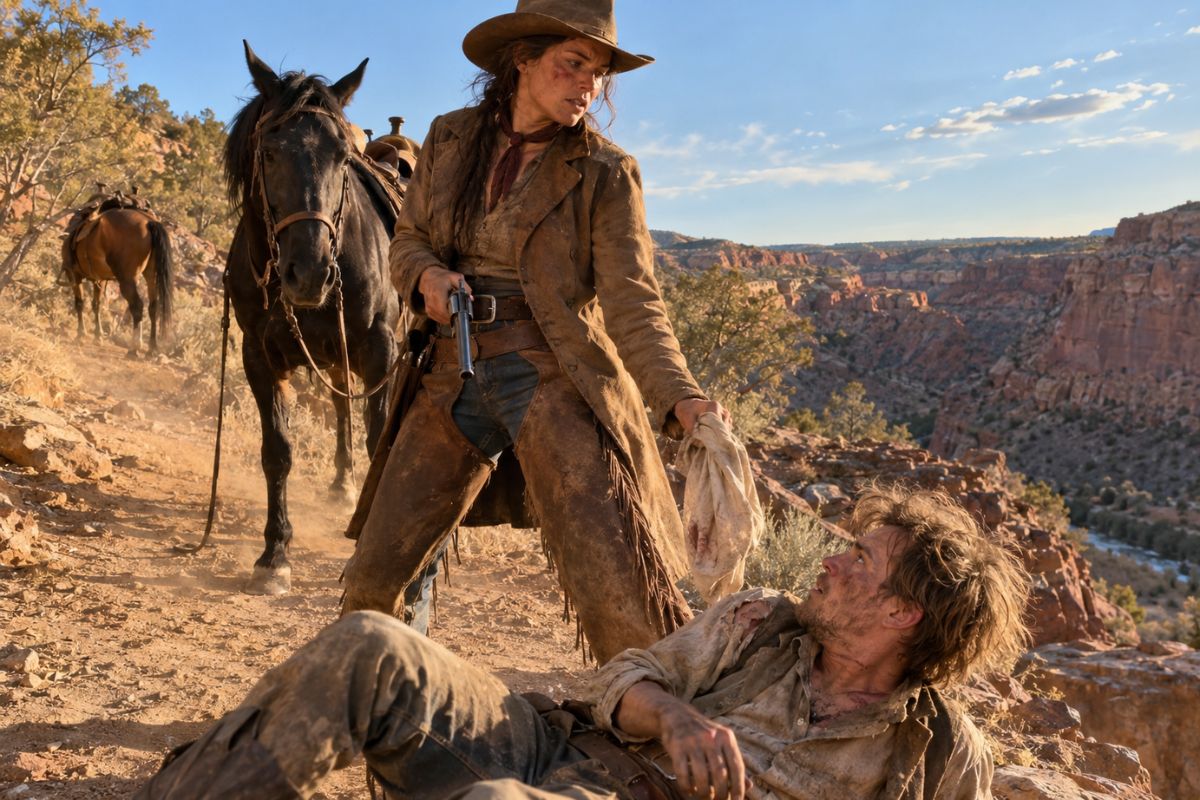
Clara was off Tempest before he could get his breath back. She kicked his rifle away and stood over him with her revolver drawn.
“Stay down,” she said.
He stayed down. She reached down and pulled off his mask.
He was young, twenty-two or twenty-three, with a sunburned face and pale eyebrows. She had seen that face before, three years ago, at a Pueblo horse sale. He had been wearing a shirt with a sparrow stitched over the pocket.
“You work for Iron Sparrow,” she said slowly. “You work for my father.”
“Your father’s dead.”
He lunged.
It wasn’t the kind of fight anyone would put in a dime novel. It was fast and clumsy and ugly. His fist caught her on the cheekbone, and she went down in the dust with her ears ringing. Her revolver skidded away. He scrambled for it on his knees.
Clara grabbed a fistful of dirt and threw it in his eyes.
He reeled back, blinded, and she got to the gun first. She brought the butt down across his wrist when he reached for his own holster, and he gave up.
They stared at each other, both breathing hard.
“What’s your name?”
“Dale.” He spat grit. “Dale Mercer.”
“Who sent you, Dale?”
He wiped his eyes with his sleeve and wouldn’t answer. She asked twice more. On the third time he looked up, and there was something strange in his face. It almost looked like pity.
“You should’ve listened,” he said, “when your father told you never to come back.”
Clara went very still.
Never come back.
Those were Jacob Vance’s words, spoken in the barn at dawn twelve years ago, with her packed saddlebags already on the horse and her mother coughing in the house behind them.
Nobody else had been in that barn but her father and her.
At least, that was what she had believed for twelve years.
She took Dale’s rifle and his revolver and let him walk. She didn’t know what else to do with him, and the only law was three miles away.
Her cheek was already swelling when she rode through the gate of Iron Sparrow Ranch at sundown.
The house looked smaller than she remembered, and more tired. The porch rail had been mended with rawhide in two places. The iron sparrow her grandfather had forged still hung over the gate, rusted dark red, its wings spread.
A man stood on the porch with his arms crossed. He was tall, lean, and twenty-six years old, and he had their mother’s straight nose and their father’s way of standing like a fence post.
“Ethan,” Clara said.
Her brother looked at her for a long moment. He took in the dust on her coat, the faded denim under her leather chaps, the gun belt, the bruise rising on her face, the thin white scar along her left eyebrow from the bronc that had thrown her in her second year in Colorado.
The last time he had seen her, she’d been a girl in a blue dress with her hair pinned up. Now she wore it tied loosely at the back of her neck, and her gray-green eyes held nothing soft.
“Funeral was three weeks ago,” he said.
“I came as soon as I got word.”
“You got word twelve years ago that Mama was dying.” His voice didn’t rise. That made it worse. “You didn’t come then.”
“Ethan—”
“You rode out of this yard while she was coughing blood into a handkerchief. I stood right there and watched you go.” He pointed at the dirt by the water trough, as if the spot were still marked. “I was fourteen. You didn’t even look back.”
Clara had looked back. She had looked back once, at the ridge, and seen her father standing in the barn door with his arms folded, and she had made herself look away.
She didn’t say any of that.
“Somebody tried to stop me on the road today,” she said instead. “Three men. One of them was one of yours. Dale Mercer.”
Something flickered across Ethan’s face. Then it closed again.
“Dale quit two weeks ago. I don’t know what he does now.” He turned toward the door. “There’s supper. Rosa will be glad to see you, anyhow. She’s the only one.”
Rosa Delgado had cooked for Iron Sparrow for twenty years. She put both hands on Clara’s face, clucked at the bruise, and said nothing about the twelve years, which was the kindest thing anyone had done for Clara in a month.
At the long table sat Walter Briggs.
He was sixty-one now, gray-bearded, with the rolling walk of a man who had spent forty years on horseback. He had been her father’s foreman for as long as Clara could remember. He had put her on her first pony. He had shown her how to rope a calf when her father was too busy.
He stood up when she came in and took off his hat.
“Clara Jean,” he said quietly. “You look just like your mother.”
For the first time since the telegram, Clara nearly cried.
Over supper, she asked about the accident. Walter answered, because Ethan wouldn’t.
“Jake went up Cutter’s Grade with the light wagon, hauling salt to the high camp. Axle gave on the steep turn. The wagon went over.” He looked at his plate. “I found him myself the next morning. It was quick, Clara. That much I can promise you.”
“He mailed me a letter before he died,” Clara said. “He said if anyone told me he fell, I shouldn’t believe them.”
Walter’s fork stopped halfway to his mouth.
Ethan set his down entirely. “Pa wasn’t himself these last months. He was drinking. He got into a shouting match with Harlan Creed right in the middle of Front Street. People say he pulled his gun.”
“Pa hated drinking.”
“Pa hated a lot of things,” Ethan said. “You’d know that if you’d been here.”
Walter cleared his throat. “Your father wasn’t a man for writing letters, Clara. Maybe that’s why it spooked you. But he was worn thin, and he was scared about money. Scared men write strange things.”
After supper, Walter left a note tucked under the coffeepot for the morning. She read it by lamplight before bed.
Rosa left biscuits in the warmer. Ride careful. Don’t take the north road alone. —W.
He always had made his capital R the old-fashioned way, with the tail curling backward like a hook. She had forgotten that. She smiled at it and tucked it into her pocket beside her father’s letter.
The money turned out to be real, and it was worse than she had imagined.
Ethan laid it out the next morning in their father’s office. He did it plainly, the way you’d tell a stranger the price of a horse.
Three dry summers. A hard winter in ’89 that killed four hundred head. A bank in Santa Fe that wouldn’t renew the note. And then Harlan Creed, who had been quietly lending money to half the struggling ranchers in the valley, had bought that note.
“We owe him six thousand four hundred dollars,” Ethan said. “He’s given us ten days. After that, he takes the ranch.”
“Ten days?”
“Seven, now. He gave me the notice the morning after the funeral.”
Clara sat down slowly in her father’s chair. She knew the name, and she knew what it meant.
The night before she left Iron Sparrow, when she was seventeen, her father had said one strange thing to her before his temper had turned cold. If a man named Harlan Creed ever offers you anything—work, money, a kind word—you don’t take it. Understand me? You don’t trust that man.
She had never met Harlan Creed. She had carried that warning for twelve years anyway.
“I’m going to see him,” she said.
“He’ll eat you alive.”
“Then I’ll be dinner.” She stood up. “Somebody knew Pa’s exact words to me in that barn, Ethan. Somebody put Dale Mercer on that road. I’d like to know who.”
Harlan Creed’s office was above his freight warehouse on Front Street, and it was nicer than anything in Red Mercy had a right to be. There was a Turkish rug, a glass-fronted bookcase, and a window looking out toward the depot.
Creed himself was forty-eight, gray at the temples, and dressed like a banker. He did not stand up behind his desk. He did not smile falsely, either. He looked at the bruise on her face with what seemed like honest concern.
“Miss Vance. I’m sorry about your father. Truly.”
“Are you?”
“We disagreed about nearly everything for fifteen years. That doesn’t mean I wanted him at the bottom of Cutter’s Grade.” He folded his hands. “It was a tragedy. It was also an ordinary one. Men go off mountain roads every year out here.”
“He didn’t think he’d fall.”
Creed was quiet a moment. Then he opened a drawer, took out a bank draft, and slid it across the desk.
It was for two thousand dollars.
“That’s yours,” he said. “Not a loan. Not a trick. Take it, go back to Colorado, and build yourself something. There’s nothing left for you here but debt and grief.”
Clara didn’t touch it. “My father told me never to trust you.”
“Your father told you a great many things.” Creed leaned back. “Here’s one more thing to consider. Your father spent twelve years making sure you stayed alive, Miss Vance. Don’t waste his effort.”
The words hit her like cold water.
“What does that mean?”
Creed looked at her with something she couldn’t read. It might have been sadness.
“Ask your brother,” he said, “why you were sent away.”
She found Ethan in the corral, working a young gelding on a lunge line.
“Creed says you know why Pa sent me off.”
Ethan kept the horse circling. “Creed says a lot of things.”
“Did you know?”
“I know you left.” He finally pulled the gelding in and turned toward her, and his face was hard. “I don’t know anything else, Clara. Nobody ever told me anything. Pa never said your name in this house again. Not once. Not when Mama died. Not at Christmas. Not ever.”
He walked the gelding past her toward the barn. Halfway there, he stopped without turning around.
“He set a plate for you,” he said. “Every Christmas. At the end of the table. He never said who it was for. He just set it and nobody touched it.”
Then he went inside.
Clara stood alone in the corral for a long time.
Walter Briggs would not talk about her leaving.
“I gave your pa my word,” he said the next morning, as they rode the fence line together. “He made me promise the day you left. I’d never speak of it. Not to you, not to your brother, not to anybody. A man’s word has to count for something, Clara, even after the other fella’s gone.”
“He’s dead, Walt.”
“That’s when it counts most.”
So she went looking on her own.
Her father’s office was the same as it had always been. There were the same maps of the valley pinned to the wall and the same tally books on the shelf. She went through every drawer. She read letters from cattle buyers and bills from the blacksmith. She found nothing.
Then she remembered something from when she was nine years old. She had crept into this office and watched her father kneel by the stove and lift a floorboard to hide the cash box from a drifter who’d come asking for work.
It was the third board from the wall. It was still loose.
Under it was not a cash box. It was a narrow leather ledger, its corners worn round.
Most of it was ordinary ranch accounts, the kind her father had kept in pencil. But near the back, on page after page, was the same entry.
C.V. — Colorado — $20.
Once a month. The first entry was dated October 1880, six weeks after she’d left. The last was dated this past July.
She counted them twice.
One hundred and forty-two payments. Two thousand eight hundred and forty dollars.
Clara sat on the floor of her father’s office with the ledger in her lap and couldn’t breathe properly.
C.V. That was her. Clara Vance, in Colorado.
For twelve years, her father had been sending her money every month.
She had never received one cent of it.
She had spent her first winter in Colorado sleeping in a tack room and mucking stalls for a dollar a day. She had written him once that winter, one letter saying she was sorry and asking whether she could come home. No answer came. So she decided he meant what he’d said in the barn, and she stopped hoping.
Someone had taken every payment.
And if they’d taken the money, what else had they taken?
The fire started a little after two in the morning.
Clara woke to smoke. At first she thought she was dreaming about the Pueblo livery fire from four years ago. Then she heard the horses screaming.
She was in her boots and out the door before she was fully awake. The main stable was burning at the north end, and orange light was already climbing the hayloft wall.
Fourteen horses were inside. Tempest was one of them. So was Captain, Ethan’s big bay stallion, the best horse on the ranch and the last thing their father had bought before the money ran out.
Ethan was already running across the yard in his nightshirt.
“Rear doors!” Clara shouted. “Get the rear doors open!”
She went in the front.
The heat hit her like a wall. The smoke was so thick she worked by feel and sound, moving down the stalls, pulling the knots of lead ropes loose, throwing stall doors open. The horses bolted past her toward the cold air. One mare wouldn’t move, so Clara pulled her coat off, threw it over the mare’s eyes, and led her out blind.
Tempest was in the eighth stall. Clara’s hands shook getting the latch.
At the far end of the barn, Ethan was hauling on the rear doors. They had swollen in last month’s rain and he couldn’t get them to move. Then they gave all at once, and cold night air poured in. The fire roared up hungrily to meet it.
A burning beam came down between them.
It crashed across the aisle with a shower of sparks. Suddenly Ethan was on the far side of it with Captain, the stallion rearing and screaming, and the whole back wall of the barn going orange around them.
“Ethan!”
“Get out!” he yelled. “Clara, get out!”
She didn’t. She climbed the stall partition beside the beam, dropped down on the other side, grabbed Captain’s halter with one hand and her brother’s collar with the other, and pulled.
They went out the rear doors together, all three of them. They were barely clear of the frame when the roof above the last stalls folded in behind them.
They lay in the wet grass behind the corral, coughing.
Ethan turned his head and looked at her. His face was black with soot, and his eyes were streaming.
He didn’t say thank you. He didn’t have to.
Twelve of the fourteen horses were saved. The ranch hands and Walter formed a bucket line from the trough and kept the fire from spreading to the bunkhouse. By dawn, the stable was a black skeleton, still smoking.
Clara walked back to the house to wash her face. Then she stopped in the office doorway.
The third board from the wall had been pried up and left on its side.
The ledger was gone.
She understood it all in one terrible second. The fire had never been about the horses. It was a way to empty the house.
Through the office window, far off across the south pasture, she saw a single rider heading for the river at a hard gallop.
Tempest was standing loose by the water trough, still wild-eyed from the smoke. Clara didn’t take time for a saddle. She grabbed a fistful of mane, swung up bareback, and went.
The rider had a quarter-mile lead, but he was riding scared and Clara wasn’t. She closed the gap along the river flats. At the ford, where the water ran knee-deep over the rocks, she drew even with him and threw herself sideways.
They went into the river together.
The cold knocked the air out of both of them. The rider came up swinging, but weakly. Clara got an arm around his neck and dragged him to the gravel bar, and when she rolled him over she wasn’t surprised at all.
“Hello again, Dale.”
Dale Mercer was shaking, but not from the cold.
The ledger was still inside his coat, soaked through. She pulled it out and held it.
“You set fire to a barn full of horses,” she said.
“I didn’t set it.” His teeth were chattering. “I swear to God I didn’t. I was only supposed to take the book while everybody was out fighting the fire. I didn’t know he’d—” He stopped.
“Who? Creed?”
“No.” Dale shook his head hard. “It isn’t Creed. It was never Creed. You’ve got it wrong. Everybody’s got it wrong. It’s—”
A rifle shot cracked from the ridge above the river.
The bullet kicked up gravel a foot from Dale’s knee.
Clara hit him in the chest with her shoulder and drove them both behind the big boulder at the edge of the ford. The second shot struck the rock where her head had been. The third went into the river, and the ledger went with it. It was knocked out of her hand when they fell, and it was swept downstream in the fast brown current.
She watched it go. There was nothing she could do.
The shooting stopped. Hoofbeats faded along the ridge.
Clara looked at Dale. He was white as paper.
“He was shooting at you,” she said. “As much as me.”
Dale didn’t answer. He didn’t need to. Whoever was up on that ridge had just decided Dale Mercer knew too much to keep breathing.
That changed everything.
There was another enemy. And Dale was just as afraid of him as she was.
She brought Dale back to the ranch and locked him in the tack room. He wouldn’t say another word. He sat on an overturned bucket with his arms around his knees, like a boy.
Walter came up from the ashes of the stable, smelling of smoke. He looked at the tack room door and then at Clara.
“You ought to hand that boy to the sheriff.”
“I will,” she said. “When he tells me who he’s afraid of.”
Walter’s jaw worked. “Could be he’s afraid of the rope. Horse stealing and arson are hanging matters, Clara.”
“He didn’t steal a horse. He stole a book.”
Walter looked at her a long moment and went back to work.
That afternoon, Ethan carried a wooden box into the kitchen and set it on the table in front of her.
“Pa’s things,” he said. “Bell brought them back from the—from the road. I couldn’t open it.”
Inside was her father’s hat, crushed on one side. There was his pocketknife, his reading spectacles with one lens cracked, a half-empty tin of tobacco, and at the bottom, wrapped in a flour sack, his silver-handled revolver.
Clara’s breath caught.
She knew that gun. When she was fourteen, her father had taken her out behind the corral with a row of tin cans on a fence rail and handed her this revolver. He showed her how to stand, how to breathe out before the shot, and how to keep both eyes open.
A gun’s not for proving anything, he’d told her. It’s a tool, like a rope or a shovel. The day you pull it to prove you’re somebody, you’ve already lost.
She picked it up now. It was heavier than she remembered. Out of old habit, she swung the cylinder open to check the loads.
She frowned.
The chambers were clean. The cartridges were old, tarnished green at the brass. Dust had settled into the gap between the cylinder and the frame. There was a thin, undisturbed skin of it. Nothing had been fired from this gun in years.
“Ethan,” she said slowly. “You told me Pa pulled his gun on Creed on Front Street. Who told you he fired?”
Ethan frowned. “Everybody said it. Half the town.”
“Who saw it?”
He thought. “Walt did. Walt was with him that day. He said Pa drew and put a shot into the boardwalk at Creed’s feet.”
Clara held the revolver out to him, cylinder open.
“Then how come this gun hasn’t been fired since Mama was alive?”
Ethan stared at it. He didn’t answer.
Somebody had been telling stories about Jacob Vance. They were telling a town that he was drinking, reckless, and violent. The kind of man who might drive a wagon too fast down a mountain road and go over the edge.
The kind of man nobody would ask questions about.
That night, cleaning the revolver at the kitchen table, Clara noticed that the left side of the wooden grip had come loose. It must have happened in the wreck. When she eased the screw out and lifted the panel, a tiny square of paper fell onto the table, folded as small as a fingernail.
She unfolded it under the lamp. It was her father’s handwriting, in pencil.
Creed. Mercer. Bell.
That was all. Three names.
Creed was the man her father had warned her against.
Mercer was the boy locked in her tack room.
And Bell was Sheriff Owen Bell. He was the man who had sent her the telegram. He was the man who had officially ruled her father’s death an accident.
He had been her father’s closest friend for thirty years. He had taught her to fish. He had carried her on his shoulders at the Fourth of July picnic when she was six.
Clara folded the paper again and put it in her pocket with the other two notes, her father’s and Walter’s.
In the morning, she rode to town.
The sheriff’s office smelled of coffee and gun oil. Owen Bell was fifty-two now, heavier in the middle, with a gray mustache and tired eyes. He stood when she came in, and she saw him take in the bruise, the smoke-singed coat, and the gun belt.
“Clara. I heard about the stable.”
“Did you also hear that my father’s revolver hasn’t been fired in ten years?”
Bell was quiet.
“You ruled it an accident,” she said. “You looked at that wagon and you wrote accident. Why?”
“Because that’s what I could prove.”
“And what couldn’t you prove?”
He didn’t answer. She set the paper on his desk.
Creed. Mercer. Bell.
He looked at it for a long time. Something moved in his face that she didn’t understand.
“Tell me what my father knew,” Clara said. “Tell me why your name is in his gun.”
“I can’t do that yet.”
Clara drew her revolver.
She didn’t point it at him, not quite. She held it low, at her side, where they could both see it.
Owen Bell didn’t reach for his own gun. He didn’t even look at it. He sat back down in his chair and folded his hands on the desk and looked at her with an old, deep weariness.
“If you believe shooting me will answer your questions,” he said, “then your father failed to teach you the most important thing about carrying that gun.”
It was so close to her father’s own words that it went through her like a blade.
The day you pull it to prove you’re somebody, you’ve already lost.
Clara holstered the revolver. Her hand was shaking. She sat down across from him because her knees wouldn’t hold her.
Bell got up, poured two cups of coffee, and set one in front of her. He sat back down and was quiet a while.
“Somebody’s been stealing cattle in this valley for years,” he said at last. “Not whole herds. Nothing a man would notice all at once. Six head here, ten head there. They take them off the smaller outfits, the ranches already hanging by a thread. They alter the brands, or mix the cattle into legitimate herds headed for the railroad, and they ship them out with honest cattle. The ranchers come up short at tally time. They can’t make their notes. They go under.”
“And their land gets sold.”
“Cheap. To buyers nobody ever quite meets.” Bell turned his cup slowly. “Your father figured it out about a year ago. Iron Sparrow was losing cattle too. First he thought it was Creed. Creed was buying up notes all over the valley. It looked like a man squeezing the ranches from both ends.”
“But it wasn’t Creed.”
“Jake didn’t think so, in the end. He said somebody was using Creed’s freight wagons and Creed’s shipping pens and Creed’s name without Creed knowing a thing about it. He said he was close to proving who. He was going to bring it to me.” Bell looked up. “He died two days later.”
“And you called it an accident.”
“I called it what I could prove, Clara. The wagon was wrecked. There were no witnesses and no tracks worth a damn after a night of rain. If I’d written murder, whoever did this would have known I was hunting them. They’d have cleaned up everything and disappeared.” His voice roughened. “I wrote accident so they’d think they got away with it. So they’d get careless.”
“And the telegram to me?”
“That was your father’s wish. He made me promise. If anything happened to him, I was to send for you.” Bell looked away. “He said, She’ll come, Owen. She’s too stubborn not to.“
Clara looked down at her coffee and couldn’t see it clearly.
Rosa told her about the Mercers.
She did it while rolling out tortillas, not looking up, as if it were just old gossip.
“Tom Mercer worked here, a long time ago. Dale’s father. Good with a rope, bad with money. He rode a white horse, a gray gone pale with age, and he was proud of it.” She pressed the dough flat. “He left the ranch the same autumn you did. Went off to Texas and never came back. Died down there, I heard. The boy grew up with nothing.”
Clara stood very still at the window.
A pale horse.
She had spent twelve years not letting herself remember that night. She let herself remember it now.
She was seventeen. Her mother had been sick for months. Clara couldn’t sleep in that house, not with the coughing coming through the walls. So some nights she slipped out and walked to the north creek, where the cottonwoods grew thick. She would sit on the bank and cry where nobody could hear her.
That night, there had been cattle at the crossing.
Twenty or thirty head, being pushed through the water in the dark by four or five riders. There was no moon. There was one hooded lantern. She’d crouched in the brush, not understanding at first. Then the lantern swung, and for one moment the light fell full on her face.
A man on a pale horse looked straight at her.
She ran. She ran all the way back to the house. Her father was standing in the yard in his nightshirt with a lantern of his own. He’d found her bed empty.
She told him what she’d seen. He listened without a word.
The next morning, at dawn, he told her to pack.
She had argued. She had cried. She had begged him to let her stay with her mother. And her father, who had never once raised his hand or his voice to her, looked at her across the barn with a face like stone.
I’ve got no place here for a daughter who won’t obey me. You’ll go to your aunt in Colorado. You won’t write. You won’t come back. Not ever. Do you understand me?
She had understood that her father didn’t love her anymore.
That was all she’d understood, for twelve years.
She found Walter mending harness in the ruins of the stable. She stood in front of him until he put the awl down.
“I know about the north creek,” she said. “I know what I saw that night. I know Tom Mercer rode a pale horse. Walt, I need you to break your promise.”
Walter looked at her for a long time. Then he sighed, and the sigh seemed to come up from somewhere very deep.
“Sit down, Clara Jean.”
She sat on an overturned barrel. He talked with his eyes on the harness in his hands.
“Your pa came to me that night after you told him. He was half out of his head. He said you’d seen Tom Mercer’s bunch moving stolen cattle across our land, and Tom had seen you. And Tom Mercer ran with some hard men in those days, Clara. Men who wouldn’t leave a witness. Not even a girl. Not even a rancher’s girl.”
“So he sent me away.”
“He wanted to keep you in the house with a shotgun by the door. I told him that wouldn’t hold. Your mother was dying. He couldn’t watch you every minute.” Walter’s hands stilled. “I told him to send you to Lorena’s in Colorado. Far enough that nobody’d bother to follow. I told him it was the only way.”
“Why didn’t he just tell me?”
“Because you’d have come back.” Walter looked up at her. “You would have. The minight your mother got worse, you’d have been on a horse. He knew you. You’d have come back to see her, and somebody might have been waiting. So he made you think he didn’t want you. He figured you’d stay gone out of pride, if nothing else.”
“He was right,” Clara said. Her voice didn’t sound like her own.
“He was right,” Walter agreed quietly.
“And Mama died that winter. And I didn’t come.”
Walter didn’t say anything. There wasn’t anything to say.
Clara looked out across the burned stable toward the house, toward the porch where her father must have stood a thousand evenings looking at the road.
Jacob Vance had saved her life. And in doing it, he had given up the one thing he could never get back. His daughter had hated him for twelve years, and then he had died.
“Thank you for telling me, Walt,” she said.
He nodded and picked up the awl again.
Only much later did she remember that the ledger had shown twenty dollars a month for twelve years. The first payment was in October 1880.
And that Walter Briggs had told her, the night she came home, that her father wasn’t a man for writing letters.
That evening, she found Ethan sitting on the corral fence in the dusk, watching Captain graze.
She climbed up beside him. For a while they just sat.
“I know why Pa sent me away,” she said. “I saw rustlers at the north crossing. One of them saw me. He was afraid they’d come for me.”
Ethan didn’t move. But she saw his hands tighten on the rail.
“Ethan?”
“I woke him up,” her brother said.
She turned to look at him.
“That night. I went to get water and your bed was empty. I thought you’d snuck off to see Billy Hask from the Rafter J. You were always sweet on him. I went and woke Pa up because I was mad you were getting away with something.” His voice was thin and very young. “And in the morning he sent you away. Mama was dying and he sent you away, and I thought it was because of me. Because I told on you.”
“Oh, Ethan.”
“Twelve years.” He wiped his face with the back of his wrist, fast, like he was ashamed of it. “It’s hard to forgive somebody for leaving when you think you’re the reason they left. It’s easier to just hate them.”
Creed’s words came back to her. Ask your brother why you were sent away.
Her father must have known. Somehow, he’d known what Ethan carried. He’d never found a way to lift it from him.
Clara put her hand on the back of her brother’s neck the way their mother used to. He didn’t pull away.
“It wasn’t you,” she said. “You didn’t send me anywhere. You were fourteen. You were just the one who noticed I was gone.”
They sat on the fence until it was too dark to see the horse.
In the morning, Clara went back to Harlan Creed.
This time he was standing at the window when she came in. He turned and looked at her face, and whatever he saw there made him nod.
“You’ve found something.”
“I found out my father wasn’t drinking and didn’t fire at you. And I found out somebody has been using your wagons and your shipping pens to move stolen cattle.”
Creed was quiet. Then he crossed the room and locked the door.
“Sit down, Miss Vance.”
He told her the rest.
Six months ago, Jacob Vance had walked into this office for the first time in fifteen years. He’d closed the door and said, Harlan, I think somebody is robbing both of us, and I think I’m the only fool in this valley who can prove it.
“I didn’t believe him at first,” Creed said. “I’d lent money to eleven ranches in this valley. Four of them had gone under in two years. It was ruining me. Every one that failed cost me more than I ever got back in land. Why would I steal from my own debtors? I need them to pay me.”
“But somebody was buying the land.”
“Through agents. Through a land office in Las Vegas, through names nobody in this valley had ever heard of.” Creed sat down across from her. “Your father and I began comparing records. His tally books against my shipping manifests. We found cattle leaving my pens under a brand called the Broken Ladder. No such ranch exists. The consignment slips were signed by a man calling himself R. Waite. Nobody’s ever seen him.”
“And the fight on Front Street?”
Something like a smile touched Creed’s mouth. “Theatre. Jake’s idea. If the valley thought we hated each other worse than ever, nobody would think we were working together. He shouted. I shouted. He put his hand on his gun and never drew it.” The smile faded. “I didn’t know until afterward that someone was telling the whole town he’d fired.”
“You told me he spent twelve years keeping me alive.”
“He told me about you. About that night at the north crossing. He said whoever was running this now might be the same man who saw you then.” Creed paused. “He said if they ever knew he’d got close, they’d come after the thing he loved most. So he’d made sure, long ago, that nobody thought he loved you at all.”
Clara looked down at her hands.
“He also told me,” Creed said, more gently, “that he’d written you every month for twelve years and never had one answer. He thought you’d burned the letters. He said he didn’t blame you.”
“I never got them,” Clara said. “Not one.”
Creed was silent.
“Whoever’s behind this,” Clara said, “knows ranch debts. Knows cattle movements. Knows what the sheriff’s doing. Knows the land office.”
“Yes.”
“Somebody everybody trusts.”
“Yes.”
“Owen Bell,” Clara said.
Creed looked at her for a long moment and didn’t answer. Clara took that as agreement.
She was wrong. She wouldn’t know how wrong for two more days.
Creed kept his most important records in a strongbox at the freight office at Sandoval Siding, eleven miles east of Red Mercy, where the railroad crossed the Piedra River. They included the original consignment slips signed by R. Waite and the shipping tallies Jacob had matched against his own.
“I moved them there after your father died,” he said. “It seemed safer than town.”
They set out the next morning in Creed’s light spring wagon, with Tempest tied behind. Creed drove. Clara rode beside him with her rifle across her knees.
They were a mile from the railroad bridge when the riders came out of the arroyo.
There were five of them this time, masked, and they didn’t bother with warnings. The first volley hit the wagon box. The second hit Creed.
He jerked back against the seat with a grunt and dropped the reins, clutching his left shoulder.
“I’m all right,” he said through his teeth. “Take the lines.”
Clara grabbed them. The team was already running wild and the wagon was bouncing badly on the rutted road. Ahead she could see the bridge approach, where the road ran right alongside the railroad embankment. A freight train was crawling up the grade toward the bridge, slow and heavy, trailing coal smoke.
The wagon’s left wheel hit a rock and she felt it tilt.
“Creed! Jump!”
He jumped, rolling into the brush beside the road. Clara drew her knife, leaned out over the dashboard, and cut the traces. The team pulled free and galloped on, and the empty wagon slewed sideways and went over into the ditch behind her with a crash.
She landed on her feet, stumbled, and ran.
The riders were coming. Creed was down in the brush with a bleeding shoulder, and she couldn’t fight five men in open country. But she could draw them away from him.
The freight train was beside her now, slow on the uphill grade. Clara grabbed the iron ladder on the side of a boxcar and swung herself up.
She climbed to the roof. Behind her, two riders spurred alongside and followed her up the ladders. The other three hung back. They had seen Creed in the brush and turned toward him. But far back down the road, Clara saw dust. It was a single rider coming fast from the direction of Red Mercy, and she prayed it was Bell.
Then there was no more time to pray about anything.
The train crested the grade and began to gather speed. Clara crouched on the swaying roof of the boxcar. The wind tore at her hat. The first gunman came over the end of the car toward her, bent low.
He didn’t shoot. Maybe he was afraid of falling. Maybe he wanted her alive. He came at her with his fists, and they fought on the narrow walkway along the roof with the ground rushing past below.
He was bigger than she was. He caught her by the coat and swung her toward the edge.
Her boots went out from under her.
For one long moment, there was nothing beneath her but air and blurred earth. Then her hand closed on the iron handrail at the roof’s edge, and she held on.
He stepped toward her to stamp on her fingers.
Clara pulled herself up with everything she had, got a knee on the roof, and drove her shoulder into his legs. He toppled backward off the end of the boxcar. He landed with a thud on the next car’s load: a flatcar stacked high with bales under canvas tarpaulins. He lay there, dazed and swearing. He was bruised, but not dead.
She didn’t want him dead. She wanted answers.
A shot cracked past her head. The second gunman was four cars down, firing from behind the smokestack blast that came streaming back along the train.
Clara dropped through the open hatch of a cattle car. It was empty except for straw and the smell of cattle. She ran its length in the dimness. When the engine’s steam rolled back over the cars in a thick white cloud, she climbed out the far side and came up behind him in the smoke.
He heard her too late. She put her revolver against his back.
“Drop it.”
He dropped it. It went over the side and vanished into the brush.
She pulled down his bandanna.
She knew him. He was Lonnie Pruitt, a quiet, sandy-haired Iron Sparrow hand who had helped carry buckets the night of the stable fire. He had stood beside her in the bucket line. He had handed her water.
“Who sent you, Lonnie?”
His lips were pressed white. “Can’t tell you. He’ll kill me.”
“Who will?”
“The old man,” Lonnie said, and then shut his mouth and wouldn’t open it again, not for anything.
The train stopped at Sandoval Siding forty minutes later. The stationmaster came running, and the brakeman helped her tie both men with baling wire.
At the depot, she found the rider she’d seen coming up the road. It was Sheriff Owen Bell, with Harlan Creed slumped white-faced in the saddle behind him. Bell had found Creed in the brush and driven off the three riders who’d turned back for him.
Clara looked at Bell for a long moment.
Then she understood she had been wrong about him. If Bell were the enemy, Creed would be dead in a ditch, and nobody would ever know who’d done it.
“I owe you an apology, Owen,” she said.
“You owe me a cup of coffee,” Bell said. “Let’s get this man to a doctor and open that strongbox.”
The consignment slips were exactly what Creed had promised. There were dozens of them, going back years. They listed cattle wearing the Broken Ladder brand, shipped east from Creed’s own pens, and every one was signed R. Waite.
Clara looked at them in the lamplight of the freight office. Something tugged at her, as if she were trying to catch a word just out of reach.
Then she knew.
With hands that didn’t feel like her own, she reached into her coat pocket and took out the three papers she had carried there for a week.
There was her father’s letter. If they tell you I fell, Clara, do not believe them.
There was the slip from the revolver grip. Creed. Mercer. Bell.
And there was the note that had been tucked under the coffeepot her first morning home. Rosa left biscuits in the warmer. Ride careful. Don’t take the north road alone. —W.
She laid it on the desk beside the consignment slips.
Every capital R had the same tail. It curled backward, like a hook.
Ride careful. Rosa. R. Waite.
Owen Bell leaned over her shoulder and went quiet.
“Walter,” Clara whispered.
The old man.
She looked at the slip from her father’s revolver again. Creed. Mercer. Bell. She had read it as a list of suspects. She had been reading it wrong all week.
It was a list of the people Jacob Vance trusted.
Creed was his secret partner. Bell was his oldest friend. And Mercer was the boy he’d believed would come clean in the end, the son of the man on the pale horse.
The name that wasn’t on it was Walter Briggs. For twelve years, Walter had been the only other person in the barn when her father said never come back.
Walter hadn’t been listening from the doorway. He had been standing there.
They rode through the night and reached Iron Sparrow near noon. Walter Briggs was out with the cattle on the high range, as he was most days this time of year.
Owen Bell and Clara searched the foreman’s cabin.
It was a plain, neat room with a cot, a stove, and a shelf of almanacs. Under the cot was an old army trunk with a padlock. Bell broke it with the butt of his revolver.
Inside were stubs of bank drafts. There were dozens and dozens of them, drawn on the First Territorial Bank of Santa Fe, payable to Clara Vance, Colorado. They were endorsed on the back with a signature that wasn’t hers and cashed in Albuquerque.
Beneath them, wrapped in oilcloth, was one letter.
Only one. The envelope was addressed in her father’s hand to Miss Clara Vance, care of Mrs. Lorena Pratt, Colorado Springs, Colorado. It had never been stamped or mailed, and it had never been opened.
Clara sat down on the cabin floor.
“Where are the rest?” she said. “Ledger shows payments every month. There should be a hundred and forty letters.”
Bell shook his head slowly. He had found a few scraps in the cold ashes of the stove: blackened paper edges with a word or two of handwriting surviving. Clara. Your mother. Forgive.
“He burned them,” Bell said. “As they came. He kept the money and burned the letters.”
“But not this one.”
“Not that one.”
She didn’t know why. Maybe Walter didn’t know either.
That afternoon, Clara rode to town and asked Ada Whitlock, who had run the post office counter at the mercantile for twenty years, a single question.
“Did my father ever mail anything to Colorado?”
Ada thought about it a long time. “No, honey. Not once, that I recall. Walt Briggs brought in the ranch mail and picked it up. Always has. Your pa hardly came to town.” She hesitated. “I asked him once, years ago, if he ever heard from you. He said, I write her every month, Ada. I thought he meant like a prayer. You know. Something you say to God and don’t expect an answer.”
Only one letter had ever gone out from Jacob Vance with his own hand on it. That was the last one, eleven words long. He hadn’t mailed it in Red Mercy. It had been posted from Sandoval Siding, where no one knew him. By then, he must have finally begun to wonder about his oldest friend.
Clara opened the letter that night at the kitchen table with Ethan beside her. She had asked him to be there. She didn’t think she could read it alone.
The paper was yellowed but perfectly preserved. It was dated October 2, 1880. That was six weeks after she had ridden away.
Clara,
I don’t know if you’ll open this. I wouldn’t blame you if you threw it in the stove. I said things to you in the barn that no father should ever say to his girl, and I said them on purpose. You ought to know that, because it’s the truth, and you’ve been lied to enough.
You saw something at the north crossing that you shouldn’t have seen. The men you saw would have come for you. I couldn’t protect you here, not with your mother so sick and me stretched so thin. So I sent you away. And I knew you. I knew you’d come back the minute you heard your mother was worse, whatever I told you. Unless you hated me enough not to.
So I made you hate me.
I’d rather have you alive and angry with me than buried here knowing I loved you.
Your mother asks for you every day. I tell her you’re safe. That’s the only thing that lets her sleep. When you’re older, and this is over, I’ll come and find you myself, and I’ll tell you all of it to your face, and you can decide whether I’m forgiven.
Until then, I’ll write. Every month. You don’t have to answer.
Your father, who is not angry with you and never was,
Jacob Vance
Clara set the letter down on the table.
For twelve years, she had carried a father who didn’t love her. It had been heavy, but she had known the shape of it. She had built her whole life around its weight.
Now she found she had carried the wrong thing all along. The real thing was so much heavier.
He had loved her. He had written. He had waited. He had set a plate at the end of the table every Christmas. And he had died believing she’d thrown his letters in the stove.
She didn’t cry loudly. She just put both hands over her face and sat there.
Ethan didn’t say anything. After a while he got up, poured two cups of coffee, and set one down beside her hand. Then he sat back down and stayed.
Walter Briggs never came back to his cabin.
Somebody must have warned him. Maybe it was one of the riders who got away at the bridge, or maybe he’d seen Bell’s horse in the yard from the high range. Either way, Walter knew.
He didn’t run.
Bell arrested Lonnie Pruitt and the man from the flatcar and locked them in the Red Mercy jail. He swore in two deputies from among the ranch hands at the Rafter J. Creed came out to Iron Sparrow with his arm in a sling and a rifle in his good hand, and refused to be sent home.
“Your father was my partner,” he said. “Whatever it cost me, I didn’t give him much while he was living. Let me give him this.”
Dale Mercer, let out of the tack room at last, sat on the porch step and finally told them everything. Walter had paid off his mother’s debts in Texas after his father died. He had brought Dale north and given him work. Then, a little at a time, he had pulled him into it. Dale said he’d thought it was only cattle. He never believed anyone would get hurt.
Then Jacob Vance went off Cutter’s Grade, and Dale found out what kind of man he’d been working for.
“Your pa caught me on the south range in August,” Dale said. His voice was rough. “Moving a dozen of his own steers toward the Ladder pens. He could’ve shot me or had me hanged. Instead he sat me down on a rock and said my daddy was a good roper who made bad choices, and I didn’t have to be the same. He said, Come to me when you’re ready to tell the truth, son.” Dale looked down at his hands. “I wasn’t ready. Then he was dead.”
Clara took the little square of paper out of her pocket and handed it to him.
Creed. Mercer. Bell.
Dale stared at it for a long time. His mouth worked.
“He put me on a list,” he said, “with the sheriff.”
“He trusted you,” Clara said. “Don’t make him wrong.”
Walter came on the fourth night after Sandoval Siding.
It was past midnight, cloudy and moonless, the way he must have liked it for moving cattle. Clara was awake. She had barely slept in days. She was at the kitchen window when she saw movement at the outer fence line. There were dark riders cutting the wire and coming across the pasture at a lope.
There were eight or nine of them. They were the last of Walter’s men, the desperate ones with nowhere else to go.
“Ethan!” she shouted up the stairs. “Owen! They’re here!”
The first shots came through the parlor window.
Everything happened fast after that, and later she could remember it only in pieces.
She remembered Bell and Creed crouched behind the stone watering trough in the yard. The sheriff and the cattleman who had pretended to despise each other for fifteen years were firing side by side. Creed was working his rifle one-handed, bracing the barrel on the trough’s lip.
She remembered running for the bunkhouse in the dark to wake the hands, bent double. Tempest had broken loose from the corral in the confusion and came galloping out of the black. Clara caught her mane on the run and swung up. She rode the fence line bareback, yelling for the men to get their rifles and keep low.
She remembered seeing the lamp in the ranch office window go out.
Ethan had gone for the ledgers. Their father’s old tally books were stacked there, along with copies of Creed’s consignment slips. It was all the evidence they had. Two of Walter’s men had cut him off from the house, and now he was pinned inside the office. Bullets were splintering the door frame, and someone was yelling for him to come out and sign.
That was what Walter wanted. He wanted the records burned and the deed signed away. He wanted Iron Sparrow, the ranch he’d always believed should have been half his.
Clara came off Tempest at the corner of the house. The side window of the office was dark. She pulled her coat over her arm, drove her elbow through the glass, and went in over the sill.
Ethan was crouched behind the big desk with their father’s shotgun, holding the door.
“You came in the window,” he said, almost laughing.
“The door seemed busy.”
They held the office together until the hands from the bunkhouse came around the barn and drove the two men off.
In the half-built new barn, a fistfight broke out. Dale Mercer was grappling with one of his old partners in the straw, and he won. Horses stampeded out of the corral and scattered the attackers in the yard. Clara saw one rider thrown when his horse shied from a loose, panicked mare. She saw another pinned against the wagon shed by Bell’s deputies until he threw down his gun.
Clara knew this land. She knew every dip and draw and gully of it. She knew the dry wash behind the barn where a rider in the dark would lose his footing. She knew the old stone fence in the south pasture that a stranger couldn’t see until he was on top of it. More than once that night, she won by knowing where the ground would give way, not by shooting faster.
It was over in less than an hour.
Five of Walter’s men were caught. Two had run. One of the Rafter J deputies had a bullet crease in his arm. One Iron Sparrow hand had broken his leg when his horse went down. No one on the ranch had died.
But Walter wasn’t among the men they’d caught.
Clara saw him in the first gray light, far off, a single figure on a big roan horse heading hard for the mountains.
Heading for Cutter’s Grade.
She didn’t wait for Bell. She saddled Tempest properly this time and went after him.
The sun was up by the time she reached the grade.
It was a lonely stretch of road, cut into the side of the mountain, with a sheer drop on one side and red rock on the other. At the steep turn, where the road bent back on itself, the guard rail was broken. Far below, at the bottom of the slope, lay the remains of an overturned wagon, its wheels in the air. It had been three weeks and it was still there. No one had had the heart to haul it out.
Walter’s roan stood riderless beside the road, favoring one leg.
Walter himself was down the slope, near the broken wagon. He was sitting against a boulder with his left leg bent wrong beneath him. The roan had gone down on the loose rock and thrown him. His rifle was out of reach. His hat was gone. He looked old.
Clara climbed down to him with her father’s silver-handled revolver in her hand.
He watched her come.
“You look like her,” he said. “Your mother. Always did.”
“Why, Walt?”
He laughed, a dry, broken sound. “You want the whole story? All right.”
He told her. He and Jacob had been two broke cowboys, riding for other men’s brands in Texas thirty years ago. They’d shared blankets and rations and everything they had. When Jacob scraped together enough to buy this land, Walter believed they were partners.
“His name went on the deed,” Walter said. “Mine went on the payroll. Twenty-eight years, Clara. Twenty-eight years I watched him become Mr. Vance. Watched him marry, have children, sit on the church board. And I was still the hired man. I was good old Walt.”
“So you stole from him.”
“A few head at first. Just enough to feel like some of it was mine.” He shrugged. “Then I found I had a talent for it. And you’d be amazed how cheap a ranch gets when it’s already dying.”
“And the night at the north crossing?”
“I was there,” Walter said. “Tom Mercer saw you, but so did I. And when your pa came to me in a panic, I told him to send you away. Seemed tidy. You’d be gone, and nobody would ever have to find out what you’d seen.” He looked up at her. “I didn’t count on him writing you every month for twelve years.”
“So you burned the letters.”
“I wanted him to know what it felt like,” Walter said. There was something almost wondering in his voice. “Watching the thing you want most in this world belong to somebody else. I wanted him to wait for something that was never coming.”
“Then why did you keep the first one?”
For the first time, Walter didn’t have an answer. He looked away, down the valley.
“And my father,” Clara said. “Up here.”
Walter was quiet a long time.
“He found out about the Broken Ladder in August. He could’ve gone straight to Bell. Instead he came to me. Told me I had a week to leave the territory. Said he’d give me a head start for old times’ sake.” Walter’s voice thinned. “I met him up here to talk it over. I brought two men. We blocked the road, and he got down off the wagon and stood right there and said, Walt, think about everything we’ve been through. The Pecos crossing. The winter of ’71. Think about all of it before you decide what you’re going to be.“
“And?”
“And I decided.” Walter closed his eyes. “Horses spooked. Wagon went over. I didn’t plan that part. But I rode back down this mountain and I let everybody believe he fell. I told the whole town he’d been drinking. Told them he’d fired at Creed.” He opened his eyes. “So there it is. Do what you came to do.”
Clara raised the revolver.
“Go on,” Walter said softly. “You’ve got his gun. You’ve got every reason. Nobody out here would blame you. Bell would write it up as self-defense. Your pa begged me to think about everything we’d been through, and I didn’t. So don’t you think about it either. Just do it.”
Her finger rested on the trigger.
She thought about twelve years of Christmas plates at the end of a table. She thought about a hundred and forty letters burned in a foreman’s stove, one a month. She thought about her mother, asking for her every day until there were no more days. She thought about her father standing on this road, with his oldest friend in front of him, asking him to remember.
She thought about a row of tin cans on a fence rail, her father’s hand steady on her shoulder, and his voice in her ear.
The day you pull it to prove you’re somebody, you’ve already lost.
Clara lowered the gun.
Walter stared at her.
“You already took twelve years from me,” she said. “You’re not taking the rest.”
She sat down on a rock across from him and waited, with her father’s revolver resting on her knee.
Owen Bell came down the road forty minutes later with a deputy and a spare horse. He looked from Walter to Clara and back again, and she saw something in his face ease.
He knelt, put the irons on Walter Briggs, and said, very quietly, “Jake would’ve done the same.”
“I know,” Clara said. “That’s why I did it.”
Arresting Walter Briggs did not pay a single dollar of Iron Sparrow’s debt.
Clara had known it wouldn’t. But it was still hard to sit at the kitchen table with Ethan and Harlan Creed and look at the numbers.
Six thousand four hundred dollars. The deadline had passed during the siege. Creed had said nothing about it.
He said something now.
“I’m not going to take your ranch,” he said. “Your father and I were partners at the end. I don’t foreclose on partners. But I can’t just forgive the note, either. Half my own debtors are going under. I’d be finished by spring.”
“So what’s the offer?” Clara asked.
“Sell me the eastern range. Piñon Flats, from the Dry Fork to the county line. It’s good grass in a wet year. That pays off the note, with some left over to rebuild the stable. You keep the house, the barns, the main pasture, the north creek, and the family land. Iron Sparrow survives.” He paused. “Smaller.”
Ethan’s face went hard.
“No.”
“Ethan—”
“No.” He stood up. “Pa bled for every acre of this place. He gave up his whole life for it. He gave up you for it, Clara.” His voice cracked. “If we sell the eastern range, we’re telling him it wasn’t worth it.”
Clara sat quietly a moment. Then she took her father’s letter from her pocket and laid it on the table between them.
“He didn’t give me up for the ranch,” she said. “He gave me up to keep me alive. But he did give up a lot for this land. He gave up talking to his friends. He gave up telling his children the truth. He carried everything alone because he thought that’s what a man does to hold on to what’s his. And look where it got him.”
Ethan didn’t answer.
“I don’t want to hold on to every acre and lose each other,” Clara said. “I’ve already lost twelve years. I’d sell every blade of grass east of the Dry Fork to keep from losing twelve more.”
Her brother looked at the letter for a long time. Then he looked at her.
Slowly, he sat back down.
“Piñon Flats,” he said at last. “Not the north creek. Never the north creek.”
“Never the north creek,” Clara agreed.
They signed the papers that afternoon. Creed put his name beside theirs with his good hand. On his way out, he stopped in the door.
“There’s one more offer,” he said to Clara. “I’ve got freight lines, cattle interests, land from here to Las Vegas. And now, apparently, no one I can trust to run any of it. I could use a partner who knows horses, knows cattle, and doesn’t scare.” He paused. “You’d do well, Miss Vance. Better than you’d ever do on a half-sized ranch that’s two dry summers from trouble.”
Clara thought about it honestly. She owed him that.
“Thank you, Mr. Creed,” she said. “But no.”
“Because your father would’ve wanted you here?”
“No,” Clara said. “Because I want to be here. For twelve years, I didn’t get to choose where I belonged. Now I do.”
Creed nodded slowly, put on his hat, and went out.
Walter Briggs was tried in Santa Fe that winter. He pleaded guilty to cattle theft, fraud, and the death of Jacob Vance, and was sentenced to spend the rest of his life in the territorial penitentiary. He did not look at Clara once during the trial.
On the last day, as they led him out, he passed close to her seat. He stopped for half a second.
“I kept that letter,” he said, too low for anyone else to hear, “because it was the only thing he ever wrote that sounded like the man I used to know.”
Then the guards moved him on.
Clara never saw him again. She didn’t know whether she had forgiven him. Some days she thought she might, someday. Other days she thought forgiveness might just be the choice to stop letting him take anything more from her. Maybe that would have to be enough.
Dale Mercer testified against Walter at the trial. Bell kept his word and saw to it that the court went easy on him. The judge gave Dale a year’s sentence, suspended, on condition that he leave the territory.
He came to Iron Sparrow once before he left. He stood in the yard with his hat in his hands.
“Heading for Oregon,” he said. “My mother’s people are up there. I’ll find work.”
“You could stay,” Clara said. “Once things settle.”
Dale shook his head. “Every man in this valley knows what I did. I’d rather start somewhere they don’t, and earn it clean.” He hesitated. “Your pa put my name on that list. I’d like to be the man he wrote down.”
She gave him the little square of paper from the revolver grip. He looked at it, folded it carefully, and put it in his shirt pocket over his heart.
Then he rode north and didn’t look back. But he raised one hand at the ridge.
By spring, the new stable stood where the old one had burned.
Clara and Ethan had raised the frame themselves, with help from the Iron Sparrow hands and two men from the Rafter J and, one memorable Saturday, Harlan Creed. He came out in a good wool coat and spent the afternoon holding the wrong end of boards and being told so by Rosa.
Owen Bell came to supper most Sundays. He and Clara sat on the porch afterward and talked about her father. Sometimes they talked about hard things. More often they told small stories. There was the time Jacob fell in the stock tank at the Fourth of July picnic. There was the Christmas he tried to make a cake.
Clara and Ethan still argued. They argued about the price of hay and whether to breed Captain to the Rafter J mares and whether a woman ought to ride the fence line alone. Clara won that argument. Some mornings they rode out together without saying a word, and it felt easy. Other mornings the old hurt came back for no reason and they gave each other a wide berth until noon.
But neither of them left.
Clara still had her father’s silver-handled revolver, but she didn’t wear it every day anymore.
One evening in April, she took it down, cleaned it, and hung it on two pegs above the fireplace in the parlor. Beside it, in a plain pine frame Ethan had built for her, she hung the first letter Jacob Vance had written her, six weeks after sending her away.
I’d rather have you alive and angry with me than buried here knowing I loved you.
She wasn’t angry anymore. She was here. And she knew.
Early one morning in May, Ethan came out onto the porch with his coffee and found his sister in the yard, saddling Tempest.
For a moment he stood very still. His coffee cup went cold in his hand. He was fourteen years old again, watching his sister’s back as she rode out through the gate.
“Clara,” he said. “Where are you going?”
She finished tightening the cinch and looked up at him. Behind her, the sun was just coming over the mountains, and the whole valley was turning gold. There was the north creek with its cottonwoods, and the new stable with the iron sparrow over the gate, its wings spread.
She smiled.
“Checking the north herd.”
Ethan nodded toward the open range. His voice was careful, like a man who wasn’t sure he was allowed to ask.
“You coming back?”
Twelve years ago, that question would have broken something inside her.
Now Clara swung into the saddle and gathered up the reins. She looked at her brother, and at the house, and at the end of the long kitchen table she could just see through the window. From now on, that place would be set for someone who was actually there.
“I’m already home,” she said.
Thank you so much for reading this story!
I’d really love to hear your comments and thoughts about this story — your feedback is truly valuable and helps us a lot.
Please leave a comment and share this Facebook post to support the author. Every reaction and review makes a big difference!
This story is a work of fiction created for entertainment and inspirational purposes. While it may draw on real-world themes, all characters, names, and events are imagined. Any resemblance to actual people or situations is purely coincidental.