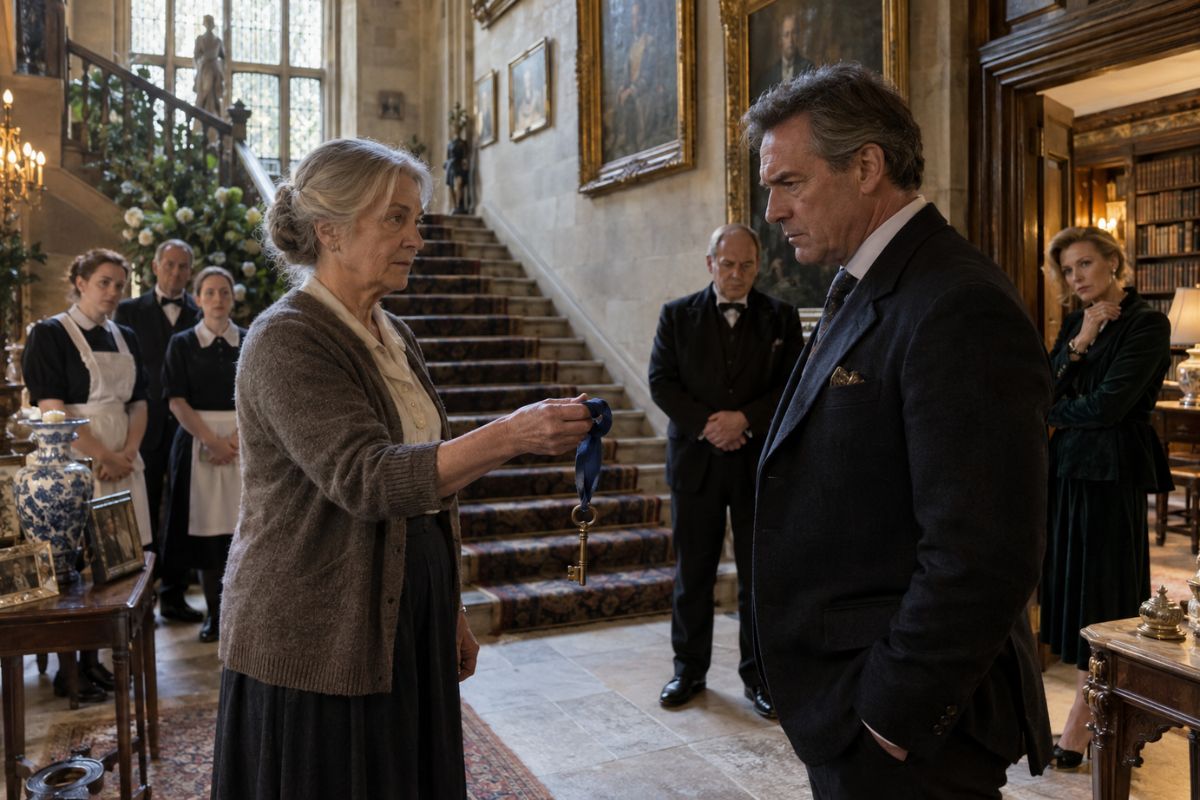
“You have thirty days, Mrs. Price.”
Adrian Harcourt said it from the foot of the great staircase, with twelve members of the Blackmere Estate staff standing close enough to hear.
Eleanor Price did not argue.
That bothered him more than anger would have.
At sixty-eight, she was a narrow, gray-haired woman who still wore sensible black shoes and kept a ring of old brass keys clipped inside the pocket of her cardigan. She had served Blackmere for thirty-seven years. For most of Adrian’s childhood, she had seemed to exist everywhere at once—appearing with clean towels, closing curtains before storms, remembering which guests disliked onions and which children were afraid of the dark.
Now she stood beneath the portrait of Adrian’s grandfather as if receiving the weather forecast.
Adrian continued.
“The cottage was provided as staff accommodation. You retired three years ago. We can no longer afford arrangements based on sentiment.”
A chair creaked behind him.
Someone shifted his weight.
Nobody spoke.
Eleanor looked at Adrian for several seconds.
Then she said, “I’ll leave.”
His shoulders relaxed slightly.
“But not until you open your mother’s room.”
That changed the air.
Adrian’s younger sister, Caroline, who had been standing near the library doors, lifted her head sharply.
“There is no mother’s room,” Adrian said.
Eleanor reached into her cardigan.
She removed a single iron key.
It was longer than his hand, darkened with age, with a faded strip of blue ribbon tied through the top.
“The east wing,” she said.
Adrian stared at it.
Half of Blackmere’s east wing had been closed for years because the roof leaked and heating it cost more than some families earned in a year. He had walked those corridors as a boy, but he could not remember a room belonging to his mother there.
Eleanor held the key out.
“Your father made me promise nobody opened it until you came home willingly.”
A few of the staff looked away.
Caroline’s mouth tightened.
Adrian felt something old and unwelcome move beneath his ribs.
He had not come home willingly.
He had returned because his father was dead.
He had returned because the eleventh Duke of Blackmere—his title now, whether he liked it or not—had inherited eleven million pounds in liabilities, roofs that needed replacing, land that barely paid for itself, a mansion that swallowed money in winter, and generations of expectations nailed to every wall.
He had returned because there was nobody else.
And he had been at Blackmere for nineteen days.
“That,” Adrian said, “is exactly the kind of manipulation I intend to end.”
Eleanor’s hand remained extended.
“What manipulation?”
“Using my father’s name to protect your position.”
Something flickered across her face.
Not guilt.
Not outrage.
Disappointment, perhaps.
That irritated him more.
“My father is no longer here to contradict you.”
“No,” Eleanor said quietly. “He isn’t.”
Adrian took the key.
The brass was cold.
For one strange second, he remembered another object resting in his childhood palm.
Silver.
Small enough to fit beneath both hands.
Music when he wound it.
His mother saying, Keep it somewhere safe, darling.
The memory vanished as quickly as it came.
Adrian slipped the key into his jacket pocket.
“I’ll have the estate office arrange your move.”
Eleanor nodded.
Then, for the first time, her voice hardened.
“You may throw me out of Blackmere, Your Grace.”
She glanced toward the pocket holding the key.
“But you cannot blame me if you choose not to know what you inherited.”
She walked away before he could answer.
No one in the hall spoke.
Adrian turned to the staff.
“The meeting is over.”
Only Caroline remained.
When the others had gone, she closed the library doors.
“You shouldn’t open that room.”
Adrian looked at her.
“Five minutes ago you didn’t know it existed.”
“I knew there was a room.”
“That is not what you said.”
“I said there was no mother’s room.”
Caroline was fifty, four years younger than Adrian, and had inherited their father’s gift for making distinctions sound like verdicts.
She folded her arms.
“Eleanor was with Father constantly during his final years. He stopped discussing estate affairs with me. He locked papers away. He changed accountants. He started sending her into York on errands he wouldn’t explain.”
“And?”
“And now she has a secret room and a key she claims Father gave her.”
Adrian watched his sister carefully.
“What are you suggesting?”
Caroline did not answer immediately.
At last she said, “I’m suggesting our father became a different man around her.”
Adrian gave a humorless laugh.
“Father became a different man around everyone. Usually a worse one.”
“That isn’t what I mean.”
He understood.
He wished he didn’t.
“You think they were having an affair?”
“I think Mother died forty-two years ago. I think Eleanor was young then. And I think Father trusted her with things he never trusted us with.”
Adrian’s hand touched the key through his pocket.
Caroline lowered her voice.
“Whatever is in that room, ask yourself why she waited until you threatened her cottage before mentioning it.”
That question stayed with him.
So did another.
Why had his father left instructions for Adrian specifically?
Not Caroline.
Not the solicitors.
Not the estate manager.
Adrian.
And why had he said Adrian had to come home willingly when everyone who knew Adrian understood that was the one thing he was least likely to do?
That night, Adrian placed the iron key on the desk in his father’s study.
He did not use it.
For six days, he did not even touch it.
He had more urgent problems.
Blackmere House required nearly £900,000 in structural repairs over the next eighteen months.
Two agricultural leases were underperforming.
The old dairy complex had been vacant for four years.
Insurance costs had risen.
Tourism revenue had fallen.
His father had borrowed heavily against land that previous generations had treated as untouchable.
The estate’s solicitor, Felix Ward, laid the figures across the dining table one gray Thursday morning.
Felix was thirty-nine, precise without being cold, and had developed the exhausted patience of a man explaining arithmetic to people who preferred ancestry.
“There is one solution that gets you solvent fastest,” he said.
Adrian studied the map.
A red line circled fourteen cottages along the western road.
West Mere Cottages.
Former staff homes.
Some were occupied by retired gardeners, farm workers, housemaids, drivers, groundsmen, and their widows.
One of them belonged to Eleanor.
“Sale value?” Adrian asked.
“Between four and five million as a group, perhaps more if the buyer redevelops.”
“They have tenancy protections?”
“Some stronger than others.”
Felix hesitated.
“Most can eventually be sold with vacant possession, depending on agreements.”
Adrian looked up.
“Eventually?”
“It would not be pleasant.”
“I didn’t ask if it would be pleasant.”
“No.”
Felix met his eyes.
“You asked what saves the house.”
Adrian looked toward the windows.
Beyond them stretched the lawns, the long stone terrace, the yew hedges his grandfather had ordered clipped into squares because, according to family legend, “nature requires discipline.”
Beyond that lay the lake.
Beyond the lake, the west road.
Fourteen roofs visible between September trees.
Fourteen households.
“This estate employs people,” Adrian said. “If the main house fails, more than fourteen families are affected.”
“That is also true.”
“Then sentiment cannot decide this.”
Felix gathered the papers.
“Sentiment rarely calls itself sentiment when it has a spreadsheet.”
Adrian frowned.
“Was that legal advice?”
“No.”
“Good.”
Felix slipped the file beneath his arm.
“It was free.”
Two days later, Adrian drove out to West Mere to inspect the cottages.
He told himself it was practical.
If he intended to sell them, he should know what condition they were in.
The first cottage belonged to Martha Keene, seventy-four, whose husband had worked Blackmere’s gardens for forty-six years.
Adrian remembered Mr. Keene vaguely: large hands, green cap, the smell of damp earth.
Martha opened the door before Adrian knocked.
“I saw the car.”
She did not invite him inside.
“I’m reviewing estate property,” Adrian said.
“So I hear.”
Her front gutter had recently been replaced.
The brickwork around the lower window had been repointed.
A handrail ran beside the front steps, new enough that the timber had not yet weathered.
Adrian looked at it.
“Did the estate pay for these repairs?”
Martha’s expression changed.
“Why?”
“I’m trying to establish maintenance liabilities.”
“No.”
“You paid privately?”
She seemed embarrassed by the question.
“Somebody helped.”
“Who?”
Martha looked past him toward the road.
“Does it matter?”
“It does if estate properties are being altered without authorization.”
That earned him a look.
“My husband gave this place fifty years of his back, Your Grace. I doubt a handrail has brought down the Harcourt dynasty.”
Adrian exhaled.
“Mrs. Keene—”
“Eleanor paid for it.”
He stopped.
Martha immediately seemed to regret speaking.
“Eleanor Price?”
“Forget I said anything.”
“With what money?”
“That is not mine to tell.”
“She’s been living in estate accommodation.”
“So have I.”
“She has a pension, presumably.”
“Presumably.”
“How many repairs has she paid for?”
Martha stepped backward.
“Ask her.”
Then she closed the door.
Adrian stood alone beside the new handrail.
By the time he reached the fourth cottage, he had found a repaired boiler, replacement roof tiles, and a bathroom rail installed for a retired farmworker recovering from surgery.
Every time he asked, the answer eventually came back to Eleanor.
Small sums.
Thirty pounds.
Seventy.
A hundred here.
Two hundred there.
Never enough to transform a house.
Enough to stop a leak.
Enough to keep a furnace running.
Enough to make one set of steps safer.
At the last cottage he encountered Samuel Reed, Blackmere’s estate manager, repairing a gate hinge.
Samuel was fifty-nine and had started on the estate at sixteen, first in the stables, then forestry, then maintenance.
He wiped his hands on a cloth.
“You’re inspecting the cottages.”
“Apparently everyone knows my schedule before I do.”
“Blackmere has always run on gossip and diesel.”
Adrian almost smiled.
Almost.
“Did you know Mrs. Price was paying for repairs?”
Samuel’s expression told him the answer.
“You did.”
“She helped occasionally.”
“She has no money.”
“She has enough to decide what to do with some of it.”
“Why would she pay for estate property out of her own pocket?”
Samuel returned to the hinge.
“Maybe because a leak does not care who owns the roof.”
“That sounds like something she would say.”
“It is.”
Adrian studied him.
“How long?”
Samuel tightened the screw.
“Years.”
“And my father allowed it?”
Another pause.
“Sometimes.”
“Sometimes?”
“Sometimes he reimbursed her.”
“Why didn’t the estate simply pay directly?”
Samuel looked toward Blackmere House, visible in the distance.
“Your father had complicated ideas about pride.”
“That is an elegant way to say he was impossible.”
Samuel gave a small shrug.
“You said it.”
“Why Eleanor?”
Samuel’s face became guarded.
“Ask Eleanor.”
Adrian had begun to hate those words.
He found her that afternoon in the cottage he intended to take from her.
Boxes lined the hallway.
She had already removed the photographs from the sitting room walls, leaving pale rectangles on old wallpaper.
Adrian stood in the doorway.
“You’ve been paying for repairs.”
Eleanor folded a tea towel.
“Yes.”
“Why?”
“Because things broke.”
“That isn’t an answer.”
“It was for the people whose boilers broke.”
“You understand those buildings belong to the estate.”
“I have always understood who owns what at Blackmere.”
Something in her tone struck him.
He stepped farther inside.
“You made payments for years.”
“Yes.”
“Father reimbursed some.”
“Yes.”
“Why?”
She placed the folded towel in a box.
“You have a key.”
Adrian’s jaw tightened.
“Stop doing that.”
“Doing what?”
“Turning every question back to that room.”
“Because you keep asking questions whose answers are in it.”
He stared at her.
“You could simply tell me.”
“I could.”
“Then tell me.”
“No.”
The refusal was so calm that he nearly laughed.
Instead he said, “You are in no position to negotiate.”
“I am not negotiating.”
“You want your cottage.”
“I told you I would leave.”
“You want me to feel guilty.”
“No.”
“What do you want?”
For the first time, Eleanor looked tired.
Not old.
Tired.
“I want to finish keeping a promise.”
“To my father?”
She looked at him for a long moment.
“No.”
Adrian felt the room change.
“To whom?”
Eleanor picked up another towel.
“You have the key.”
He left furious.
That evening Caroline joined him for dinner.
They ate at one end of a table built for twenty-six people.
Blackmere had rooms designed for crowds and a talent for making two people feel lonelier than one.
Caroline noticed Adrian barely touched his lamb.
“You went to see Eleanor.”
“Yes.”
“Did she confess?”
“To what?”
Caroline set down her fork.
“You know what I think.”
“She was paying for cottage repairs.”
Caroline blinked.
“What?”
“Out of her own money.”
“That makes no sense.”
“I’m beginning to suspect that phrase may be Blackmere’s family motto.”
Caroline ignored him.
“Why would she do that?”
“She won’t say.”
“Father?”
“He reimbursed some of it.”
Caroline’s face stiffened.
“There. You see?”
“See what?”
“He was giving her money.”
“For repairs.”
“So she claims.”
Adrian leaned back.
“You truly believe they were involved.”
“I believe Father spent years behaving as if Eleanor held something over him.”
“Blackmail?”
“I didn’t say that.”
“You implied worse.”
Caroline looked down at her plate.
After a moment she said, “You were gone.”
The words landed harder than Adrian expected.
“I was living my life.”
“You left at twenty-one and came back for Christmas when it suited you.”
“Father made it abundantly clear he preferred Blackmere without me.”
“You still escaped.”
“And you stayed.”
“Yes.”
There it was.
The old wound.
Adrian had gone to London, then Edinburgh, then abroad for long stretches, building a career advising historic-property investors who wanted old buildings without old obligations.
Caroline had married, divorced, returned, and become their father’s unofficial hostess, organizer, and occasional target.
“You think I don’t know what staying cost you,” Adrian said.
“No. I think you have never asked.”
Neither spoke for several seconds.
Then Caroline said, “After Father’s stroke three years ago, Eleanor was the only person he allowed into the east wing.”
Adrian looked at her.
“What did they do there?”
“I don’t know.”
“You never followed?”
“Of course I followed.”
That was the most Caroline thing she could have said.
“And?”
“The door was locked.”
“The room?”
“The entire corridor.”
She rubbed a thumb along the stem of her wineglass.
“One afternoon I heard Father crying.”
Adrian almost dismissed it.
Then he saw Caroline’s face.
Their father did not cry.
Not publicly.
Not privately, as far as either child knew.
“He knew you were there?”
“No.”
“What did Eleanor say?”
“She came out and told me he was tired.”
“And you assumed affair?”
“I assumed secrets.”
Caroline met his eyes.
“In this family, secrets usually cost someone.”
Later, unable to sleep, Adrian wandered through rooms he had known all his life.
The portrait gallery.
The yellow drawing room.
The long hall where his mother once let him slide in his socks despite his father’s objections.
He stopped outside a small cabinet near the old nursery stairs.
As a child, he had kept treasures there.
A carved horse.
Foreign coins.
A pocket compass.
The silver music box.
He could see it now.
Oval.
Engraved with tiny ivy leaves.
When the lid opened, it played the first notes of a melody his mother used to hum.
He had been twelve when she gave it to him.
Three weeks before she died after a sudden worsening of an illness the family had believed she would recover from.
He remembered being angry at the box.
That embarrassed him now, but children did not grieve logically.
His mother had promised she would return from the hospital.
The box had stayed.
She had not.
The night after the funeral, Adrian had shoved it into the cabinet and told Eleanor he never wanted to see it again.
Later, it disappeared.
For forty-two years, he had assumed his father had thrown it away.
Adrian returned to the study.
The iron key lay where he had left it.
He picked it up.
Then he put it down again.
Three days later, a photograph changed everything.
He found it inside a damaged ledger while reviewing storage boxes in the old estate office.
It slipped from between the pages and landed faceup.
Two young women stood beside Blackmere’s kitchen garden in summer.
One was Eleanor.
Adrian recognized her only after several seconds.
She could not have been more than twenty-five.
The other woman was his mother.
Catherine Harcourt.
She was laughing at something outside the frame, wearing trousers and a loose white shirt—clothes his father would never have allowed in a formal family photograph.
Eleanor stood beside her, smiling.
Between them, held in both women’s hands, was the silver music box.
Adrian sat down.
On the back, in his mother’s handwriting, were seven words.
For Adrian, when he understands keeping things.
Below that, in different handwriting:
C.H. — June 1984.
Adrian’s mother had died in July 1984.
He carried the photograph to Eleanor’s cottage.
She was wrapping plates in newspaper when he entered without knocking.
He placed the picture on the table.
Eleanor froze.
“Where did you find that?”
“An estate ledger.”
She sat slowly.
“You knew my mother.”
“Yes.”
“No. Not as employer and employee.”
Eleanor touched the photograph with one finger.
“No.”
“You were friends.”
“Yes.”
“How close?”
“She was the closest friend I ever had.”
The answer struck him with an unexpected sense of betrayal.
Not because Eleanor had done anything wrong.
Because there had been a whole life around his mother he had never known existed.
“My father knew?”
“Eventually.”
“What does that mean?”
Eleanor looked at him.
“Your mother was lonely here.”
Adrian said nothing.
“She had friends before she married. She had opinions. Plans. She liked crowded kitchens more than formal dining rooms. She knew the names of people’s children. She could be stubborn and impatient, and she hated being told a thing could not be changed merely because it had always been done that way.”
That sounded so unlike the polished woman in formal portraits that Adrian wanted to reject it.
But somewhere beneath memory, he could hear his mother laughing as she ran barefoot across the lawn.
“Why you?” he asked.
“I was twenty-six. New to the house. I spoke when I should have kept quiet.”
“That usually gets people dismissed.”
“Your mother thought it was funny.”
Eleanor smiled faintly.
“She started coming down to the pantry after dinner. Then we began walking.”
“Did she give you the music box?”
“No.”
“She gave it to me.”
“I know.”
“Then why are you holding it?”
“Because we bought it together.”
Adrian stared at her.
“She chose the design. I found the shop.”
He looked at the photograph again.
The woman standing beside his mother was not a servant posed politely near her employer.
They were leaning toward one another.
Friends.
Equals, at least for that moment.
“Why did you never tell me?”
“Because you were twelve and grieving.”
“I haven’t been twelve for a very long time.”
“No.”
“Then why?”
Eleanor’s eyes moved toward his jacket pocket.
He had begun carrying the key without realizing it.
“Because the rest belongs in the room.”
Adrian’s patience broke.
“My mother is dead. My father is dead. You’ve spent thirty-seven years deciding which truths I’m old enough to hear.”
Eleanor flinched.
It was small, but he saw it.
He regretted the cruelty and continued anyway.
“Did my father have an affair with you?”
Her face went perfectly still.
“No.”
“Caroline believes—”
“I know what Caroline believes.”
“Then tell her.”
“She never asked me directly.”
Adrian almost shouted.
Instead he lowered his voice.
“Did he?”
“No.”
“Did he want one?”
“No.”
“Did you?”
Eleanor pushed back her chair.
“No.”
The quiet force of the word made him ashamed.
She picked up the photograph and held it out.
“Your father and I spent many years trying to repair damage that began before either of you understood money.”
“What damage?”
“Open the room.”
He took the photograph but did not move.
Eleanor’s voice softened.
“Your mother trusted me with things she was afraid to say aloud in this house. Your father knew that. For a long time, he hated me for it.”
“Then why keep you?”
“Because after she died, I was the only person left who knew what she had done.”
Adrian’s hand tightened around the photograph.
“What had she done?”
Eleanor looked at him with unbearable sadness.
“She saved Blackmere once already.”
The next morning, Adrian opened the east wing.
Samuel came with him as far as the corridor.
“Want company?” he asked.
“No.”
Samuel nodded.
At the far end stood a door painted pale blue.
Adrian had passed it as a boy.
He remembered that much now.
He remembered his mother disappearing through it once while he chased Caroline along the corridor.
He remembered being told the room was unused.
The iron key resisted at first.
Then the lock turned.
Dust moved in the thin morning light.
The room was not grand.
That surprised him.
A narrow bed stood against one wall beneath a faded quilt.
There was a writing desk, two armchairs, shelves, an old electric heater, and curtains patterned with small blue flowers.
Boxes filled one side of the room.
On the desk sat the silver music box.
Adrian did not enter for almost a minute.
He had spent his life believing Blackmere’s most important rooms were the ones shown to visitors.
The state dining room.
The library.
The ballroom.
The portrait gallery.
But standing at the threshold of that plain bedroom, he felt the strange certainty that this small forgotten room contained more of his family than all the formal rooms combined.
He stepped inside.
The air smelled of wood, paper, and dust.
Beside the music box lay an envelope.
Not addressed to him.
It read:
For Edmund, when pride becomes more expensive than truth.
His father’s name.
The envelope had been opened years ago.
Inside was a letter from his mother.
Adrian sat in the nearest chair.
He read.
Then he read it again.
By the end, his hands were shaking.
Not because of scandal.
Because of arithmetic.
His father had lost an enormous amount of money.
Not all at once.
Not through gambling or some dramatic crime.
Through pride.
Bad land purchases.
Loans taken to modernize farming operations too quickly.
Investments he refused to abandon because admitting failure would have embarrassed him.
Guarantees made against estate income.
Then more borrowing to hide earlier losses.
By 1983, Blackmere had been approaching a crisis.
The banks were not threatening the main house first.
They were looking at worker housing and productive farmland.
The cottages.
The farms.
The homes of people who had served the family for decades.
Adrian continued reading.
His mother had discovered the truth almost by accident.
A letter delivered to the wrong desk.
A conversation interrupted.
A figure that did not match another figure.
She confronted her husband.
He told her it was temporary.
She did not believe him.
According to her letter, she told Edmund she intended to leave Blackmere and take the children.
Then something stopped her.
Not love.
Not immediately.
The cottages.
Forty-three families depended directly on estate housing at the time.
More depended on wages.
Catherine Harcourt had inherited money from her grandmother, held separately from the estate.
She had planned to keep it for Adrian and Caroline.
Instead, she used a substantial portion to create a private trust.
The trust purchased several threatened estate obligations, financed urgent repairs, and bought time for debts to be renegotiated.
Eleanor had helped.
Adrian lowered the letter.
That made no sense.
A housekeeper in her twenties did not establish trusts for duchesses.
He opened the next folder.
There were letters to a solicitor.
Receipts.
Notes.
Eleanor had not managed the legal work.
She had carried messages.
Collected signatures.
Visited cottage residents under the pretense of household errands.
Helped Catherine identify which families were most vulnerable.
More importantly, she had been someone Catherine trusted not to tell Edmund until the plan was secure.
Adrian found another letter.
This one was Eleanor’s handwriting.
Your Grace, she is not trying to humiliate you. She is trying to make certain your mistake does not become someone else’s homelessness. There is a difference.
His father had kept it.
Why?
Adrian read for hours.
By noon, one truth had become another.
His mother had intended to leave.
She stayed.
But not because the marriage suddenly healed.
She stayed because leaving immediately would have destabilized negotiations and because she refused to let employees pay for her husband’s failures.
For nearly a year, she and Eleanor worked quietly with advisers to protect the most vulnerable estate families.
Then Catherine became ill.
There were no dramatic medical documents.
Just appointment dates.
A few notes.
One letter mentioning that she was tired of being “looked at as if I am made of thin glass.”
Another said she had told the children as little as possible because she wanted their last months with her to contain ordinary things.
Adrian stopped reading.
He remembered a picnic beside the lake.
His mother cutting an apple with a small knife.
Caroline complaining about ants.
Adrian kicking off his shoes.
He had never known she was ill that day.
He pressed his thumb against his forehead.
For forty-two years he had believed adults had lied because children were not important enough to know.
Now he understood they had lied because his mother wanted him to have one final summer in which she was simply his mother.
Not a dying duchess.
Not a betrayed wife.
Not the woman trying to prevent an estate from collapsing.
Just Mum.
He cried then.
Quietly.
Angrily.
He removed his glasses and wiped them though they were not dirty.
When he could read again, he opened another box.
These documents were newer.
His father’s handwriting filled the margins.
Payment schedules.
Bank transfers.
Sales of personal assets.
A boat Adrian barely remembered.
A collection of antique sporting guns sold decades earlier.
Two parcels of land.
Investment income redirected.
One note repeated throughout the files.
Catherine account.
At first Adrian thought it meant the trust.
Then he understood.
His father had been repaying his wife.
Not to her, because she was dead.
To what she had protected.
Every year, when he could, Edmund placed money back into funds used for cottages, pensions, repairs, and emergency assistance.
Twenty years.
The man Adrian had believed incapable of admitting fault had spent two decades quietly paying for one.
Not nobly.
Not perfectly.
There were angry letters.
Arguments with trustees.
Periods when he stopped payments because the estate was under pressure.
Then he restarted them.
He never renamed a building after Catherine.
Never commissioned a plaque.
Never told his children.
He simply kept paying.
Adrian heard someone at the door.
Caroline stood there.
Her face had gone pale.
“You opened it.”
He nodded.
She entered cautiously.
Then she saw the music box.
“Oh.”
Adrian looked at her.
“You remember it?”
“Of course.”
“I thought Father threw it away.”
Caroline shook her head.
“You did.”
“What?”
“You threw it down the nursery stairs.”
Adrian stared at her.
“No.”
“Yes. After Mother’s funeral.”
He could see it.
Not clearly.
A flash of silver.
The box hitting carpeted steps.
Him shouting that he hated it.
“I thought it disappeared from the cabinet.”
Caroline touched the lid.
“Eleanor picked it up.”
“Why didn’t I remember?”
“You were twelve.”
He looked toward the files.
“Father wasn’t having an affair with her.”
Caroline closed her eyes briefly.
“I see.”
“She was Mother’s friend.”
“I see.”
“Mother was going to leave Father.”
Caroline opened her eyes.
Adrian told her.
Not everything.
Enough.
When he reached the trust, Caroline sat down.
When he explained the repayments, her expression shifted from suspicion to disbelief and then something closer to grief.
“He never told me.”
“No.”
“I stayed here.”
“I know.”
“I gave him twenty-five years of my life after my divorce, and he never told me.”
Adrian heard the child inside the complaint.
He understood it because he had his own.
“No,” he said. “He didn’t.”
Caroline looked toward the desk.
“So what? We are meant to forgive him now?”
“I don’t know.”
“For nearly bankrupting the estate? For lying to Mother? For making us think Eleanor—”
“I don’t know.”
Caroline stood abruptly.
“I hate this room.”
She walked out.
Adrian did not follow.
He remained until evening.
At the bottom of the final box, he found a folder labeled in his father’s handwriting:
A.H.
Inside were three letters.
The first was from Catherine to Edmund.
The second was from Edmund to Eleanor.
The third was sealed.
On the front:
Adrian.
His mother’s handwriting.
Adrian stared at it for a long time.
He did not open it.
Not that day.
The next morning, a consortium from London arrived to tour West Mere Cottages.
Adrian had arranged the visit before opening the room.
He considered canceling.
He did not.
That mattered to him later.
At the time, he told himself he needed options.
The buyers arrived in two black cars.
They were courteous.
No villains.
No cruel remarks.
They saw old cottages near a famous estate and understood what affluent buyers might pay after renovation.
One asked whether units could be combined.
Another asked about planning restrictions.
A third asked how soon existing occupants might leave.
Adrian answered what he could.
At Martha Keene’s cottage, the group stopped beside the wooden handrail Eleanor had paid for.
Martha watched through the curtain.
Adrian pretended not to notice.
Afterward Felix found him near the stable yard.
“They’re serious.”
“How serious?”
“Potentially £4.6 million.”
Adrian looked toward Blackmere House.
Enough to handle the most dangerous loans.
Enough to fix the roof.
Enough to preserve the central estate.
“What happens if I refuse?”
“We sell elsewhere.”
“Which land?”
Felix opened the map.
“The South Fell parcel is attractive.”
Adrian immediately shook his head.
“No.”
Six hundred acres of moor and woodland stretched along Blackmere’s southern boundary.
His family had owned it for more than four centuries.
There were grouse moors, old hunting tracks, and ruins of a medieval watchtower.
As children, Adrian and Caroline had been told that losing South Fell would mean they had failed every Harcourt before them.
“What else?”
“The paintings.”
“Which?”
“The five from the west gallery.”
Adrian frowned.
“Father considered them untouchable.”
“So did his father.”
“Value?”
“Potentially significant.”
“How significant?”
“Enough, combined with a partial South Fell sale and some commercial restructuring, to avoid selling the cottages.”
Adrian looked at him.
“Why didn’t you lead with that?”
Felix folded the map.
“Because you asked how to save the house.”
“And this doesn’t?”
“It saves Blackmere.”
“What’s the difference?”
Felix looked toward the mansion.
“That depends on what you think Blackmere is.”
Adrian disliked the answer because it sounded too much like Eleanor.
That evening he finally opened his mother’s letter.
The paper was thin.
The handwriting began firmly and weakened near the end.
My darling Adrian,
If you are reading this, then I failed at my first plan, which was to tell you these things myself when you were old enough to think of your father and me as people rather than simply your parents.
Adrian stopped.
He read the sentence again.
I do not know what Blackmere will become by the time you inherit responsibility for it, if you ever do. I hope you choose a life because it is yours, not because generations of dead people expect it of you.
Despite himself, Adrian laughed once.
His mother had never respected ceremony as much as the portraits suggested.
He continued.
She did not excuse Edmund.
She described him as proud, frightened, loving in ways that often looked like control, and capable of confusing preservation with duty.
Then she wrote about the cottages.
About the cook whose husband had died.
The shepherd with four daughters.
The gardener caring for his disabled brother.
People Adrian did not know.
People his mother did.
Then came the sentence that made him put the letter down.
A house is not a family simply because generations of one family have slept in it.
Below it:
If Blackmere ever asks you to choose between its walls and the people who have given their lives to keeping those walls standing, remember which of the two can feel the cold.
Adrian stood.
He walked to the window.
West Mere lay beyond the trees.
He could see smoke rising from two chimneys.
He returned to the letter.
Near the end, his mother mentioned Eleanor.
Eleanor knows more of my heart than anyone except my children, though you are too young to carry these burdens now. I have asked her to keep the music box because you are angry with it, and I cannot blame you. Perhaps one day you will understand that keeping something does not always mean possessing it. Sometimes it means protecting its meaning until someone is ready for it.
Then:
Do not preserve Blackmere for me.
Preserve what was worth loving about it.
The final line was simply:
Mum.
Adrian remained in the east wing until long after dark.
The next morning Eleanor left her cottage.
He saw boxes beside Samuel’s truck.
Adrian crossed the gravel.
“Where are you going?”
Eleanor looked surprised to see him.
“My niece has a spare room near Harrogate.”
“You still have eleven days.”
“I don’t need eleven days.”
He glanced at the boxes.
“You could have waited.”
“For what?”
He had no answer.
She lifted a small suitcase.
Adrian took it from her without asking.
“I read the letters.”
Eleanor’s hands stopped.
“All of them?”
“Most.”
“Your mother’s?”
“Yes.”
She looked toward Blackmere.
For years, Adrian had thought of Eleanor as someone who belonged to the house.
Now she looked like what she was.
A woman leaving a place where she had spent more than half her life.
“Why thirty-one years?” Adrian asked.
She understood immediately.
“The room.”
“Yes.”
“Your father moved everything there thirty-one years ago.”
“Why then?”
“He had finally paid the first large portion back into Catherine’s trust. Before that, the papers were stored in different places because he could barely stand to look at them.”
“So the room wasn’t sealed after Mother died.”
“No.”
“He created it later.”
Eleanor nodded.
“He said if the papers were going to shame him, they might as well shame him properly. All in one place.”
Adrian almost smiled.
That sounded like his father.
“Why my mother’s old bedroom?”
“It wasn’t really her bedroom. She used it when she wanted somewhere quiet. She wrote there. Sometimes she slept there when she and your father were arguing.”
“Did you know he would spend twenty years repaying the trust?”
“No.”
“Why did he?”
Eleanor looked at the truck.
“You should have asked him.”
“I can’t.”
“No.”
“So I’m asking you.”
She took a moment.
“Because your mother died before he could become the husband he had finally decided to try to be.”
Adrian looked away.
Eleanor continued.
“He could be cruel with pride. Not with fists. With silence. With decisions. With making people feel foolish for disagreeing with him. Your mother stopped being afraid of that before he stopped doing it.”
“Why did you stay?”
“For her.”
“For forty-two years?”
“At first.”
“And later?”
Eleanor looked toward the cottages.
“Your father changed.”
Adrian said nothing.
“Not dramatically. People rarely do. He still shouted. Still hated being corrected. Still believed expensive wine was a personality trait.”
Adrian laughed despite himself.
Eleanor smiled.
“But he started listening.”
“To you?”
“Sometimes.”
“To Caroline?”
“Not enough.”
“To me?”
“You were gone.”
There was no accusation in it.
That made it worse.
Adrian looked at the loaded truck.
“I haven’t decided about the cottages.”
“I know.”
“You know?”
“Samuel talks too much.”
“He claims Blackmere runs on gossip and diesel.”
“He stole that from me.”
Adrian looked at her.
“You’re not going to ask me to protect your cottage?”
“No.”
“Why?”
“Because then you could tell yourself you were doing it for me.”
“And that would be bad?”
“It would be easier.”
“What is wrong with easier?”
“Nothing, when easy is honest.”
He studied her face.
“What do you think I should do?”
Eleanor shook her head.
“No.”
“You refused to explain the room. Now you refuse to give advice.”
“Your mother left you a choice, not an instruction manual.”
“She told me what she believed.”
“Yes.”
“And you agree.”
“Yes.”
“Then tell me.”
Eleanor stepped closer.
“You are fifty-four years old, Adrian.”
She had not called him by his first name since he was a boy.
“You have spent half your life angry that your father decided what Blackmere meant for everyone else.”
She nodded toward the house.
“Do not make him responsible for this decision too.”
Then she got into Samuel’s truck.
Adrian watched them drive away.
That afternoon the Harcourt family descended on Blackmere.
Not the whole family.
Enough.
An uncle.
Two cousins.
A widowed great-aunt.
Caroline.
Felix attended because someone had to keep the conversation attached to reality.
They met in the library.
The proposal to sell the cottages had become known.
So had the alternative.
South Fell.
Paintings.
A collection of furniture.
A long lease on an unused farm complex to a local hospitality business.
The reaction was immediate.
“You cannot sell South Fell.”
“That collection survived two wars.”
“Once land leaves the estate, it never comes back.”
“Your father would have been appalled.”
That last one came from cousin Richard.
Adrian looked at him.
“My father mortgaged half of it.”
“That is different.”
“How?”
“He was preserving the estate.”
“With debt?”
“He expected recovery.”
“He expected obedience from arithmetic.”
Richard frowned.
Caroline, seated near the fireplace, said nothing.
Adrian turned to Felix.
“If we sell the cottages, what remains unchanged?”
“The core estate survives with more room financially.”
“The west gallery remains?”
“Yes.”
“South Fell?”
“Yes.”
“House?”
“Yes.”
“Staff reductions?”
“Still likely, but fewer.”
“And fourteen households eventually become somebody else’s problem.”
Richard sighed.
“They are tenants, Adrian. Not prisoners. People move.”
Martha Keene’s new handrail appeared in Adrian’s mind.
“Some are in their seventies.”
“Then the buyer can negotiate.”
“The buyer wants vacant possession.”
His uncle leaned forward.
“You are allowing emotion to distort fiduciary responsibility.”
“To whom?”
“To the estate.”
Adrian looked around the room.
There it was.
The sentence beneath every argument.
As if the estate were a living thing sitting among them.
As if stone could be loyal.
As if paintings could grow old.
As if land remembered who had harvested it.
“What is the estate?” Adrian asked.
His uncle stared at him.
“What?”
“Define it.”
“For heaven’s sake.”
“No. Everyone keeps saying I must save the estate. Tell me what that means.”
“The house. The land. The heritage.”
“The people?”
Richard waved a hand.
“Obviously the people matter.”
“Do they?”
“Don’t be dramatic.”
Adrian almost smiled.
All his life, he had been told emotion was weakness.
Now the family wanted him to preserve a hill because their ancestors had once shot birds on it.
Caroline finally spoke.
“Mother protected the cottages.”
Every head turned.
Adrian looked at her.
She had not discussed the letters since leaving the room.
Caroline’s hands were clasped tightly in her lap.
“Our mother used her own inheritance to protect estate families when Father’s finances nearly collapsed.”
Their uncle stared.
“What are you talking about?”
Caroline swallowed.
“Father hid the losses.”
Adrian could see what it cost her to say it aloud.
She continued.
“He spent years repairing the damage afterward.”
Richard shook his head.
“This is ridiculous.”
“No,” Caroline said. “It’s humiliating.”
The room quieted.
She looked at Adrian.
“And true.”
Later, after the relatives left, Caroline remained in the library.
“You’re selling South Fell,” she said.
“Part of it.”
“And the paintings.”
“Three.”
“Father loved those paintings.”
“Father loved calling them priceless while insuring them for very specific amounts.”
Caroline gave a tired laugh.
Then her face tightened again.
“I still hate it.”
“So do I.”
“You do?”
“Of course.”
“You spent thirty years acting as if you despised this place.”
“I despised what it did to us.”
“That isn’t the same thing.”
“No.”
Adrian looked around the library.
“I thought selling the cottages would prove I wasn’t sentimental.”
Caroline waited.
“I thought that was strength.”
“What changed?”
He thought of their mother’s letter.
Eleanor’s boxes.
Martha Keene behind the curtain.
Their father writing Catherine account beside twenty years of repayments nobody would ever praise him for.
“I realized I was about to make the same mistake Father made.”
Caroline frowned.
“Father saved Blackmere.”
“Eventually.”
“No. I mean his mistake.”
He looked at her.
“He kept treating the house as if protecting it justified anything done to the people around it.”
Caroline looked away.
“You sound like Mother.”
“I barely remember Mother.”
“Maybe that isn’t the same as not knowing her.”
The sales took months.
Nothing happened cleanly.
South Fell did not attract the first price advisers predicted.
One painting sold below estimate.
A buyer withdrew from the old dairy development.
Blackmere still had to reduce staff hours temporarily.
Several rooms in the main house were closed to visitors because Adrian refused to repair decorative plaster before fixing cottage roofs.
His relatives stopped inviting him to certain dinners.
One newspaper described him as “the Duke dismantling his inheritance.”
Adrian clipped the article.
Then, after staring at it for an hour, threw it away.
The final restructuring was less elegant than the plan.
It was also real.
A conservation group purchased part of South Fell with restrictions keeping much of it open land.
The three paintings went to private collections.
Two pieces of ceremonial silver followed.
The old dairy became a collection of workshops and small offices after the estate partnered with local businesses rather than chasing a luxury hotel proposal.
One unused wing of Blackmere was leased for events.
The most expensive private shooting operation ended.
The cottages were placed under long-term tenancy arrangements that gave current residents security and established a repair fund supported by commercial estate income.
Blackmere House remained.
Smaller.
Less grand.
Solvent enough to breathe.
The day the cottage agreements were signed, Adrian drove to Harrogate.
Eleanor lived with her niece above a florist shop.
When she opened the door, she looked at him and said, “You look tired.”
“I have become acquainted with lawyers.”
“That will do it.”
“I’ve come to ask you something.”
“If this is about returning to work, no.”
“It isn’t.”
“Good.”
“Come home.”
Eleanor’s expression changed.
Adrian immediately realized the problem.
“I don’t mean the house.”
She said nothing.
“Your cottage.”
Still nothing.
“It’s protected now. All of them are.”
Eleanor’s fingers tightened slightly around the door.
“You didn’t have to do that.”
“I know.”
“Did you sell South Fell?”
“Two-thirds of the portion under consideration.”
“The paintings?”
“Three.”
She winced.
“Your father would haunt you.”
“He already does. Mostly through paperwork.”
Eleanor laughed.
Then her eyes filled, though no tears fell.
“You saved the house?”
“Enough of it.”
“And the people?”
Adrian thought before answering.
“I stopped pretending those were separate questions.”
Eleanor looked down the hallway toward her niece’s kitchen.
“I’m comfortable here.”
“I know.”
“My niece makes terrible tea.”
“That seems like a reason to leave.”
“She may improve.”
“At her age, unlikely.”
Eleanor smiled.
Then Adrian said, “There is another reason.”
“What?”
“I need help.”
She raised an eyebrow.
“With what?”
“Not running the house.”
“Good.”
“Understanding it.”
She studied him.
Finally she said, “I’ll visit.”
It was not the answer he wanted.
He accepted it.
Caroline changed more slowly.
For weeks she avoided the east wing.
Then one November afternoon, she asked Samuel for the key.
Adrian did not know she had gone there until he found her sitting on the floor beside one of the boxes.
She held a letter.
“Mother wrote about me.”
Adrian leaned against the doorframe.
“I assumed she did.”
“She said I was bossy.”
“You were.”
“I was eight.”
“You were remarkably gifted.”
Caroline gave him an irritated look.
Then she smiled.
“She said I watched people before trusting them.”
“That also survived.”
Caroline lowered the letter.
“For years I thought Eleanor took Father away from us.”
Adrian entered the room.
“Maybe Father took himself away.”
Caroline nodded.
“I was horrible to her.”
“Frequently.”
“You might try being less pleased about that.”
“I’m working on mercy.”
She folded the letter carefully.
“Do you forgive Father?”
Adrian sat in the other chair.
“No.”
Caroline looked surprised.
“I thought that was the point of all this.”
“I understand him better.”
“That isn’t forgiveness?”
“I don’t think so.”
He looked toward their father’s payment ledgers.
“He hurt Mother. He frightened people with decisions he was too proud to admit were wrong. He spent years making you feel that staying was your duty and me feel that leaving was betrayal.”
Caroline stared at the floor.
“But?”
“But he tried to repair some of what he damaged.”
“He never apologized.”
“No.”
“Not to us.”
“No.”
“Not even to Eleanor properly, I expect.”
“Probably not.”
Caroline looked toward the old desk.
“That’s very Father.”
“Yes.”
She was quiet for a while.
Then she said, “Maybe repair was the closest he knew how to come.”
Adrian thought about that.
“Maybe.”
By spring, Eleanor had returned to West Mere.
Not because Adrian persuaded her.
She claimed it was because her niece still made terrible tea.
Nobody believed her.
She did not return as housekeeper.
She refused every suggestion that she advise the estate formally.
Yet she appeared frequently enough that staff began asking her questions again.
Adrian tried to stop them.
Eleanor told him to mind his own business.
Blackmere opened fewer rooms to visitors that year.
The guided tour no longer included the west gallery because three bare spaces made the Harcourt collection look awkward.
Adrian left the spaces bare.
His uncle suggested replacements.
Adrian refused.
“People can see what saving something costs,” he said.
He later worried the remark sounded theatrical.
Eleanor told him it did.
The cottage repair fund installed six new boilers before the next winter.
Martha Keene’s roof was replaced.
Samuel became director of estate operations and, for the first time in forty-three years, had his name printed on an office door.
Caroline began volunteering twice a week with the estate archives.
She told everyone it was temporary.
By autumn she had cataloged four generations of letters and become terrifyingly protective of them.
Adrian restored one room.
Only one.
Not the ballroom ceiling.
Not the state dining room.
Not the bedroom used by visiting royalty a century before.
The small pale-blue room in the east wing.
He repaired the window.
Replaced the damaged plaster.
Had the old desk cleaned but not refinished.
Kept the blue-flowered curtains even though the fabric had faded almost white.
The bed remained.
So did the two mismatched chairs.
He placed copies of his mother’s letters in archival boxes and moved the originals to protected storage.
The room was not included on public tours.
It belonged to no official exhibition.
It was simply Catherine’s room.
One afternoon Caroline walked in and found Adrian winding the silver music box.
The mechanism caught twice before the melody began.
Soft.
Uneven.
Familiar.
Caroline stood in the doorway.
“You fixed it.”
“Samuel knew someone.”
“Of course he did.”
They listened.
Neither spoke until the melody ended.
Then Caroline said, “Are you keeping it here?”
“No.”
“Where?”
Adrian closed the lid.
“I’m taking it to Eleanor.”
He found her in her cottage trimming dead leaves from a plant on the windowsill.
“Don’t tell me something else is broken,” she said.
“Something is always broken.”
“That is estate management.”
He placed the silver box on her table.
Eleanor stopped.
For several seconds, she only looked at it.
Then she sat down.
“I remember buying this.”
“So you’ve mentioned.”
“Your mother made the shopkeeper play every box twice.”
“That also sounds like her.”
“She hated choosing badly.”
Adrian slid the box toward Eleanor.
“It should be yours.”
Eleanor looked up.
“No.”
“You kept it for forty-two years.”
“I kept it for you.”
“I threw it down the stairs.”
“You were twelve.”
“I didn’t want it.”
“You wanted your mother.”
The simplicity of the sentence caught him.
He looked away.
Eleanor pushed the box back.
“It was never mine.”
“She trusted you with it.”
“She trusted me to keep it.”
“That sounds like ownership.”
“No.”
She rested one hand beside the box.
“I was only keeping it until you understood what she meant by leaving it behind.”
Adrian stared at the silver lid.
For most of his life, inheritance had meant possession.
Titles.
Rooms.
Land.
Portraits.
Debts.
Things passed down because somebody had owned them before him.
His mother had understood something different.
She had spent money she could have kept.
Stayed when leaving would have been easier.
Protected homes she did not live in.
Trusted a young housekeeper because friendship mattered more to her than rank.
His father, for all his failures, had eventually spent twenty years returning what pride had cost.
Eleanor had guarded a room she did not own, letters she did not write, money she did not inherit, and a music box that had never belonged to her.
And Adrian had nearly thrown her out because a spreadsheet told him her cottage was an asset.
He opened the music box.
The tune began.
Eleanor looked toward the window.
Outside, afternoon light lay across the row of cottages.
A delivery van stopped near Martha Keene’s gate.
Samuel’s truck passed on the road toward the dairy workshops.
In the distance, Blackmere House rose above the trees.
Still enormous.
Still expensive.
Still imperfect.
Smaller now, somehow.
Or perhaps merely in its proper place.
“I used to think Mother left me this,” Adrian said.
Eleanor shook her head.
“No.”
He looked at her.
“What did she leave me?”
Eleanor smiled.
“You finally know.”
The melody slowed.
Adrian closed the lid before it finished.
He carried the music box back to Blackmere and placed it on his mother’s old desk in the quiet blue room.
Not under glass.
Not behind a rope.
Just there.
Months later, when winter settled over Yorkshire and the first frost silvered the cottage roofs, Adrian stood at the room’s window and watched lights appearing one by one along West Mere Road.
Fourteen homes.
Fourteen families still there.
Behind him sat the box his mother had once asked someone else to keep safe.
Adrian finally understood why.
Some inheritances were meant to be owned.
Others were meant to be kept.
And for the first time in generations, Blackmere knew the difference.
Thank you so much for reading this story!
I’d really love to hear your comments and thoughts about this story — your feedback is truly valuable and helps us a lot.
Please leave a comment and share this Facebook post to support the author. Every reaction and review makes a big difference!
This story is a work of fiction created for entertainment and inspirational purposes. While it may draw on real-world themes, all characters, names, and events are imagined. Any resemblance to actual people or situations is purely coincidental.