“My son married a woman who arrived with very little and immediately began deciding what my family could afford.”
Margaret Vale said it without raising her voice.
That somehow made it worse.
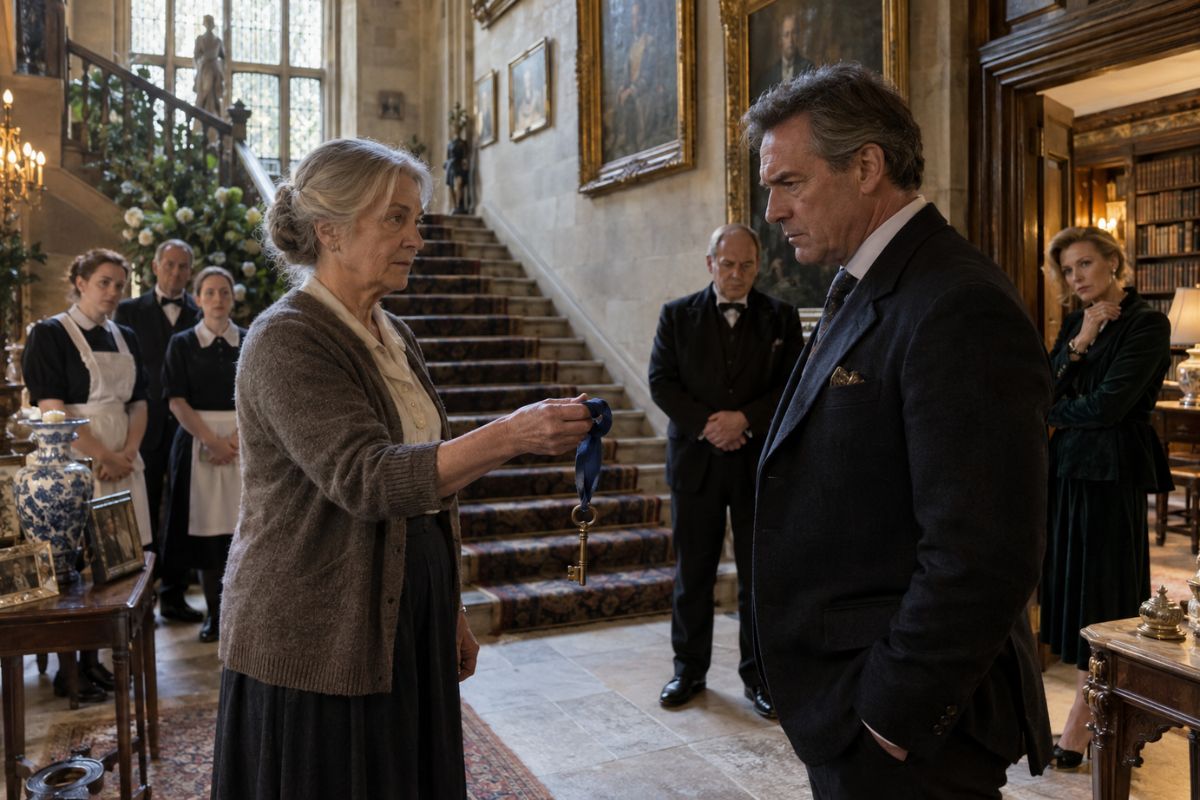
The long dining room at Ashcombe Hall had survived two wars, six generations of Vales, leaking roofs, collapsing chimneys, and one unfortunate decade in which Margaret’s late husband had believed burgundy wallpaper showed “confidence.”
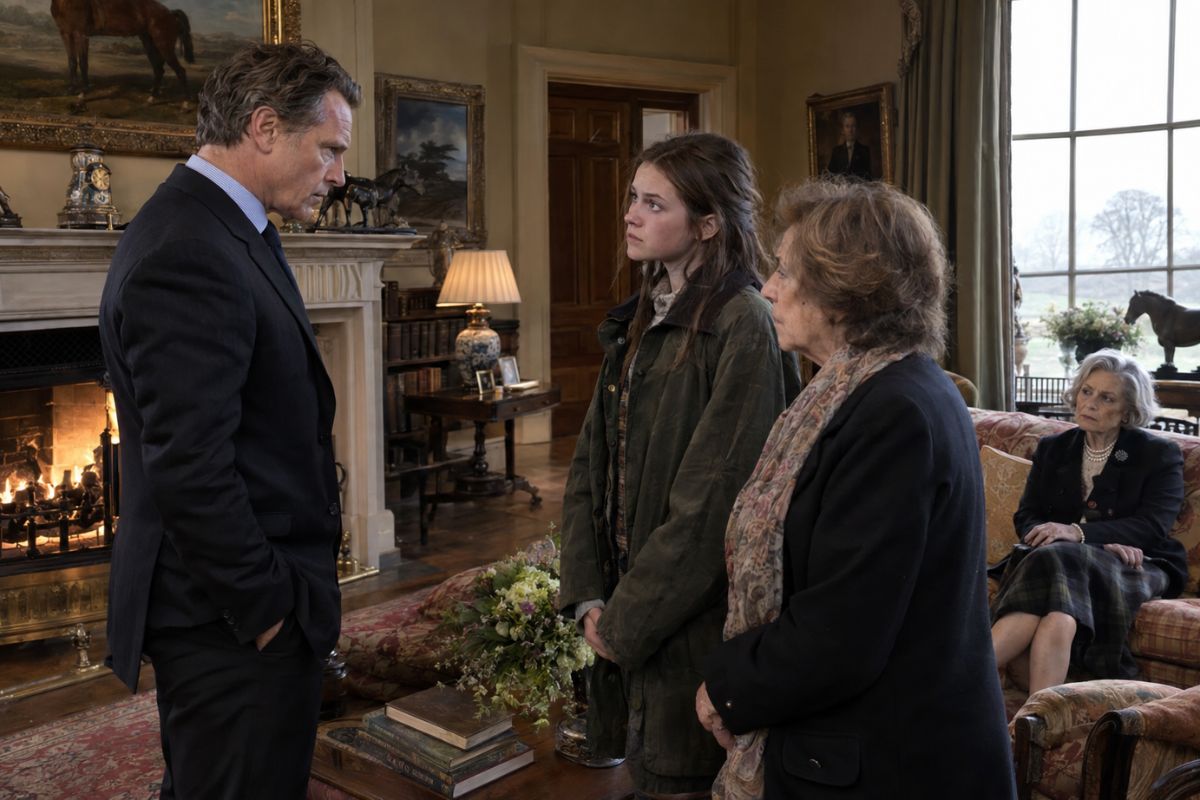
Yet on that gray Thursday afternoon, the room seemed too small for the six people seated inside it.
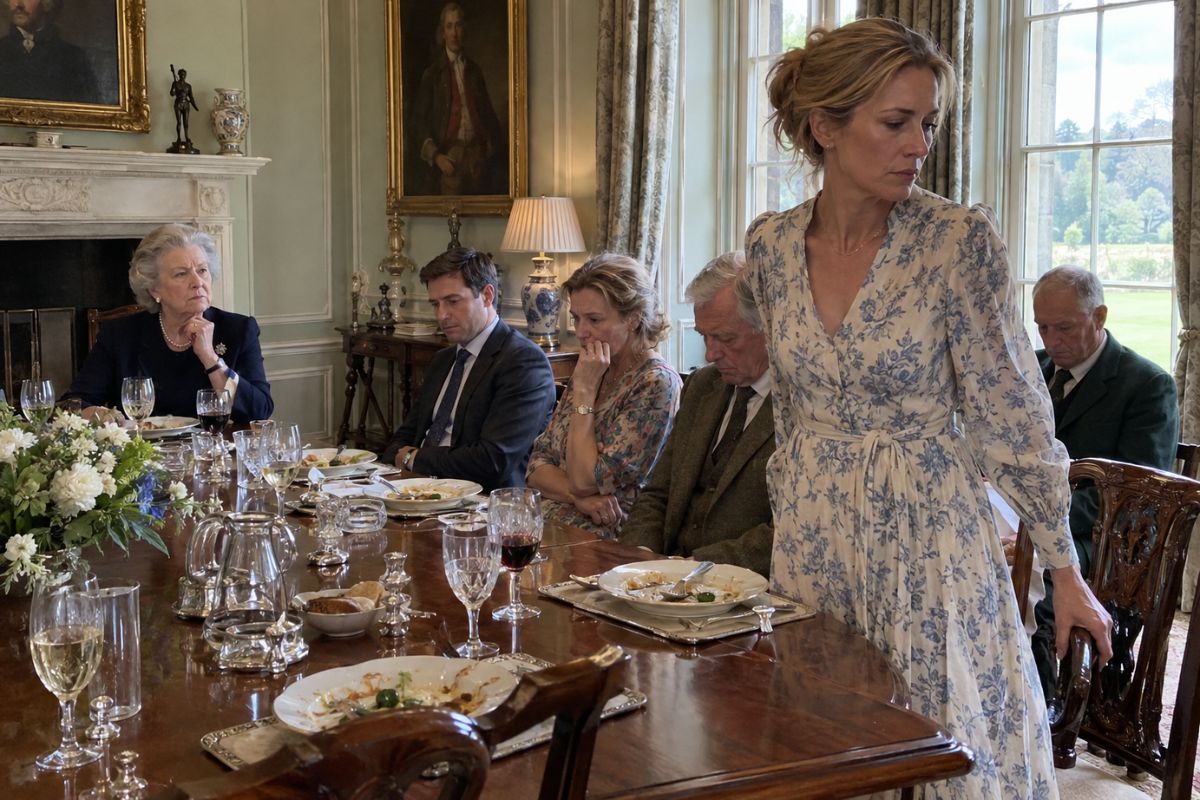
At one end of the polished table sat Margaret, the seventy-two-year-old Dowager Duchess of Ashcombe, her silver hair pinned neatly beneath a narrow velvet headband.
At the other sat Rebecca Miller Vale, forty-six, born in Ohio, widowed once, remarried eighteen months earlier to Margaret’s only son.
Between them, untouched soup cooled in porcelain bowls carrying the Vale crest.
Rebecca set down her spoon.
She did not look angry.
She did not look embarrassed.
She simply looked at Margaret for several seconds, as if deciding whether anything she might say would improve what had just happened.
Then she folded her napkin.
“Excuse me.”
Margaret’s niece Eleanor shifted uncomfortably in her chair.
Thomas Bell, Ashcombe’s groundskeeper, who had been invited because Julian had insisted senior staff should occasionally join family meals, stared at his hands.
The family accountant, Peter Harcourt, removed his glasses and began polishing lenses that were already clean.
Rebecca stood.
Margaret watched her.
She had expected a defense.
Perhaps outrage.
Perhaps the sharp American directness Rebecca sometimes displayed when she believed a discussion had become dishonest.
Instead Rebecca pushed in her chair.
“Margaret,” she said quietly, “I hope one day you understand why I haven’t answered you.”
Then she left.
Her footsteps faded through the corridor.
Margaret felt an immediate flash of triumph.
Silence, after all, was often the closest thing guilt came to confession.
But Thomas Bell was looking at her now.
Not angrily.
That would have been easier.
He looked disappointed.
And Peter Harcourt, a man who had advised the Vale family for twenty-three years, put his glasses back on and said something Margaret would remember long afterward.
“Your Grace, there are occasions when not defending oneself has nothing to do with having no defense.”
Margaret lifted her chin.
“If there is something I ought to know, Mr. Harcourt, perhaps someone should finally have the courage to tell me.”
Peter looked toward the door Rebecca had just closed.
“I suspect,” he said, “that is precisely the problem.”
Three months earlier, Margaret would have considered such a lunch impossible.
Her son Julian had been healthy then.
At fifty-one, Julian Vale, the eighth Duke of Ashcombe, was tall, mild-mannered, quietly funny, and far less impressed by his title than Margaret believed a duke ought to be.
He had spent much of his adult life disappointing her in gentle ways.
He wore old boots.
He knew the names of every grounds employee’s children.
He preferred village pubs to London clubs.
He once helped stack chairs after a charity concert and had been photographed carrying folding tables through the rain.
Margaret kept that newspaper clipping only because she disliked it.
Then there was Rebecca.
Margaret had first met her at a reception in London two years earlier.
Rebecca Miller had been visiting England as part of an educational leadership exchange.
She had spent twenty-one years working in public schools in Ohio, first as an English teacher and later as a district administrator.
She was neither glamorous nor timid.
Her brown hair was usually tucked behind one ear.
She wore sensible shoes.
When introduced to Margaret as “Her Grace,” Rebecca had smiled and said, “I’m probably going to need help with all of this.”
Margaret had not smiled back.
Julian had.
Apparently that was enough.
Within eight months they were engaged.
Margaret had asked Julian whether he understood how quickly the relationship had moved.
He had replied, “At my age, Mother, I no longer consider two years of committee meetings a prerequisite for happiness.”
Margaret had disliked the joke.
She had disliked the engagement even more.
Rebecca had a daughter, Hannah, twenty-three, from her first marriage.
She had modest savings.
Her late husband, Daniel Miller, had worked as a civil engineer and died suddenly when Hannah was fourteen.
Rebecca had stayed in the same small house outside Columbus afterward.
She had continued working.
She had paid for Hannah’s college mostly through scholarships, savings, and what Margaret privately considered the peculiarly American religion of student loans.
There was nothing scandalous about Rebecca’s past.
That, in Margaret’s view, did not necessarily make it reassuring.
She had spent fifty years watching people approach Ashcombe Hall differently once they understood what it represented.
Money.
History.
Access.
Prestige.
Even people who claimed not to care seemed to stand straighter beneath the portraits.
Margaret knew how titles changed people.
She simply believed Rebecca might be better at hiding it.
Her suspicions deepened after the wedding.
Rebecca refused the diamond bracelet Julian offered her.
She sold three designer gowns he had purchased for formal events.
She kept wearing a scratched stainless-steel watch worth perhaps seventy dollars.
The watch had belonged to Daniel.
When Margaret once suggested a jeweler might restore it, Rebecca touched the worn metal band.
“I like it the way it is.”
Margaret had interpreted that as performance.
Rebecca also objected to an autumn banquet traditionally held for several hundred invited guests.
“The roof over the east corridor is leaking,” Rebecca told Julian. “Why are we spending thirty thousand pounds entertaining people who already ate dinner before they came?”
Margaret nearly dropped her teacup.
“It is not dinner,” she said.
“What is it?”
“A tradition.”
Rebecca waited.
Margaret disliked people who waited.
They forced others to hear the weakness in their own explanations.
Rebecca finally said, “Can the tradition survive sandwiches?”
Julian laughed so hard he had to set down his coffee.
Margaret did not.
The banquet was canceled.
Two months later, Rebecca questioned a proposed renovation of the unused north guest wing.
Then she asked why Ashcombe was paying three separate contractors to maintain rooms nobody had entered in years.
Then she suggested opening portions of the house year-round instead of limiting visitors to twelve summer weekends.
Then she proposed converting old stable offices into rentable meeting rooms for local organizations.
It was all reasonable.
That was what made it intolerable.
Margaret began noticing how often Julian said, “Rebecca thinks…”
Rebecca thinks the north wing should wait.
Rebecca thinks we need another estimate.
Rebecca thinks the estate shop could sell locally made goods.
Rebecca thinks we should publish the maintenance costs.
Rebecca thinks the staff deserve clearer pension information.
Margaret heard not prudence but invasion.
Ashcombe had belonged to the Vale family for nearly three hundred years.
Rebecca had lived there nine months.
Yet she spoke about electricity bills as if the house were a school building with an inefficient boiler.
She spoke about guest rooms as if family history could be measured per occupied square foot.
And she did something Margaret found especially irritating.
She asked employees questions.
Not polite questions.
Real ones.
When had the gutters last been replaced?
Did the gardeners have enough seasonal help?
Was Mrs. Pike in the laundry still working four days a week because she wanted to, or because her pension paperwork had never been resolved?
Why had Thomas Bell delayed dental treatment?
Why did the cook’s assistant keep taking the bus from Bath at five in the morning when staff housing stood empty?
Margaret considered this boundary crossing.
The staff seemed to consider it kindness.
Then Julian collapsed.
It happened in the estate office on a cold January morning.
Rebecca was upstairs speaking with Hannah by phone when she heard something fall.
By the time she reached the office, Julian was conscious but confused and struggling to answer simple questions.
Rebecca called emergency services immediately.
She stayed beside him until paramedics arrived.
Margaret reached the hospital forty minutes later.
No one used dramatic words.
No one needed to.
Julian had suffered a serious neurological event caused by a previously undiagnosed vascular problem.
He survived.
His doctors expected meaningful recovery.
But recovery, they warned, would be measured in months, not days.
For a while Julian needed help walking safely.
His speech slowed when he was tired.
His right hand occasionally failed to cooperate with simple tasks.
The man who had spent his life moving casually through enormous rooms suddenly needed concentration to button a shirt.
Margaret would have traded every portrait in Ashcombe to spare him that humiliation.
But even grief had rules in her world.
She arrived at the hospital each morning properly dressed.
She never cried in the corridor.
She thanked nurses.
She kept flowers trimmed.
She spoke about recovery as though issuing instructions to an uncertain future.
Rebecca did something Margaret found harder to understand.
She adjusted.
Within days, she had notebooks.
Medication schedules.
Rehabilitation appointments.
Lists of questions.
She learned which foods Julian found easiest to manage when fatigue made swallowing difficult.
She sat through therapy sessions without praising him like a child.
When he became frustrated, she let him be frustrated.
When he struggled to say a word, she did not finish every sentence for him.
One afternoon Margaret entered his room and found Julian repeatedly attempting to sign his own name.
His handwriting looked jagged.
Rebecca sat nearby reading.
Margaret said, “Surely he has done enough for today.”
Rebecca looked up.
Julian shook his head.
“No,” he said slowly. “Need… this.”
Rebecca said, “Then do it again.”
Margaret thought the words sounded hard.
Julian smiled.
That frightened Margaret more than if he had complained.
Rebecca understood something about her son that Margaret, in that moment, did not.
And Margaret hated herself for noticing.
With Julian temporarily unable to manage Ashcombe’s affairs, decisions still had to be made.
Invoices still arrived.
Employees still needed wages.
The boiler still failed.
Insurance renewals did not care that the duke was learning to walk confidently again.
Rebecca began spending long hours with Peter Harcourt.
The meetings were private.
Doors closed.
Account books arrived from storage.
Documents disappeared into Rebecca’s bedroom study.
Margaret asked what they were discussing.
Rebecca answered, “Estate finances.”
“As though I wouldn’t know that.”
Rebecca paused.
“Julian asked Peter and me to review everything.”
“My son can barely concentrate for twenty minutes.”
“He asked before he left the hospital.”
Margaret stiffened.
“And why was I not included?”
Rebecca’s expression changed just slightly.
There it was again.
That hesitation.
Margaret had seen it before.
At the canceled banquet.
During the renovation discussion.
Whenever bills were mentioned.
“Because,” Rebecca said, “Julian wanted us to understand the full situation before involving anyone else.”
Anyone else.
Margaret, the Dowager Duchess of Ashcombe, had been reduced to anyone else in her own home.
Then Rebecca sold the gowns.
Not merely one.
Three.
Julian had bought them before their wedding for formal occasions.
Rebecca arranged for them to be sold through a London consignment firm.
When Margaret discovered this, she confronted her in the blue sitting room.
“Do you intend to sell everything my son gives you?”
Rebecca looked up from a stack of papers.
“I wasn’t wearing them.”
“That is hardly the point.”
“What is the point?”
Margaret felt heat rise in her face.
“The point is that Julian chose them for you.”
“Julian told a stylist to choose them for me.”
“You are his wife.”
“Yes.”
“Then perhaps you might occasionally behave as though you understand what that means.”
Rebecca closed the folder.
“I understand exactly what being his wife means.”
Margaret looked at the cheap watch on her wrist.
“Do you?”
Rebecca followed her eyes.
For a moment, neither woman spoke.
Then Rebecca said, “I’m not replacing Daniel by loving Julian.”
Margaret had not expected that.
“I never said you were.”
“You didn’t have to.”
“That watch has nothing to do with this.”
“It has everything to do with this.”
Rebecca stood.
“Some things aren’t disloyal because they belonged to another life.”
Margaret answered too quickly.
“And some things are held onto because people enjoy reminding everyone what they sacrificed.”
Rebecca stared at her.
Margaret knew immediately she had gone too far.
Rebecca simply gathered the papers.
“Good afternoon, Margaret.”
That silence again.
Always silence.
Margaret mistook it for calculation.
She did not yet understand that Rebecca’s silences were often where she placed the words she refused to use as weapons.
Julian returned home in March.
A hospital bed was placed temporarily in a sunny room overlooking the south lawn.
He hated it.
He also needed it.
For the first week, Margaret found reasons to visit constantly.
Fresh flowers.
Mail.
Soup.
Newspapers.
Information Julian had not requested.
One morning she found Rebecca kneeling beside the bed tying his shoe.
Julian was irritated.
“I can do that.”
“You can,” Rebecca said. “But your therapist said save your energy for the stairs.”
“I hate the stairs.”
“You hated them before.”
He smiled.
Margaret stopped in the doorway.
Rebecca looked up.
“Morning.”
Margaret lifted a tray.
“I brought tea.”
“Perfect.”
She set it down.
Then noticed a paper beside Rebecca’s chair.
An invoice.
At the top was the name Harcourt & Fenwick Estate Accounting.
At the bottom, a handwritten figure had been circled.
£18,740.
Margaret felt a chill.
She could not read the description.
Rebecca turned the page over.
Too quickly.
Margaret noticed.
“Something wrong?”
“No.”
“What is that bill?”
“It’s being handled.”
“By whom?”
Rebecca looked at her.
“Me.”
That answer stayed with Margaret all week.
£18,740.
Handled by Rebecca.
Thomas Bell had worked at Ashcombe for thirty-eight years.
He began at twenty-five, newly married and terrified of Margaret’s late husband, Charles.
He now supervised the grounds with three younger workers and a seasonal crew.
At sixty-three, his hair was gray, his left knee complained about rain, and he knew which cedar tree had been struck by lightning in 1989 without consulting a map.
Thomas was not deferential enough for Margaret’s taste, though never disrespectful.
He had also become oddly protective of Rebecca.
When she joined him on morning walks through the grounds, he showed her cracked retaining walls and drainage problems.
Margaret once watched through a window as Rebecca and Thomas stood in raincoats beside an overflowing ditch, arguing cheerfully about whether it could wait until summer.
“You’ve corrupted her,” Margaret told him afterward.
Thomas smiled.
“Your Grace?”
“She talks about drainage now.”
“Useful subject.”
“For a duchess?”
“For anybody who doesn’t want a flooded cellar.”
Margaret almost smiled.
Almost.
Then Thomas added, “Mrs. Vale asks good questions.”
“She is the Duchess of Ashcombe.”
“Beg pardon. Still getting used to it.”
Margaret looked at him sharply.
Thomas smiled again.
He had spent too many years at Ashcombe to be frightened by titles anymore.
It irritated her.
It also made him one of the few people she trusted.
Which was why she noticed when Thomas started avoiding her questions about Rebecca.
“Why is she meeting Peter so often?”
“You’d need to ask her.”
“I have.”
“And?”
“She gives me half an answer.”
Thomas pushed leaves from a stone drain with his boot.
“Maybe half is all she’s allowed to give.”
“Allowed by whom?”
Thomas did not answer.
“Thomas.”
He straightened.
“Your Grace, there are things that belong to the person whose business they are.”
“This estate is my business.”
Thomas held her gaze.
“That,” he said carefully, “might be part of the trouble.”
Margaret went cold.
“You are forgetting yourself.”
“No, ma’am.”
He touched the brim of his cap and walked away.
Margaret stood beside the gravel path furious enough to dismiss him.
She did not.
Thomas knew Ashcombe better than almost anyone alive.
Including, Margaret sometimes suspected, the woman who had spent half a century defending it.
The luncheon confrontation came twelve days later.
Rebecca and Peter had spent the morning inside the estate office.
Margaret had passed the door twice.
Both times conversation stopped.
At lunch, Eleanor mentioned that several rooms in the west wing might be opened to visitors.
Margaret placed down her fork.
“Who decided that?”
Rebecca replied, “No one yet.”
“Then why is Eleanor discussing it?”
Eleanor flushed.
“I only heard—”
“From whom?”
Rebecca sighed.
“Margaret.”
“No. I would genuinely like to understand how decisions about Ashcombe are apparently being discussed everywhere except with me.”
Julian was resting upstairs.
Peter had joined them because he was staying through the afternoon.
Rebecca said, “We’re reviewing options.”
“Selling rooms?”
“You cannot sell individual rooms in an ancestral house like slices of cake.”
“I am aware of that.”
“I sometimes wonder.”
Peter intervened.
“Your Grace—”
Margaret raised a hand.
“No, Peter. I think perhaps we should stop pretending.”
Rebecca’s face went still.
Margaret continued.
“My son marries a woman who arrives with very little and immediately begins deciding what my family can afford.”
Eleanor whispered, “Aunt Margaret.”
But Margaret was looking only at Rebecca.
“The banquet disappears. Renovations are canceled. Clothes are sold. Rooms are discussed as revenue. You spend hours privately examining our accounts. Now I hear of restructuring.”
Rebecca set down her spoon.
“What are you accusing me of?”
Margaret had imagined this moment several times.
She had always expected satisfaction.
Instead she felt strangely breathless.
“I am asking what you want.”
Rebecca’s expression hardened.
“What do I want?”
“Yes.”
“From Ashcombe?”
“From my son.”
Thomas looked down.
Peter said, “This has gone far enough.”
Margaret ignored him.
“You knew who Julian was when you married him.”
Rebecca stared at her.
Then something changed in her face.
Not shame.
Not guilt.
Weariness.
“My husband was learning to walk again six weeks ago.”
“I know that.”
“No. You know it happened. There is a difference.”
Margaret flinched.
Rebecca pushed back her chair.
Margaret heard herself say the sentence she would later wish she could retrieve from the air.
“My son married a woman who arrived with very little and immediately began deciding what my family could afford.”
Rebecca left.
She offered no defense.
And Margaret, because pride has a remarkable ability to translate evidence into whatever language it prefers, decided that meant she was right.
Three days later, Margaret found the recipe book.
She was not looking for it.
She had gone into the old service kitchen searching for a silver cake server used during Julian’s childhood birthdays.
The main kitchen had been renovated years ago, but the smaller room behind it still held decades of mismatched utensils, serving pieces, linens, cookbooks, and objects nobody could quite bring themselves to throw away.
Margaret opened the wrong cupboard.
A stack of handwritten notebooks leaned against a ceramic jar.
One slipped out.
It landed at her feet.
The cover was faded blue.
Across the front, in familiar handwriting, were the words:
Recipes — Evelyn Vale, 1963
Margaret froze.
Evelyn had been Charles’s mother.
The previous Duchess of Ashcombe.
She had died nearly twenty years earlier.
Evelyn had taught Margaret how to run Christmas dinners without letting guests see the panic behind the swinging kitchen door.
She had also taught her how to make lemon tart, though Margaret had never admitted that Evelyn’s was better.
Margaret carried the book to the table.
Inside were recipes written in blue fountain pen.
Steak and kidney pie.
Apple fool.
Scones.
Shortbread.
Christmas pudding.
Beside one recipe Evelyn had written: Charles hates raisins but eats them when important people are watching.
Margaret laughed before she could stop herself.
Then something fell from between the pages.
A receipt.
Margaret picked it up.
The name at the top was unfamiliar.
It was a solicitor’s office in Bath.
A handwritten note had been attached.
Pension adjustment — A. Pike. Paid personally. R.M.V.
Margaret frowned.
R.M.V.
Rebecca Miller Vale.
She turned another page.
A second folded receipt.
This one from a financial services firm.
Shortfall contribution — T. Bell.
Amount: £6,900.
Paid by Rebecca Vale.
Margaret’s heartbeat changed.
She searched the book.
There were more.
Three staff members.
Mrs. Alice Pike from the laundry.
Thomas Bell.
George Henshaw, who had retired from maintenance the previous autumn.
Each had pension discrepancies linked to years of irregular estate contributions.
Not theft.
Not fraud.
Neglect.
Some payments had been delayed during difficult years.
Others had been entered incorrectly when administrative responsibility changed.
Ashcombe owed them money.
Rebecca had paid the difference personally.
One receipt showed £4,880.
Another £6,960.
Another £6,900.
Total:
£18,740.
The circled figure.
Margaret sat down.
For several moments she heard only the clock above the pantry door.
Then she found another page.
A deposit receipt from a property sale in Ohio.
Rebecca Miller.
Net proceeds after closing costs and remaining obligations.
Margaret stared at the figure.
The money had come from Rebecca.
Not Julian.
Not Ashcombe.
Rebecca had sold something of her own.
Margaret closed the book.
Opened it again.
Read the receipts twice.
Then a third time.
She felt irritation first.
That surprised her.
Why had Rebecca done this secretly?
Why put money into pension problems she had not created?
Why hide the evidence inside Evelyn’s recipe book?
And why, if Margaret’s accusations were false, had Rebecca simply walked out?
She found Peter in the estate office.
He looked at the recipe book in her hand and immediately understood.
“You knew.”
Peter closed his laptop.
“Yes.”
“You allowed me to accuse her.”
His eyebrows rose.
“I advised you to stop.”
“You could have explained.”
“It was not my information to share.”
Margaret placed the receipts on the desk.
“Why did she do this?”
Peter leaned back.
“She was furious.”
“At whom?”
“At us.”
Margaret blinked.
Peter continued.
“When she discovered the pension problems, she asked why they hadn’t been corrected.”
“And?”
“I explained that the estate did not have sufficient liquid funds at the time.”
Margaret stared at him.
“The estate always has sufficient funds for employee obligations.”
Peter said nothing.
That silence felt different.
Margaret lowered herself into the chair across from him.
“What do you mean?”
Peter folded his hands.
“Rebecca asked the same question.”
“And?”
“She paid the shortfall.”
“Without asking Julian?”
“She told him.”
Margaret’s head lifted.
“He knew?”
“Yes.”
“And approved?”
“Reluctantly.”
Margaret looked down at the receipts.
“Why hide them?”
“She didn’t.”
“They were inside a recipe book.”
“Mrs. Pike put them there.”
Margaret looked up.
Peter almost smiled.
“Apparently Mrs. Pike keeps old household paperwork in places she believes no one else will look.”
Margaret frowned.
“Inside Evelyn’s recipes?”
“She said no one cooks from them anymore.”
Margaret was offended by that for at least three seconds.
Then the larger point returned.
“Why would Rebecca spend nearly nineteen thousand pounds on people she had known less than a year?”
Peter’s face softened.
“That,” he said, “you should ask her.”
Rebecca did not return to Ashcombe that night.
She had gone to stay with Hannah in Bath, where Hannah was completing a temporary research placement at a university library.
Margaret learned this from Julian.
He sat in a chair beside the window, walking cane resting against his knee.
His speech was much stronger now, though fatigue occasionally slowed him.
“Did you ask her to leave?” he said.
“No.”
“Did you make staying pleasant?”
Margaret stood near the fireplace.
“I found the pension receipts.”
Julian shut his eyes briefly.
“So now we’re talking.”
“Were you never going to tell me?”
“She asked me not to.”
“Why?”
“Because she wasn’t doing it for you.”
Margaret frowned.
“That makes no sense.”
“It does to Rebecca.”
Julian picked up his teacup with his left hand.
His right hand had improved, but when tired he still avoided using it.
“She hates being thanked for things she thinks should have happened anyway.”
“That is ridiculous.”
“Yes.”
He smiled faintly.
“One of the things I love about her.”
Margaret sat opposite him.
“She sold property in Ohio.”
Julian’s smile disappeared.
“It was Daniel’s house.”
“Her first husband?”
“Yes.”
“She still owned it?”
“Partly. After Daniel died, she and Hannah remained there for several years. Later she moved closer to work and rented the house to a family friend. She finally sold it last year.”
“And used the money here.”
“Some of it.”
“Why?”
Julian looked toward the rain-dark lawn.
“You’ll have to ask her.”
Margaret’s frustration rose.
“Everyone keeps saying that.”
“Maybe because you keep asking everyone except Rebecca.”
“I tried.”
“No, Mother.”
He turned toward her.
“You questioned her. You did not ask her.”
Margaret felt as though the distinction were pedantic.
Then she remembered Rebecca saying, There is a difference.
“Did you know,” Margaret asked, “that she was meeting Peter because of the estate’s financial problems?”
Julian’s expression tightened.
“Yes.”
“How severe are they?”
He did not answer immediately.
Margaret knew then.
Perhaps some part of her had known for years.
She simply had not allowed herself to assemble the knowledge into a sentence.
The deferred maintenance.
The loans.
The expensive rooms left closed.
The shrinking staff.
The furniture quietly sold through intermediaries and explained as “collection refinement.”
The years Charles had borrowed to preserve appearances.
The inheritance taxes.
The roof.
The heating.
The insurance.
The endless appetite of old stone.
Margaret whispered, “How bad?”
Julian looked at her.
“Bad enough that Rebecca isn’t the problem.”
Thomas Bell found Margaret the next morning near the kitchen garden.
She had spent half the night awake.
Thomas was pruning winter damage from an old climbing rose.
“Thomas.”
He glanced over.
“Your Grace.”
“I know about the pension.”
His hands stopped.
Margaret rarely apologized.
Not because she never regretted things.
Because apology felt, to her, dangerously close to surrender.
“I am sorry,” she said.
Thomas looked genuinely startled.
Margaret found that irritating.
“You needn’t appear astonished.”
“No, ma’am.”
“I should have known.”
Thomas returned his attention to the rose.
“That part’s true.”
She stared at him.
He clipped another branch.
Margaret almost walked away.
Instead she said, “Why did Rebecca do it?”
Thomas sighed.
“She’s told me not to talk about it.”
“Everyone has suddenly developed an extraordinary respect for Rebecca’s privacy.”
“She earned some.”
Margaret swallowed her reply.
“I am asking because I may have misunderstood her.”
Thomas looked over.
“How much?”
“What?”
“How much have you misunderstood her?”
Margaret felt the answer before she gave it.
“Possibly everything.”
Thomas rested the pruning shears against his leg.
Then he said, “Walk with me.”
They crossed the lower garden toward an old stone bench overlooking the valley.
Thomas sat.
Margaret remained standing.
He waited until she sat too.
“I knew her name before she came here,” he said.
Margaret turned.
“What?”
“Rebecca Miller.”
“How?”
Thomas rubbed a hand over his knee.
“Julian.”
The cold air seemed suddenly thinner.
Thomas continued.
“Years ago, His Grace had a little charitable fund.”
Margaret frowned.
“What fund?”
“Educational hardship grants, mostly. Families. Teachers. School staff. People hit by something they hadn’t planned for.”
“My son?”
Thomas nodded.
Margaret almost laughed from disbelief.
“Julian has never managed a charity.”
“Not publicly.”
Thomas looked toward the house.
“Your husband wouldn’t have approved.”
Margaret stiffened.
“Charles gave generously.”
“To institutions.”
Thomas chose his words carefully.
“Places with names on buildings.”
Margaret knew that was true.
“Julian wanted something else.”
Thomas explained.
When Julian was in his thirties, a former university friend began working for an educational charity that helped families facing short-term crises.
Job loss.
Illness.
Bereavement.
Housing emergencies.
Julian began contributing anonymously.
Not enormous amounts.
Enough to stop catastrophe from becoming permanent for certain families.
A few mortgage payments.
Utility bills.
School expenses.
Emergency transportation.
Sometimes larger grants.
He insisted his name remain absent from public records whenever possible.
Charles discovered one of the contributions.
He called it “sentimental nonsense.”
Julian continued anyway.
Thomas knew because he had occasionally helped Julian prepare correspondence when privacy mattered.
“How does Rebecca fit into this?”
Thomas looked at Margaret.
“Her husband died when her daughter was fourteen.”
Margaret felt her stomach tighten.
Thomas continued.
“Daniel Miller left life insurance, but there were delays, debts, and expenses. Rebecca missed work. She was raising Hannah. For a while, she came close to losing the house.”
Margaret pictured Rebecca’s scratched watch.
“I thought Daniel had provided for them.”
“He tried. Doesn’t mean life cooperated.”
Thomas paused.
“A charity helped Rebecca for several months.”
Margaret stared at him.
“No.”
Thomas nodded.
“Julian funded the grant.”
“How could he possibly have known her?”
“He didn’t.”
The words landed with almost physical force.
“They had never met.”
Margaret’s voice dropped.
“And Rebecca knows?”
“Not then.”
“When?”
“After she married him.”
Thomas explained that Rebecca had found an old letter among papers Julian kept from his charitable work.
The letter was a thank-you note.
A woman from Ohio had written about a mortgage assistance grant she believed came from an anonymous donor.
She wrote that losing her husband had felt like standing in a house where every light went out at once.
The grant had not solved her life.
It had bought time.
Time to settle insurance questions.
Time to keep working.
Time to prevent Hannah from losing both her father and her home in the same year.
Julian had kept the letter.
Rebecca recognized the handwriting.
Her own.
Margaret sat perfectly still.
“She never told him?”
Thomas shook his head.
“Why?”
“You’d have to ask her.”
Margaret gave him a look.
Thomas smiled faintly.
“Though if you’re asking me, I’d say she didn’t want the story of their marriage to become a debt.”
Margaret looked back toward Ashcombe Hall.
Its honey-colored stone rose above bare winter trees.
For most of her life, the house had looked permanent.
Now, for the first time, she saw how much of permanence was simply repair nobody noticed.
Thomas spoke softly.
“She found out the man she loved had helped her years before he knew she existed.”
Margaret whispered, “And instead of telling him…”
“She started doing the same for someone else.”
The pension receipts.
Mrs. Pike.
George Henshaw.
Thomas himself.
Margaret felt something inside her rearrange painfully.
All those months she had interpreted Rebecca’s refusal of extravagance as manipulation.
Rebecca had sold gowns because seventeen thousand pounds could mean something elsewhere.
She had questioned banquets because she knew what one mortgage payment could mean to a frightened family.
She wore Daniel’s watch not because she loved Julian less.
She wore it because gratitude did not require erasing one life to honor another.
Margaret suddenly understood why Rebecca had walked out of the luncheon.
A defense would have required revealing Julian’s secret.
And her own.
Rebecca had chosen humiliation over exposing something Julian had done quietly for years.
Margaret looked down at her hands.
“I called her a fortune hunter.”
Thomas said nothing.
“She used her own money.”
Still nothing.
“I accused her in front of people.”
“Yes.”
Margaret turned sharply.
“You might occasionally soften your answers.”
“Wouldn’t help.”
She almost laughed.
Instead her eyes burned.
She removed one glove and pressed her fingers to the bridge of her nose.
“I don’t know how to fix this.”
Thomas watched the house.
“Could start by not treating it like the wallpaper.”
Rebecca returned to Ashcombe two days later because Julian asked her to.
She did not return for Margaret.
That distinction was obvious.
Hannah came with her.
Hannah Miller was twenty-three and looked more like Daniel than Rebecca, with dark hair, thoughtful eyes, and a habit of folding her arms when uncomfortable.
Margaret had always considered Hannah polite but distant.
Now she understood why.
Hannah had watched Margaret judge her mother.
She had simply been too well raised to say so.
That evening Margaret found Rebecca alone in the library.
She was sorting correspondence.
The old watch was on her wrist.
Margaret held the blue recipe book.
Rebecca looked up.
Her face changed immediately.
“You found those.”
“Yes.”
Rebecca sighed.
“I wondered where Mrs. Pike put them.”
Margaret set the book down.
“I spoke with Thomas.”
Rebecca’s eyes sharpened.
“He wasn’t supposed to tell you.”
“I gave him little choice.”
“That sounds familiar.”
Margaret accepted the blow.
“I know about Ohio.”
Rebecca stopped moving.
For several seconds, the only sound came from rain touching the windows.
Margaret said, “You knew Julian funded the grant.”
“Yes.”
“And never told him.”
“No.”
“Why?”
Rebecca sat back.
“You genuinely want to know?”
“Yes.”
Rebecca studied her.
Then she removed her glasses.
“After Daniel died, I was terrified.”
Margaret sat opposite her.
Rebecca continued.
“I had a job. I had insurance coming eventually. I was not destitute. But everything went wrong at once.”
She looked toward the fireplace.
“The insurance paperwork dragged. Daniel had medical bills. Our savings weren’t what people imagined. Hannah was fourteen. I kept thinking if I could just stay calm for her, everything would eventually catch up.”
Her thumb moved across the scratches on Daniel’s watch.
“I got behind on the mortgage.”
Margaret said nothing.
“I never told Hannah how close we came.”
From the doorway came Hannah’s voice.
“You didn’t have to.”
Both women turned.
Hannah stood there holding a mug.
Rebecca closed her eyes.
“Hannah.”
“I knew.”
Rebecca looked stricken.
“How?”
“You started buying the cheap cereal you hated.”
A sad smile crossed Hannah’s face.
“And you stopped turning on the air-conditioning unless I was home.”
Rebecca looked down.
Margaret understood suddenly that adult children often remembered things parents believed they had successfully hidden.
Hannah came into the room.
“When the charity helped us, Mom cried in the garage.”
Rebecca frowned.
“You didn’t see that.”
“I saw enough.”
Hannah sat beside her.
Rebecca reached for her hand.
Margaret looked away, feeling like an intruder.
Then Rebecca said, “The money bought us four months.”
Four months.
Such a small measurement.
Such an enormous gift.
“By then,” Rebecca continued, “the insurance issue was settled. I caught up. We kept the house.”
Margaret looked at her.
“And years later you discovered Julian’s signature.”
“On an internal letter.”
“What did you feel?”
Rebecca gave a quiet laugh.
“Angry.”
Margaret blinked.
“Angry?”
“For about five minutes.”
“Why?”
“Because I’d spent years imagining some retired teacher or church volunteer had helped us. Then I discover it was an English duke I eventually married.”
Hannah smiled.
“It offended her sense of narrative structure.”
Rebecca nudged her daughter.
Margaret almost smiled too.
Then Rebecca grew serious.
“I didn’t tell Julian because I never wanted him wondering whether gratitude had anything to do with why I loved him.”
“But it didn’t.”
“No.”
Rebecca looked straight at Margaret.
“I fell in love with him before I knew.”
Margaret lowered her eyes.
“And the pensions?”
Rebecca exhaled.
“When Peter showed me the records, I kept thinking about those four months.”
She folded her glasses.
“Mrs. Pike had worked here thirty-one years. George gave forty. Thomas gave thirty-eight. Ashcombe had made promises to them.”
“You gave away part of your own security.”
“I still have savings.”
“Not enough to be careless with.”
Rebecca’s expression softened.
“No.”
Margaret looked at the recipe book between them.
“I thought you wanted Ashcombe.”
Rebecca leaned back.
“I do.”
Margaret stiffened.
Rebecca continued.
“I want it to survive.”
The words were not what Margaret expected.
Rebecca looked around the library.
“I want Julian to stop waking at three in the morning worrying about bills he won’t tell you about. I want Thomas to retire someday without wondering whether somebody lost another form. I want visitors in these rooms. I want children running through the gardens learning something besides which rope they’re not allowed to cross.”
Margaret’s jaw tightened.
“And if that means selling half of what my family spent centuries preserving?”
Rebecca answered gently.
“Maybe the family is what should be preserved.”
Margaret looked at her.
Rebecca continued.
“That’s the part you and I don’t agree on.”
“No.”
“Not yet.”
The last two words hurt more than an accusation would have.
Because they contained hope Margaret was not sure she deserved.
The full financial picture was worse than Margaret expected.
Peter presented it the following morning.
Ashcombe Hall possessed enormous theoretical value and alarmingly little usable cash.
The estate had borrowed for repairs.
Visitor revenue had fallen.
Investment income had declined.
Taxes, insurance, heating, staffing, and emergency maintenance consumed more each year.
Parts of the roof needed substantial work.
Several rental cottages required repairs before rents could legally or reasonably rise.
The family had postponed costs so long that postponement had become more expensive than repair.
Margaret listened for twenty-five minutes.
Then she said, “We have survived worse.”
Peter looked tired.
“No, Your Grace. People before you sold land.”
“We will not.”
“They sold paintings.”
“We have sold some.”
“Not enough.”
“We can reduce staff.”
Rebecca’s head came up.
Margaret immediately regretted saying it.
Peter closed a folder.
“That would not solve the underlying problem.”
“What would?”
He hesitated.
Rebecca answered.
“Changing what Ashcombe is for.”
Margaret looked at her.
There it was.
The thing she had feared.
Not theft.
Transformation.
Rebecca laid out the options.
Open more rooms to visitors.
Extend the season.
Create a small exhibition about the estate’s agricultural and village history, including servants and workers, not only the Vale family.
Convert two unused outbuildings into community rental spaces.
Partner with local schools for educational visits.
Lease part of the stable block to small businesses.
Sell selected art and furniture not central to the family collection.
Cancel several costly traditions.
Reduce private living areas to a manageable portion of the house.
Margaret felt each suggestion like someone removing bricks from a wall.
“And what remains?” she asked.
Rebecca met her eyes.
“Ashcombe.”
“You make that sound simple.”
“No.”
Rebecca’s voice was quiet.
“I think it will be painful.”
Margaret stood.
For fifty years she had believed her duty was clear.
She had married Charles at twenty-two.
Her mother had told her, You are marrying a man, but you are also marrying responsibility.
Margaret had remembered.
Through Charles’s difficult moods.
Through financial downturns.
Through funerals.
Through weddings.
Through leaks and taxes and staff disputes and public tours.
She had maintained standards.
She had hosted dinners when there was not enough money to repair the servants’ staircase.
She had replaced curtains in rooms no one used because faded fabric looked like decline.
She had instructed staff never to discuss financial worries beyond estate offices.
She had smiled when magazines photographed the drawing room.
She had made permanence look effortless.
And now an American school administrator from Ohio was telling her that effort itself had become the problem.
“You think I don’t understand this house,” Margaret said.
Rebecca stood too.
“I think you understand it better than anyone.”
“Then why does every solution involve dismantling what I protected?”
Rebecca looked almost sad.
“Because some of what you protected was already gone.”
Margaret stared at her.
Rebecca continued.
“The question isn’t whether Ashcombe changes.”
Her voice softened.
“It already has.”
That afternoon Margaret opened a locked cabinet in her private sitting room.
Inside were financial letters dating back fifteen years.
Some were from Peter.
Others from banks.
Some were addressed to Charles before his death.
Several bore Margaret’s own notes.
Delay until spring.
Use reserve.
Do not discuss with Julian yet.
Review after summer tours.
Margaret sat on the floor beside the cabinet.
She had known.
Not every detail.
Not the current depth.
But enough.
After Charles died seven years earlier, she had inherited not the estate itself—that passed to Julian—but much of its mythology.
She continued managing social expectations.
Julian tried to modernize slowly.
Margaret resisted quickly.
When he suggested opening more rooms, she warned against turning Ashcombe into “an amusement park.”
When he proposed weddings, she called them commercial.
When he wanted a frank staff meeting about expenses, Margaret argued it would create anxiety.
She had not stolen.
She had not lied about individual numbers.
She had simply placed curtains over every window through which decline might be seen.
And Julian, who loved her, had sometimes allowed it.
Rebecca had not.
That was what Margaret had truly disliked.
Rebecca was not after Ashcombe.
Rebecca had looked directly at it.
Julian’s first major family meeting after his illness took place three weeks later.
He walked into the library using only a cane.
Rebecca remained half a step behind him but did not touch his arm.
Margaret noticed.
She noticed many things now.
Hannah sat near the windows.
Eleanor had come from London.
Peter arranged documents.
Thomas was there because Julian insisted senior staff representation mattered.
Mrs. Pike refused to attend, announcing that she had “washing enough without discussing aristocratic insolvency.”
Thomas reported this with visible enjoyment.
Julian lowered himself into a chair.
“Well,” he said, speech slightly slower than before, “apparently one medical emergency wasn’t sufficient excitement.”
Nobody laughed.
Julian looked around.
“That was a joke.”
Thomas chuckled obediently.
Margaret almost smiled.
Then she stood.
She had spent two nights rehearsing.
Now every prepared sentence felt false.
So she abandoned them.
She carried a stack of account books to the table.
Rebecca looked up.
Margaret placed both hands on the covers.
“Before Peter begins, I need to say something.”
Julian’s expression changed.
“Mother?”
She looked at her son.
Then Rebecca.
Then Thomas.
“I have spent most of my life believing my duty was to protect Ashcombe.”
Her voice was steady.
“That is true.”
She glanced at Rebecca.
“What I failed to understand was that somewhere along the way, I began confusing Ashcombe with the appearance of Ashcombe.”
No one moved.
Margaret continued.
“I knew we had financial problems.”
Julian lowered his eyes.
“I did not understand every detail. But I knew more than I admitted.”
She touched the account books.
“I delayed decisions. I discouraged changes. I insisted we maintain traditions we could not reasonably afford.”
She swallowed.
“I believed acknowledging decline would cause decline.”
Peter watched quietly.
Margaret looked at Julian again.
“That was pride.”
Her son did not rescue her.
She was grateful.
“I blamed Rebecca for asking questions I should have asked myself.”
Rebecca’s face remained unreadable.
Margaret continued.
“I accused her of coming here for money.”
Her fingers tightened around the edge of the table.
“The truth is she spent her own money correcting obligations this family had failed to meet.”
Thomas looked toward the floor.
Margaret’s voice trembled once.
She allowed it.
“Rebecca didn’t endanger Ashcombe.”
She looked around the room.
“I did. Because I was more afraid of embarrassment than I was of the truth.”
Nothing dramatic happened.
No applause.
No one rushed to embrace her.
The clock ticked.
Rain touched the windows.
Julian removed his glasses and rubbed his eyes.
Finally he said, “Thank you.”
Margaret almost wished he had shouted.
Those two words hurt more.
Rebecca spoke next.
“What do you want to do now?”
Margaret turned toward her.
That question contained everything.
Not How sorry are you?
Not How could you?
What do you want to do now?
Margaret looked at the account books.
“Sell the Reynolds landscape.”
Eleanor gasped.
Margaret almost enjoyed that.
The painting had hung in the red drawing room since 1911.
Valuable.
Beautiful.
Rarely noticed except by insurance assessors.
Julian stared.
“Mother.”
“It is not one of the family portraits.”
“No.”
“It will cover the roof work and reduce a portion of the short-term debt.”
Peter nodded slowly.
“It would make a significant difference.”
Margaret looked at Rebecca.
“Open the west rooms.”
Rebecca said nothing.
“And the old stable offices.”
Still nothing.
“Not the blue drawing room.”
Rebecca finally smiled.
“I never asked for the blue drawing room.”
“You were going to.”
“I was thinking about it.”
“Absolutely not.”
Julian laughed.
The sound startled everyone.
It was the first full laugh Margaret had heard from him since the hospital.
He leaned back, exhausted but smiling.
“Progress,” he said.
Change came slowly.
Then all at once.
The Reynolds landscape was sold privately through a reputable art dealer.
Margaret watched the empty place on the red drawing-room wall for three days before instructing staff not to replace the painting.
“Let people see where something used to be,” she said.
Thomas nearly dropped his coffee when he heard.
The west wing opened to visitors in early summer.
Rebecca helped design an exhibition called Lives of Ashcombe, featuring not only dukes and duchesses but gardeners, housekeepers, tenant farmers, cooks, nurses, drivers, teachers, wartime volunteers, and village families connected to the estate.
Margaret initially called it “excessively democratic.”
Then she spent four afternoons helping identify unnamed staff in old photographs.
“That is Mr. Pembroke,” she said over one photograph. “He repaired clocks. Dreadful temper.”
Rebecca wrote the name beneath it.
“And her?”
Margaret leaned closer.
“Lucy Grant. Kitchen maid first, later cook. She made terrible custard.”
Rebecca looked amused.
“You remember everyone.”
Margaret touched the photograph.
“Someone should.”
That became one of the most popular parts of the exhibit.
The stable block was converted into three modest rental spaces.
A local ceramics maker took one.
A historical conservation firm rented another.
The third became a community classroom used by schools, gardening groups, and adult education programs.
Margaret objected when folding plastic chairs appeared.
Rebecca replaced them with wooden ones.
Neither mentioned the compromise.
Visitors increased.
Not enough to erase every problem.
Enough to change the direction.
Ashcombe remained expensive.
Repairs remained endless.
Some staff roles changed.
Two positions were lost through retirement rather than dismissal.
A planned restoration was postponed indefinitely.
Several pieces of furniture were sold.
The annual formal banquet never returned.
In its place, Ashcombe hosted a summer community evening with local food, music, and garden tours.
Margaret complained that people were wearing sneakers on the terrace.
Then she spent forty minutes talking to a retired teacher from Bristol who remembered visiting Ashcombe as a child.
Julian continued improving.
His right hand regained most of its strength.
His speech became nearly normal except when exhausted.
He learned to pace himself, which he hated.
He returned to estate meetings twice a week.
He also discovered that surviving a serious illness gave him less patience for polite dishonesty.
When Margaret attempted to describe an unaffordable repair as “something we might revisit,” Julian said, “Mother, do you mean no?”
Margaret replied, “Possibly.”
Rebecca said, “She means no.”
Margaret glared at her.
Then smiled.
It was not a miracle reconciliation.
Some injuries remained.
Rebecca did not suddenly treat Margaret like a second mother.
Margaret did not become easy.
They argued over visitor numbers.
They argued over signs.
They argued over whether children should be allowed to sit on the lawn near the south terrace.
Margaret insisted the answer was no.
Rebecca placed picnic tables there.
Margaret claimed this was an act of aggression.
But something had changed beneath the arguments.
Margaret had stopped assuming disagreement was invasion.
Rebecca had stopped assuming Margaret’s resistance always meant contempt.
They began asking.
Sometimes, even listening.
One afternoon in September, Margaret found Julian alone in the estate office.
He was signing letters.
His handwriting was slower than before, but legible.
On the corner of the desk sat a small stack of envelopes.
Margaret recognized the return address.
The educational charity.
She leaned against the doorway.
“You still fund it.”
Julian looked up.
He followed her gaze.
“Yes.”
“You know Rebecca knows.”
His pen stopped.
He stared at her.
“What?”
Margaret realized immediately that Rebecca had never told him.
Julian’s face changed.
“She knows?”
Margaret closed her eyes briefly.
“I appear to have made another error.”
“What does she know?”
Margaret entered the room.
There was no graceful exit now.
“She discovered years ago that you funded the grant which helped her after Daniel died.”
Julian sat very still.
“What?”
“She recognized correspondence after your marriage.”
He looked toward the door as if Rebecca might suddenly appear.
“And she said nothing?”
“No.”
“How long?”
“Since shortly after the wedding.”
Julian leaned back.
Margaret watched comprehension move across his face.
The sold gowns.
The employee payments.
Rebecca’s insistence on privacy.
Her discomfort with gratitude.
He whispered, “That’s why.”
Margaret sat opposite him.
“She didn’t want you thinking she married you because she felt indebted.”
Julian laughed softly.
“That woman.”
“She also said she was angry for five minutes.”
“That sounds right.”
Margaret folded her hands.
“I am sorry.”
Julian looked at her.
“For telling me?”
“For nearly everything.”
He smiled sadly.
“That’s a broad apology.”
“I have broad qualifications.”
He laughed again.
Then became serious.
“You know, Father hated that fund.”
“I know.”
“He told me charity made people dependent.”
Margaret looked at the envelopes.
“Your father believed many things loudly.”
Julian raised an eyebrow.
It was the closest she had come to criticizing Charles openly in years.
Margaret continued.
“He was not always right.”
Julian looked at her for a long moment.
“No.”
“No.”
She stood.
At the door she paused.
“Don’t confront Rebecca as though you have uncovered a crime.”
“I wasn’t planning to.”
“She dislikes emotional ambushes.”
“So do you.”
“Yes. That’s how I recognize them.”
Julian waited until that evening.
Rebecca was in the small sitting room beside their bedroom reading reports.
He entered carrying an old sheet of paper.
She looked up.
Saw it.
Closed her eyes.
“Margaret told you.”
“She did.”
Rebecca sighed.
“I suppose we’ve made progress if she’s confessing her own mistakes quickly now.”
Julian sat beside her.
“You knew.”
“Yes.”
“For more than a year.”
“Yes.”
“You never said anything.”
“No.”
“Why?”
Rebecca looked at him.
“Because I didn’t marry the man who helped me.”
Julian frowned.
“I married the man who annoyed me at a conference by arguing that British schools didn’t have enough flexibility.”
“I was right.”
“You were insufferable.”
“You invited me to dinner.”
“I make mistakes.”
He smiled.
Rebecca took the letter from his hand.
It was her old thank-you note.
The paper had yellowed slightly.
“I wrote this at two in the morning,” she said.
“I know.”
“You know?”
“You mention it in the third paragraph.”
She reread a line and winced.
“Oh, I was dramatic.”
“You were grieving.”
Rebecca touched the paper.
“I spent years wondering who you were.”
“Disappointed?”
“Terribly.”
He laughed.
Then his expression softened.
“You paid Thomas and the others because of this?”
“Partly.”
“You sold Daniel’s house.”
“I was selling it anyway.”
“You used money that should have protected you.”
Rebecca looked at him.
“It did protect me.”
“How?”
She handed back the letter.
“It reminded me what money is for.”
Julian was quiet.
Rebecca continued.
“Those payments you made didn’t make me rich. They didn’t fix my grief. They didn’t bring Daniel back.”
Her voice lowered.
“They gave me enough time not to make desperate decisions while I was grieving.”
Julian stared at the note.
Rebecca touched his hand.
“I got to keep Hannah in her school. I got to breathe.”
Julian looked at her.
“And you never thought I deserved to know I had helped you?”
“I thought you deserved to know I loved you without owing you.”
He swallowed.
“Rebecca.”
She shook her head.
“No speeches.”
“I wasn’t going to make one.”
“You were.”
“I was going to say I love you.”
“That one is allowed.”
So he said it.
And she believed him.
By winter, the blue recipe book had returned to the kitchen.
Not hidden this time.
Rebecca kept it on an open shelf.
Margaret objected.
“That belongs in the archive.”
“It has flour on half the pages.”
“It is historically significant.”
“It’s a cookbook.”
“It belonged to a duchess.”
“So does my casserole dish.”
They compromised by making a digital copy for the archive and leaving the original where people actually cooked.
The following spring, Hannah returned from the United States for three months.
She had accepted a position at a museum in Chicago but delayed her start so she could spend time with Rebecca and Julian before beginning.
One rainy Saturday, Margaret entered the kitchen and stopped in the doorway.
Rebecca and Hannah were standing at the center island surrounded by flour.
Hannah had an apron tied badly around her waist.
Rebecca was rolling dough.
“What happened here?” Margaret asked.
Hannah looked up.
“Pie.”
“This looks like a burglary committed with flour.”
Rebecca laughed.
“We’re making my grandmother’s apple pie.”
Margaret approached.
“American pie?”
“No, Margaret. Mongolian.”
Margaret gave her a look.
Hannah covered a smile.
On the counter lay Evelyn’s blue recipe book, open beside a newer card written in Rebecca’s handwriting.
Margaret picked it up.
“Your measurements are in cups.”
“That’s how civilization works.”
“It is not.”
“Three hundred million Americans manage.”
“Barely.”
Hannah laughed.
Margaret watched Rebecca press the dough into a dish.
For a moment she remembered their first year.
The suspicions.
The canceled banquet.
The gowns.
The watch.
The closed office door.
The luncheon.
Her own voice saying, arrived with very little.
She had been wrong about that too.
Rebecca had arrived with grief she had survived.
A daughter she had raised.
A career she had built.
A first marriage she still honored without diminishing her second.
A memory of strangers helping when nobody was watching.
A belief that resources mattered only when used for people.
Margaret had looked for wealth in the wrong places.
“Needs cinnamon,” she said.
Rebecca looked offended.
“You haven’t tasted it.”
“I can tell.”
“You cannot tell cinnamon by looking.”
“Evelyn could.”
“Evelyn also thought boiled carrots belonged in gelatin.”
“That was fashionable.”
“That was criminal.”
Hannah laughed again.
Margaret opened the recipe book.
Near the back were several blank pages.
She had been waiting for the right moment.
From her cardigan pocket she removed a fountain pen.
Rebecca noticed.
“What are you doing?”
“Adding something.”
“To Evelyn’s book?”
“I think she would approve.”
“You once threatened to archive it.”
“I have developed.”
Rebecca leaned over.
Margaret covered the page.
“Don’t read while I’m writing.”
“Now I definitely want to read it.”
“Patience is a virtue.”
“Says the woman who opened three financial statements addressed to Julian because the envelopes looked suspicious.”
“They were on the breakfast table.”
“They had his name on them.”
“Details.”
Margaret finished writing.
Then she closed the book.
Rebecca reached for it.
Margaret held on.
For a second they stood with one hand each on the battered cover.
Not enemies.
Not quite mother and daughter.
Something more complicated.
And perhaps, because it had been earned, more valuable.
Margaret released it.
Rebecca opened to the final page.
The note was short.
Her expression changed as she read.
Hannah moved beside her.
Margaret looked away toward the rain-streaked windows, suddenly fascinated by the weather.
Rebecca read the words again.
Then she looked at Margaret.
No one cried.
No one needed to.
Rebecca simply closed the book and placed her hand over Margaret’s for a moment.
Later, after the pie came out slightly too dark around the edges, Julian joined them.
Thomas appeared because Hannah had apparently promised him a slice.
Mrs. Pike complained that American pastry was too sweet, then asked for seconds.
They ate at the scarred kitchen table instead of in the dining room.
Outside, Ashcombe Hall stood beneath a soft English rain.
Smaller than it had once imagined itself.
Busier than it had been in decades.
Still expensive.
Still imperfect.
Still standing.
And on the last blank page of Evelyn Vale’s old recipe book, beneath decades of stains, corrections, and family handwriting, Margaret had written:
For Rebecca—who taught me that protecting a family and protecting its appearance are not the same thing.
Thank you so much for reading this story!
I’d really love to hear your comments and thoughts about this story — your feedback is truly valuable and helps us a lot.
Please leave a comment and share this Facebook post to support the author. Every reaction and review makes a big difference!
This story is a work of fiction created for entertainment and inspirational purposes. While it may draw on real-world themes, all characters, names, and events are imagined. Any resemblance to actual people or situations is purely coincidental.