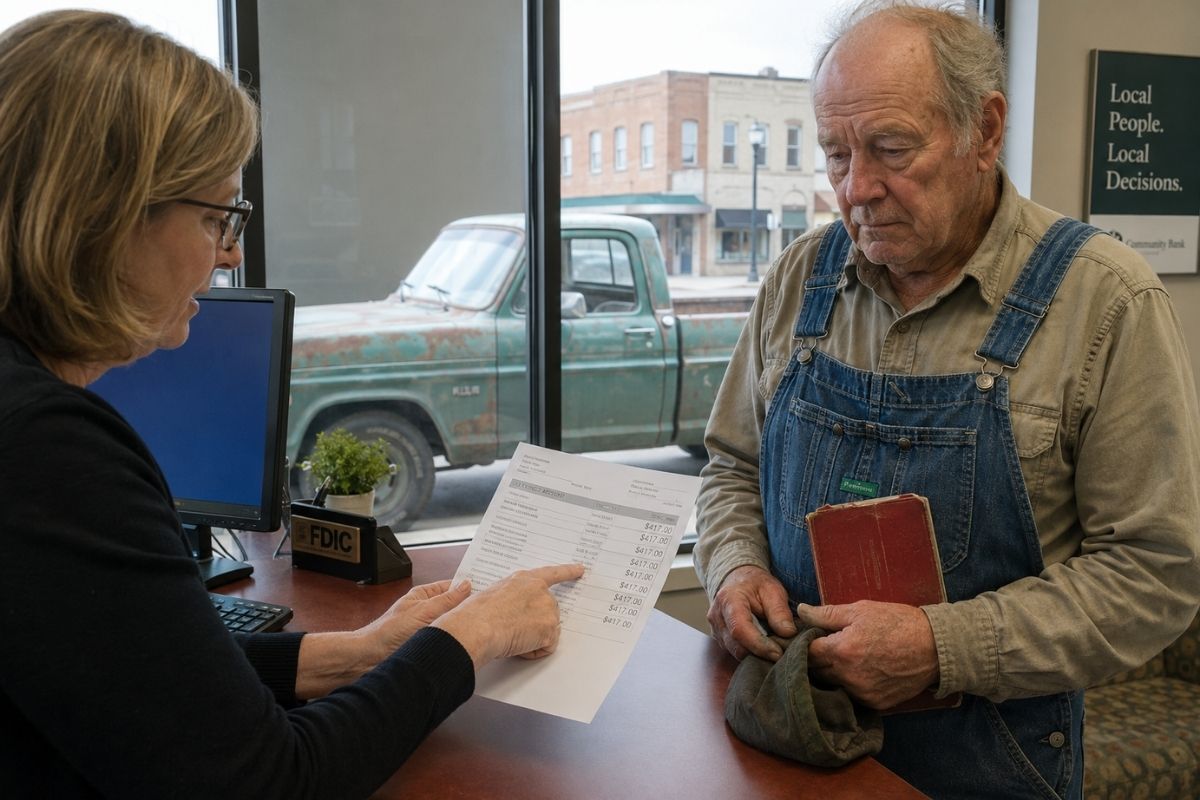
“You understand this account isn’t in your name, Mr. Bell?”
Warren Bell rested both hands on the polished edge of the bank manager’s desk.
At seventy-three, his hands looked older than the rest of him. The knuckles were swollen from decades of cold mornings, broken machinery, wire fencing, and steering tractors across uneven Iowa ground. A pale scar crossed his left thumb. Corn dust still clung to the cuffs of his patched work shirt.
“Yes,” he said.
Kendra Holt waited.
Warren waited too.
Between them sat a printed sheet showing thirty-one recent deposits.
Every one was the same.
$417.
Every Friday.
Cash.
Kendra tapped the page.
“And you’re telling me you have no ownership interest in this account?”
“That’s right.”
“You’re not related to the account holder?”
“No.”
“You don’t receive anything from these deposits?”
“No.”
“And you’ve been doing this how long?”
Warren looked toward the window.
Outside, his faded green Ford pickup sat crooked between a late-model SUV and a spotless white sedan. One rear wheel well had rusted nearly through. A coil of fencing wire lay in the bed beside two feed sacks.
He seemed to count silently.
Kendra noticed.
It confirmed what she had already begun to suspect.
“Thirty-one years,” Warren said.
Kendra leaned back.
She was forty-six, recently promoted to regional branch manager for Prairie Heritage Bank’s eastern Iowa territory, and she had spent nearly twenty years learning that unusual financial behavior deserved questions.
Sometimes questions protected people.
Sometimes they stopped fraud.
Sometimes they prevented lonely widows from sending money to strangers who claimed to love them.
And sometimes, Kendra knew, families refused to admit that an aging parent was no longer thinking clearly.
She softened her voice.
“Mr. Bell, do you know what today’s date is?”
Warren’s eyes shifted from the window to her face.
“August twenty-first.”
“And the year?”
“2026.”
“Do you know where you are?”
For the first time, something changed in his expression.
Not confusion.
Humiliation.
He looked at the nameplate on her desk.
Then at the bank logo behind her.
“Prairie Heritage Bank,” he said. “Same building where I opened my farm account when Jimmy Carter was president.”
Kendra felt heat rise into her neck.
“I’m required to ask certain questions.”
“You asked.”
She folded her hands.
“The concern is that you may be giving money to someone who is taking advantage of you.”
“No.”
“How can you be certain?”
“Because I am.”
“That isn’t really an answer.”
“It’s the answer I’ve got.”
Warren reached for his cap.
Kendra stopped him.
“There’s something else.”
He looked back.
“I’ve placed a temporary hold on the account pending review.”
His fingers froze around the cap.
For the first time since entering her office, he looked genuinely alarmed.
“No.”
“I understand you’re upset.”
“No.”
“The funds already deposited remain safe.”
“You need to open it back up.”
“Mr. Bell—”
“Open it back up.”
His voice still wasn’t loud.
That somehow made it more uncomfortable.
Kendra glanced through the glass wall toward the lobby. Two tellers were pretending not to watch.
“I can’t do that until our compliance department reviews the situation.”
Warren leaned forward.
“When?”
“I can’t promise a date.”
“The first Monday in September.”
“What about it?”
He ignored the question.
“You need that account open before the first Monday in September.”
“I cannot override the hold just because you request it.”
Warren stared at her for several seconds.
Then he said it a third time.
“Please open it before the first Monday in September.”
Kendra shook her head.
“I’m sorry.”
Warren put his cap on.
He walked out without another word.
Kendra watched him through the office glass as he crossed the lobby, stopped at the little table near the door, and opened a battered red notebook he had carried under one arm.
He wrote something.
Then he closed the notebook carefully and tucked it inside his jacket.
Kendra had no idea that before September arrived, nearly half the town would know about that notebook.
And she would discover that one of the names connected to it belonged to her own family.
The first person Warren called was not his son.
He had not called his son for six years.
Instead, he drove twelve miles outside town to the farm supply store, bought a hydraulic hose he did not actually need that day, and stood for five minutes beside a display of work gloves before asking the owner if his wife still worked mornings at the community college.
“She does Tuesdays and Thursdays,” Earl Jensen said. “Why?”
“Nothing.”
Earl studied him.
“You all right, Warren?”
“Fine.”
Warren paid in cash.
He returned to the farm and spent the afternoon replacing the hose anyway.
That was how he handled most problems.
If something could be fixed with tools, he fixed it.
If it could not be fixed with tools, he usually worked until he was too tired to think about it.
At seven that evening, he sat alone at his kitchen table with two slices of toast, canned soup, and the red notebook.
The farmhouse had grown quieter since his wife, Margaret, died four years earlier.
She had left her glasses beside the telephone.
Warren had never moved them.
Her yellow ceramic mixing bowl still sat on the second shelf because Warren could not bring himself to put it in the cabinet where she had kept the ordinary dishes.
Some absences became furniture.
The notebook lay open.
Its cover had once been bright red. Thirty-one years in truck cabs, coat pockets, barns, kitchens, and bank lobbies had worn the corners gray.
Inside were names.
First names only.
Dates.
Amounts.
A few brief notes.
Daniel — welding — 1988
Rebecca — nursing — 1989
Marcus — auto tech — 1990
Jeanette — accounting — 1990
Paul — electrical — 1991
Some years had one name.
Later years had three.
Then four.
Then seven.
Beside the most recent entry, Warren had written:
Lily Boone — Practical Nursing — Fall 2026
Underneath it:
First Monday.
He ran one finger beneath the words.
Then he turned backward through pages of names until he reached the first page.
There was only one entry.
Emily — $417
Warren closed the notebook.
He sat for a long time in the kitchen after the light outside disappeared.
Across the road, corn moved in the evening wind like dark water.
By Saturday morning, people in Bellweather knew Warren Bell’s money had been frozen.
That was not because Kendra told anyone.
It happened the way small-town information often happened: a fragment overheard in the bank lobby became a concern mentioned at the diner, which became a question at the hardware store, which became a certainty by noon.
Warren had been scammed.
Someone online had gotten to him.
A fake charity had taken advantage of him.
A woman was involved.
Possibly overseas.
By Sunday, someone claimed Warren had lost $40,000.
He had not.
By Monday, the amount had become $80,000.
That was when Cal Bell heard about it.
He was standing in the loading area behind the agricultural equipment dealership where he worked outside Des Moines when his phone rang.
“Cal?”
He recognized Earl Jensen immediately.
Nobody called him from Bellweather anymore.
His stomach tightened.
“What happened?”
“Nothing happened.”
“Then why are you calling?”
Earl sighed.
“Your dad’s having some trouble with the bank.”
Cal stared across the lot at a row of combines.
“What kind of trouble?”
“They froze some account he’s been putting money into.”
“What account?”
“Don’t know.”
“How much?”
“Don’t know that either.”
“Then what do you know?”
“I know people are saying Warren might not be handling things the way he used to.”
Cal shut his eyes.
For years he had imagined receiving this call.
A fall.
A tractor accident.
A hospital.
A sheriff.
Never this.
“Is he confused?”
“He’s seventy-three.”
“That’s not what I asked.”
“I know.”
Cal rubbed his forehead.
He was forty-six now, older than his father had been when Emily died.
That fact still startled him sometimes.
He had a thirteen-year-old daughter named Sophie, an ex-wife with whom he had finally learned to speak without turning every conversation into an old argument, a mortgage, a truck payment, and a job that occupied ten hours of most weekdays.
He also had six years of silence with his father.
Six years built on top of twenty-five years of lesser silences.
“I’ll come tomorrow,” Cal said.
“Maybe call first.”
“No.”
Earl paused.
“That sounds like the two of you.”
Cal ended the call.
Warren was repairing a gate hinge when Cal’s truck came down the gravel lane Tuesday afternoon.
He recognized the sound before he looked up.
Some things stayed inside a man no matter how much time passed.
Cal parked near the barn.
He stepped out wearing khaki work pants and a dealership polo shirt.
Warren kept turning the wrench.
“Gate broke?” Cal asked.
“No.”
“Looks broke.”
“Was.”
That was their reunion.
Cal walked closer.
For a second, they stood three feet apart, both aware that six years should have required something more than a conversation about a hinge.
Neither knew how to produce it.
Finally Cal said, “What happened at the bank?”
“Nothing.”
“They froze your money.”
“Not my money.”
Cal stared at him.
“That’s worse.”
Warren tightened the bolt.
“I’m handling it.”
“Are you?”
Warren looked up.
Cal immediately regretted the tone.
But regret had always arrived one sentence too late between them.
“I heard you’re putting cash into somebody else’s account every week.”
“Yes.”
“For how long?”
“Long time.”
“How much?”
“Four hundred seventeen.”
Cal frowned.
“Every week?”
“Yes.”
“Why?”
Warren went back to the hinge.
“Private.”
Cal laughed once, without humor.
“You called me irresponsible for taking out a loan on a motorcycle when I was twenty-two.”
“You were irresponsible.”
“And you’re handing more than twenty thousand dollars a year to somebody you won’t even name?”
“It isn’t like that.”
“Then what is it like?”
Warren stopped working.
For one moment, something almost came out.
Cal saw it.
Then Warren’s face closed again.
“You don’t need to worry about it.”
Cal’s jaw tightened.
There it was.
The sentence of his childhood.
You don’t need to worry about it.
When Margaret had gone into the hospital for surgery:
You don’t need to worry about it.
When the farm almost failed during the bad prices:
You don’t need to worry about it.
When Emily died:
You don’t need to worry about it.
When Cal asked why his father had sent him to stay with an aunt for three weeks after the funeral:
You don’t need to worry about it.
“Maybe that’s the problem,” Cal said.
Warren looked at him.
“You spent my whole life deciding what I needed to know.”
“I did what I thought was best.”
“For who?”
Warren’s grip tightened around the wrench.
Cal glanced toward the old barn.
He hated how little it had changed.
Same sliding door.
Same concrete pad.
Same narrow lane between the machine shed and the corn crib.
The same place where, thirty-one years earlier, an ambulance had stood while a fifteen-year-old boy sat on the back porch with his hands over his ears.
Cal swallowed.
“Does this have anything to do with Emily?”
Warren looked down.
That was answer enough.
Cal stepped back.
“Of course.”
“It isn’t what you think.”
“No. It never is.”
“Cal.”
“For thirty-one years, everything has been about what you lost.”
Warren’s face changed.
Cal saw the injury land and kept going anyway.
“What about what Mom lost? What about what I lost?”
“Don’t.”
“You shut everybody out, Dad.”
“I said don’t.”
“You wouldn’t even say her name for years.”
Warren set the wrench on the tractor fender.
His hands were trembling now.
Not much.
Just enough.
Cal noticed.
For a moment he wondered whether the rumors were right.
Then Warren said quietly, “Your room’s still upstairs.”
Cal stared at him.
“I’m not staying.”
Warren nodded.
“All right.”
That made Cal angrier than an argument would have.
He turned toward his truck.
Behind him Warren said, “First Monday in September.”
Cal stopped.
“What?”
“That account needs to be open by then.”
“Why?”
Warren picked up the wrench.
“Because somebody’s counting on it.”
Cal stood there another second.
Then he drove into town.
He went directly to the bank.
Kendra met him in the lobby.
“Mr. Bell?”
“Cal.”
“Kendra Holt.”
They shook hands.
“I understand you’re Warren’s son.”
“Estranged son, apparently.”
She gave a small, careful smile.
“Your father’s finances are private.”
“I’m not asking for balances.”
“What are you asking?”
“Do you think he’s being exploited?”
Kendra hesitated.
That hesitation frightened him more than a yes would have.
“I think there are enough unusual factors to justify review.”
“Meaning?”
“He is repeatedly depositing identical cash amounts into an account he doesn’t own. He declined to explain the purpose. He appeared to have difficulty answering certain questions.”
“Difficulty how?”
“Long pauses.”
Cal almost laughed.
“My father once took three days to answer my mother when she asked whether he liked the wallpaper.”
Kendra did not smile.
“I’m serious.”
“So am I.”
“Has he shown any signs of memory issues?”
Cal thought of his father remembering the exact location of every wrench in a barn with forty years of clutter.
“No.”
“Any unusual gifts?”
“He once gave me a birthday card three months late.”
Kendra’s expression tightened.
“Mr. Bell.”
“Sorry.”
He looked through the glass office wall.
On Kendra’s desk sat the printout.
He could see the repeated number even from the doorway.
“What kind of scam takes the exact same amount every Friday for thirty-one years?”
“That is part of what we’re trying to understand.”
“Thirty-one years?”
Kendra realized she had said too much.
Cal noticed.
“Did he tell you thirty-one years?”
“I really can’t discuss details.”
Cal stared at her.
Thirty-one years.
Emily had died thirty-one years earlier.
He turned toward the door.
“Mr. Bell?”
He stopped.
Kendra lowered her voice.
“I’m not trying to hurt your father.”
Cal looked back at her.
“You don’t know him well enough to hurt him.”
Then he left.
The sentence bothered Kendra all afternoon.
Not because it was rude.
Because she suspected it was untrue.
The retired teller arrived Wednesday at 9:07 a.m.
Her name was Dolores Haskell.
She was seventy-nine, five feet two inches tall, wore bright white sneakers, and had worked at Prairie Heritage’s Bellweather branch for forty-one years.
Kendra recognized her because Dolores’s retirement photograph still hung in the employee hallway.
Dolores did not sit.
“I hear you froze Warren Bell’s account.”
Kendra stood.
“Ms. Haskell, I can’t discuss customer matters.”
Dolores put her purse on the desk.
“I opened that account.”
Kendra blinked.
“You did?”
“September 1985.”
That was the year Emily died.
Kendra felt the date register somewhere in her mind.
“What can you tell me about it?”
Dolores folded her arms.
“Apparently more than you bothered to ask Warren.”
“I asked him repeatedly.”
“Did you listen?”
“I’m responsible for protecting customers.”
“That man has been protecting people since before you had a driver’s license.”
Kendra felt herself stiffen.
“I understand you know him personally.”
“I know half this county personally. That was sort of the job.”
“Then perhaps you understand why I have to be careful.”
Dolores’s expression softened slightly.
“Careful is fine.”
She tapped the desk.
“Certain is dangerous.”
Kendra glanced toward the account paperwork.
“Why isn’t his name on it?”
“That was the point.”
“What point?”
Dolores picked up her purse.
“You froze it. You figure it out.”
“Ms. Haskell.”
Dolores paused.
“Thirty-one years ago, Warren walked in here with four hundred seventeen dollars in an envelope and asked me a question.”
“What question?”
Dolores looked at her for several seconds.
“He asked if there was a way to help somebody without letting them know who helped.”
Then she left.
Kendra remained standing.
For the first time since placing the hold, she felt something shift beneath her certainty.
That afternoon, she reviewed every accessible record associated with the account.
The original paperwork had been converted from old paper files decades earlier.
The account was established under a small community education trust administered through a local nonprofit board that no longer existed in its original form.
There were no suspicious overseas transfers.
No unusual cash withdrawals.
No luxury purchases.
Money entered.
Then, every August and early September, payments went out.
Always to educational institutions.
Mostly community colleges.
Technical programs.
Nursing schools.
Apprenticeship-related tuition.
Kendra scrolled farther.
Dozens of payments.
Then hundreds.
Her stomach tightened.
She called compliance.
The analyst on the other end reviewed the same records.
“This doesn’t look like exploitation.”
“I know.”
“You froze it?”
“Yes.”
“Based on?”
“Unusual deposits and concern regarding depositor capacity.”
“Is there a complaint?”
“No.”
“Family concern?”
“Not when I initiated it.”
Silence.
Kendra looked through the glass wall.
Warren’s old pickup was not in the lot.
“I need to undo the hold.”
“You can recommend it. Regional operations has to release it now that you escalated.”
“How long?”
“Could be a week.”
Kendra looked at the calendar.
The first Monday in September was twelve days away.
Thursday morning, Tessa Boone walked into the bank holding a folded tuition notice.
She was thirty-nine, worked the breakfast shift at the Bellweather Café and cleaned two offices three nights a week.
Kendra recognized her but did not know her well.
Tessa asked for Warren.
“He isn’t here,” Kendra said.
“Then Dolores.”
“She’s retired.”
“I know she’s retired.”
Tessa looked close to panic.
“My daughter’s payment hasn’t gone through.”
“What payment?”
“School.”
Kendra’s stomach dropped.
“What school?”
“Hawthorne Community College.”
“What’s your daughter’s name?”
“Lily Boone.”
The name meant nothing to Kendra.
Yet.
Tessa unfolded the paper.
“She starts the practical nursing program September eighth. Her first tuition deadline is the Monday before Labor Day. We were told the first semester had been covered.”
“By whom?”
“I don’t know.”
“You don’t know who’s paying your daughter’s tuition?”
Tessa looked embarrassed.
“I know how that sounds.”
“How did this arrangement happen?”
“Her guidance counselor nominated her for something called the First Semester Assistance Account. We filled out forms. They said somebody local funds it.”
Kendra sat slowly.
“How much?”
“Enough for tuition and the required fees. Lily still has to work for books and gas.”
“Did anyone ever mention Warren Bell?”
Tessa’s expression changed.
“No.”
Then she looked toward the bank windows.
“Wait.”
“What?”
“Every Friday.”
Kendra said nothing.
Tessa covered her mouth.
“Oh my God.”
“What?”
“He comes into the café every Friday.”
“Warren?”
“He sits at table six. Orders coffee and one egg. Leaves four dollars.”
Kendra waited.
Tessa’s eyes filled, though she did not cry.
“My manager kept telling me he was cheap.”
“What does that have to do with anything?”
Tessa laughed softly.
“I thought so too.”
She sat across from Kendra.
“Last March, Lily’s car needed a starter. I was behind on rent. Warren heard me telling the cook I couldn’t afford it.”
“What did he do?”
“Nothing.”
“Nothing?”
“Exactly. He finished his coffee and left.”
Tessa looked down at the tuition notice.
“An hour later, Earl Jensen called from the parts store. Said somebody had paid for the starter.”
“Warren?”
“I asked Earl. He wouldn’t say.”
A silence settled between them.
Kendra looked toward the computer screen.
Every Friday.
$417.
“Mrs. Boone,” she said, “I’m working on releasing the account.”
“Why is it frozen?”
Kendra considered giving the procedural answer.
Then she stopped.
“Because I froze it.”
Tessa stared at her.
“Why?”
“I thought someone might be taking advantage of Mr. Bell.”
Tessa looked around the quiet lobby.
Then back at Kendra.
“Did you ask him?”
“Yes.”
“What did he say?”
“That no one was.”
“And you didn’t believe him?”
Kendra had no answer that sounded good.
Tessa folded the tuition notice with slow precision.
“My daughter has been working at the grocery store since sophomore year. She has eighty-six dollars in her checking account right now.”
Kendra swallowed.
“I understand.”
“No. I don’t think you do.”
Tessa stood.
“She thinks she gets to be a nurse.”
Then she walked out.
By Thursday evening, Cal knew about Lily Boone.
By Friday morning, he knew about nineteen other people.
He learned accidentally.
He was eating breakfast at the café when a man named Pete Mallory approached his table.
Pete was fifty-eight, owned a plumbing business, and had graduated two years ahead of Cal.
“I heard you’re helping Warren with the bank.”
“I’m not.”
Pete pulled out the opposite chair anyway.
“Well, tell him thanks.”
“For what?”
Pete studied him.
“You really don’t know?”
Cal set down his coffee.
“Know what?”
Pete leaned back.
“My first semester at Hawthorne. 1986.”
“What about it?”
“Somebody paid it.”
Cal stared.
Pete nodded toward the window.
“Pretty sure now I know who.”
Before Cal could answer, a woman from the next table turned around.
“My sister too.”
Another voice came from the counter.
“Me.”
Within ten minutes, Cal heard seven versions of the same story.
A tuition bill unexpectedly covered.
A welding student.
A divorced mother retraining as a medical assistant.
A kid whose father had lost his job.
A young man who later became a teacher.
None had known the donor.
None had been required to repay anything.
None had received more than the first semester.
That rule fascinated Cal.
“Why only one semester?” he asked Pete.
Pete smiled.
“The letter I got said, ‘Someone gets you through the first door. You still have to walk the hallway.’”
Cal stopped breathing for a second.
His mother used to say that.
Margaret.
Someone gets you through the first door.
He pushed back from the table.
“Where’s my father?”
Pete shrugged.
“Probably cutting south field.”
“In August?”
Pete gave him a strange look.
“He always does.”
Cal drove to the farm.
The south field was Warren’s best ground.
Forty-two acres along the creek, dark soil that held moisture even when neighboring fields struggled.
Cal found Warren on the edge with a buyer from a nearby sweet-corn operation.
A small section had already been marked.
When the buyer left, Cal walked over.
“You sell part of this every August?”
Warren wiped his forehead with a handkerchief.
“Usually.”
“Why?”
“Cash flow.”
“For the account?”
Warren looked toward the road.
“That café doesn’t know how to keep anything private.”
“It wasn’t the café.”
“Then Pete.”
“And six other people.”
Warren grunted.
“You paid their tuition?”
“Some.”
“For thirty-one years?”
Warren began walking toward the tractor.
Cal followed.
“How many?”
“I don’t count.”
“Yes, you do.”
Warren stopped.
Cal pointed toward the farmhouse.
“The red notebook.”
For the first time, Warren looked unsettled.
“You stay out of that.”
“There are names in it, aren’t there?”
“Cal.”
“How many?”
Warren rubbed a hand over his face.
“Two hundred sixteen.”
Cal stared.
“You know the exact number.”
“I know most things I’m accused of forgetting.”
The bitterness was quiet.
Cal felt ashamed on Kendra Holt’s behalf.
And on his own.
“How much money?”
“Doesn’t matter.”
“It matters if you’ve been giving away everything.”
“I haven’t.”
“You’re driving a truck with a hole in the floorboard.”
“Passenger side.”
“Dad.”
“Truck runs.”
Cal laughed in disbelief.
“You’re impossible.”
“That’s been mentioned.”
“You paid for two hundred sixteen people to start college?”
“Or training.”
“With what?”
“Corn. Repairs. Some cattle years ago. Your mother’s jam money a few times.”
Cal stopped walking.
“Mom knew?”
Warren nodded.
That hurt more than Cal expected.
His mother had known something important about his father that he had not.
“Why didn’t you tell me?”
Warren’s jaw tightened.
“It wasn’t yours to know.”
“Why? Because it was Emily’s?”
Warren looked away.
Cal saw it again.
The closing door.
He hated that door.
He had spent thirty-one years pounding against it.
“What happened that day?” Cal asked.
Warren said nothing.
“You always told people it was your fault.”
Warren’s breathing changed.
“You said you shouldn’t have had her working near the auger.”
“That’s true.”
“No. That’s not an answer.”
“Drop it.”
“I was fifteen, Dad. I’m forty-six now.”
“Drop it.”
“You think I don’t remember?”
Warren turned.
“Enough.”
“I remember the baseball game.”
That stopped him.
Cal’s voice lowered.
“I remember asking Emily to cover my shift.”
Warren’s face lost color.
Cal stared at him.
“You knew.”
The words came out barely audible.
Warren did not answer.
“You knew?”
Still nothing.
Cal stepped closer.
“I thought you didn’t know.”
“I knew afterward.”
“When?”
Warren looked past him toward the field.
“Emily told your mother where you’d gone before she went outside.”
Cal felt the ground tilt under him.
For thirty-one years, he had carried one certainty: that his father had sent Emily to work that afternoon.
He had hated Warren for it.
And beneath that hatred lived another truth Cal never allowed himself to examine closely.
He had been scheduled to help.
Emily had covered for him.
“You told everybody you sent her.”
Warren’s voice was rough.
“Yes.”
“Why?”
“Not here.”
“Why?”
Warren turned toward the barn.
“Not here.”
Cal grabbed his father’s arm.
Warren looked down at Cal’s hand.
Cal released him immediately.
“I deserve to know.”
Warren’s eyes lifted.
“Yes,” he said. “You do.”
But he kept walking.
Kendra Holt’s father lived fifty miles away in Cedar Rapids.
She called him Friday night.
His name was Paul Holt.
He was seventy-two and had retired from electrical contracting seven years earlier.
Kendra normally called Sundays.
When he answered Friday, he immediately asked what was wrong.
“Why does something have to be wrong?”
“You’re calling Friday.”
She smiled despite herself.
“I need to ask you something.”
“Go ahead.”
“When you went to trade school, who paid your first tuition?”
Silence.
Kendra sat straighter.
“Dad?”
“Why are you asking?”
“Just answer.”
“Some scholarship.”
“What scholarship?”
“Didn’t have a name.”
“When?”
“1991.”
Kendra closed her eyes.
The account records sat beside her.
One recipient.
Electrical.
“Did you ever find out who gave it?”
“No.”
“Did you try?”
“For years.”
“What do you remember?”
Paul was quiet.
Then he chuckled faintly.
“I remember your grandfather refusing to let me go.”
“Why?”
“Thought electrical work wasn’t real work.”
“He was a mechanic.”
“Exactly.”
Kendra smiled.
Paul continued.
“I’d already been accepted. Didn’t have the deposit. I was going to withdraw.”
“And?”
“Bank called. Said somebody had paid the first semester.”
“What did the letter say?”
Paul paused again.
“Something odd.”
Kendra waited.
“It said, ‘Someone gets you through the first door. You still have to walk the hallway.’”
Kendra stopped moving.
Paul’s voice softened.
“Your mother had that framed in my shop for years.”
Kendra looked across her dark kitchen toward the refrigerator.
A photograph hung there of her father holding six-year-old Kendra on his shoulders at a county fair.
“You always told me somebody gave you your first chance.”
“They did.”
“What if you knew who?”
“I’d shake his hand.”
Kendra looked down at Warren Bell’s deposit history.
“What if someone treated him badly?”
Her father went silent.
“What did you do, Kenny?”
Only her father still called her that.
Kendra pressed two fingers against her forehead.
“I thought I was protecting him.”
“From what?”
“I’m not sure anymore.”
“That sounds expensive.”
“It might be.”
“Then fix it.”
“I’m trying.”
Paul’s voice softened.
“Try faster.”
Kendra drove to Warren’s farm Saturday morning.
She had never been there.
The house was smaller than she expected.
White siding.
Green roof.
A porch sagging slightly on one corner.
The barn stood behind it, red paint faded nearly pink on the south wall.
Warren was sitting at a workbench repairing a lawn mower carburetor when she entered the open shed.
He looked up.
“You lost?”
“No.”
He returned to the carburetor.
“I came to apologize.”
“That so?”
“Yes.”
He waited.
Kendra realized she had expected him to help her.
He didn’t.
She stepped farther inside.
“I reviewed the account history.”
Warren kept working.
“I spoke to compliance.”
He tightened a small screw.
“I met Tessa Boone.”
That stopped his hands.
“Lily’s payment needs to go by Monday week.”
“I know.”
“Then open it.”
“I’ve requested an expedited release.”
“Requested?”
“The hold is at regional level now.”
“You froze it.”
“Yes.”
“Then unfreeze it.”
“I’m trying.”
Warren set down the screwdriver.
“Trying is what people say when the answer is not yet useful.”
Kendra deserved that.
She nodded.
“My father is Paul Holt.”
Warren’s expression changed.
Barely.
But enough.
Kendra saw it.
“You know him.”
Warren looked toward the barn door.
“Electrician.”
Her throat tightened.
“He was one of them.”
Warren said nothing.
“He was twenty-one.”
“Twenty.”
“October birthday.”
Warren nodded.
“He almost didn’t go.”
Kendra stared.
“You remember?”
“Remember most of them.”
“Two hundred sixteen people?”
“Two hundred seventeen if Lily gets there.”
Kendra sat on an overturned bucket.
“My father built his entire life from that chance.”
“Your father built his life himself.”
“You paid the first semester.”
“I paid a bill.”
“That bill changed everything.”
Warren’s mouth tightened.
“Don’t make a monument out of it.”
“Why not?”
“Because then people start thinking kindness belongs to special people.”
He picked up the screwdriver again.
“It doesn’t.”
Kendra watched his hands.
“What was the $417?”
Warren stopped.
He looked at her for a long moment.
“My daughter’s summer pay.”
“Emily?”
He nodded once.
Kendra knew from the records that the account began in September 1985.
She did not know the rest.
Warren looked toward the farmhouse.
“She wanted to be a nurse.”
“How old was she?”
“Seventeen.”
“What happened?”
“Farm accident.”
Kendra did not ask for details.
Warren seemed grateful for that.
“She worked summers at Miller’s Drug and helped Mrs. Miller do deliveries. Saved every dollar she could.”
“Four hundred seventeen dollars.”
“Yes.”
“Why that amount every Friday now?”
Warren gave the smallest shrug.
“Used to be once a year. Then the fund got bigger. We got more names. Margaret said if I made it weekly, I’d stop thinking of it as something I did when I was sad.”
“Did it work?”
“No.”
The answer was so plain that Kendra had no response.
Warren returned to the carburetor.
After a moment he added, “But I kept doing it.”
Kendra looked around the shed.
A man who had contributed hundreds of thousands of dollars over decades still repaired his own mower to avoid buying a new one.
“Why anonymous?”
Warren’s face hardened.
“Because it wasn’t supposed to be about me.”
“Why first semester only?”
Warren almost smiled.
“My wife’s rule.”
“Someone gets you through the first door.”
He looked up.
“You still have to walk the hallway.”
Kendra felt tears threaten and disliked herself for them.
This was not her grief.
She pushed them down.
“I humiliated you.”
Warren shrugged.
“You asked questions.”
“I called you confused.”
“You implied it.”
“I was wrong.”
Warren looked at her.
“You weren’t wrong to ask questions.”
Kendra waited.
“You were wrong when you stopped listening to the answers.”
The words landed without anger.
That made them worse.
Kendra nodded.
“I’ll fix the account.”
“Good.”
“And after that?”
“After that, Monday comes.”
Cal found the red lunchbox Sunday afternoon.
Or, more accurately, Warren chose to show it to him.
The barn loft smelled of dry wood, old hay, dust, and summer heat.
Cal had not climbed the narrow stairs in years.
Warren moved more slowly than he once had.
At the back of the loft stood an old metal cabinet.
He unlocked it with a key he wore on a shoelace beneath his shirt.
Inside were tax records, Margaret’s recipe cards, Emily’s high school yearbook, and a dented red lunchbox.
Cal recognized it instantly.
Emily had carried it to Miller’s Drug every morning the summer she died.
She had covered the front with tiny stickers: a rainbow, a nurse’s cap, a baseball, a faded blue star.
Cal touched the handle.
“You kept this?”
Warren nodded.
“For thirty-one years?”
“Yes.”
Warren sat on an old wooden chair.
Cal remained standing.
The lunchbox seemed too small to contain anything capable of changing his life.
Warren opened it.
Inside was a white paper envelope yellowed with age.
Across the front, in Emily’s handwriting:
SUMMER MONEY — DO NOT TOUCH, CAL
Cal laughed once.
Then covered his mouth.
Warren looked away.
Emily had always written in capital letters when she wanted to annoy him.
Inside the envelope was no longer the original cash.
Warren had deposited that money decades ago.
But the pay stub remained.
$417.
Under it lay a folded piece of notebook paper.
Cal’s hands began to shake.
“What is that?”
Warren said, “Read it.”
“I don’t want to.”
“Yes, you do.”
“No.”
“Cal.”
“I said I don’t want to.”
Warren looked at him.
“You came home because you thought I couldn’t manage my own affairs.”
Cal flinched.
“You wanted answers.”
He slid the note closer.
“Take one.”
Cal sat.
For several seconds he only looked at the folded paper.
Then he opened it.
The handwriting was unmistakable.
Mom—
Tell Cal I covered him. He owes me one.
I want the cherry snow cone this time. No grape.
Emily
Cal stared.
The barn disappeared.
He was fifteen again.
It was August.
He had been desperate to attend a regional baseball game with two friends.
His father had told him he had to help with afternoon chores.
Cal had argued.
Emily had rolled her eyes.
“Go,” she had said. “I’ll cover you.”
He had gone.
When he came home, sheriff’s cars were in the driveway.
For years, he had remembered his father saying one sentence to a deputy:
“I should never have had her out there.”
Cal had built an entire truth around those words.
His father made her work.
His father caused it.
His father should have let her be seventeen.
Cal’s breathing became uneven.
“You knew I asked her.”
Warren nodded.
“You knew all those years.”
“Yes.”
“Why did you tell me you sent her?”
“I said she shouldn’t have been out there.”
“You let me think—”
“I know.”
“You let me hate you.”
Warren looked at the floor.
“Yes.”
Cal stood so suddenly the chair scraped backward.
“Why?”
Warren’s face tightened.
“You were fifteen.”
“So?”
“You stopped eating.”
Cal stared.
“You wouldn’t sleep unless the hall light was on.”
“I don’t remember.”
“I do.”
Warren looked older suddenly.
“You told your mother that Emily would still be alive if you hadn’t gone to that game.”
Cal’s eyes filled.
He remembered that.
Barely.
A bedroom.
His mother sitting on the floor.
His own voice saying things no fifteen-year-old should have had to understand.
Warren continued.
“Three days later, you told me you wished you were dead instead.”
Cal’s face crumpled.
Warren’s voice broke for the first time.
“I had already buried one child.”
He stopped.
Cal turned away.
Neither spoke for a long time.
Finally Warren said, “I couldn’t lose another one because he thought a baseball game made him responsible for an accident.”
Cal wiped his face with both hands.
“So you took it.”
“What?”
“The blame.”
Warren looked toward the open loft window.
“I was her father.”
“That doesn’t answer me.”
“No.”
“You let me believe you ordered her to work.”
“Yes.”
“For thirty-one years.”
Warren did not defend himself.
Cal stared at him.
“You could have told me when I was twenty.”
“Yes.”
“Thirty.”
“Yes.”
“When Sophie was born.”
“Yes.”
“Why didn’t you?”
Warren looked down at Emily’s note.
“Because after enough years, I didn’t know whether telling you was mercy or whether I just wanted you to stop hating me.”
Cal’s anger faltered.
Warren continued.
“And I figured if the reason I told you was to make myself feel better, then maybe that wasn’t good enough.”
“That’s insane.”
“Probably.”
“You lost me.”
“I know.”
“You lost Mom too.”
Warren’s face tightened.
“She knew why.”
“She didn’t agree.”
“No.”
That surprised Cal.
“What?”
“Your mother told me every year to tell you.”
Cal stared.
Warren looked toward the lunchbox.
“She said protecting a fifteen-year-old and lying to a forty-year-old were not the same thing.”
A broken laugh escaped Cal.
“That sounds like Mom.”
“Yes.”
“Then why didn’t you listen?”
Warren met his eyes.
“Pride.”
The word sat between them.
Not sacrifice.
Not nobility.
Pride.
Warren did not excuse himself.
“First I protected you,” he said. “Then I got used to being the one who could carry it. Later, admitting the truth meant admitting I had let you hate me for years when I could’ve done something about it.”
Cal sat again.
His father’s honesty hurt more than a cleaner explanation would have.
“You weren’t protecting me anymore.”
“No.”
“You were hiding.”
“Yes.”
Cal pressed Emily’s note flat against his knee.
“Why the scholarships?”
Warren looked at the lunchbox.
“Emily wanted to be a nurse.”
“I know.”
“She had brochures.”
“I remember.”
“After the funeral, I found the envelope.”
Warren picked up the old pay stub.
“Four hundred seventeen dollars.”
“I couldn’t spend it.”
“So you gave it away?”
“Not right away.”
His voice softened.
“I sat on it almost a year.”
“What changed?”
“Dolores told your mother about a boy whose father had been laid off. Kid wanted to learn welding. Needed four hundred and some dollars.”
Warren almost smiled.
“Margaret said Emily would haunt us if we kept her money in a drawer while somebody else stayed home for lack of it.”
Cal laughed through tears.
“She would’ve.”
“Yes.”
“So you paid his tuition.”
“Part of it. Then added enough to cover the rest.”
“And the next year?”
“Your mother found somebody else.”
“And after that?”
“People started sending names to Dolores.”
Cal stared down at the notebook.
“Two hundred sixteen.”
“Seventeen, if the bank gets its head straight.”
Cal shook his head.
“You did all this because of Emily?”
Warren considered the question.
“At first.”
“And later?”
Warren looked through the loft window toward the road.
“Later, I kept meeting people who just needed somebody to open a door.”
Cal unfolded Emily’s note again.
He traced the last line with one finger.
He owes me one.
A strange laugh escaped him.
“What?”
Warren asked.
Cal looked at him.
“She spent thirty-one years being right.”
“About what?”
“I do owe her one.”
Monday morning, Kendra drove to the regional office instead of calling.
She carried a folder containing the entire account history, letters from Dolores Haskell, documentation from Hawthorne Community College, and statements from former recipients who had learned what happened.
She also carried a letter from her father.
Paul Holt had insisted on writing it.
It contained four sentences.
In 1991, an anonymous donor paid my first semester of electrical training.
That opportunity allowed me to build a thirty-four-year career and raise my family.
I recently learned Warren Bell was that donor.
Please do not confuse quietness with incapacity.
Kendra read the last sentence three times before handing it across the conference table.
The regional operations director, Martin Keene, removed his glasses.
“Why was the account frozen?”
Kendra answered without protecting herself.
“Because I believed Mr. Bell might be experiencing cognitive decline and financial exploitation.”
“What evidence?”
“Repeated unusual transactions. His age. His refusal to explain the account.”
“Anything else?”
Kendra hesitated.
“His appearance influenced my judgment.”
Martin looked up.
She continued.
“He wears old work clothes. Drives an old truck. Pauses before answering. I interpreted those things as signs that he might not understand what he was doing.”
“Did he understand?”
“Yes.”
“Completely?”
“Yes.”
Martin leaned back.
“Then why are we here instead of releasing the hold?”
“Because I escalated it under vulnerable-customer review, and branch authority no longer allows me to reverse it unilaterally.”
Martin flipped through the letters.
“You know this will become a complaint.”
“Yes.”
“Possibly a serious one.”
“Yes.”
“And if Bell requests disciplinary action?”
Kendra swallowed.
“I’ll accept whatever follows.”
Martin looked at her.
“You’re not asking me to protect you?”
“No.”
“I’m asking you to release the funds before the tuition deadline.”
By Wednesday, the story had spread beyond Bellweather.
Not through newspapers.
Not yet.
Through people.
Former recipients began calling one another.
A mechanic in Waterloo.
A respiratory therapist in Cedar Rapids.
A middle-school teacher in Ames.
A widower who ran a welding shop.
A woman who had become an accountant after leaving a difficult marriage with two children and eighty dollars in her checking account.
Some had never met Warren.
Some had.
None had known.
They did not organize a protest.
Warren would have hated that.
Instead, they began sending letters.
Not to the bank first.
To Warren.
His mailbox filled.
He disliked it immediately.
“What am I supposed to do with all these?” he asked Cal.
“Read them.”
“Seems unnecessary.”
“You kept a notebook for thirty-one years.”
“That’s different.”
“How?”
Warren had no answer.
Cal had been staying at the farm since Sunday.
He had called work and taken personal days.
The upstairs room still contained a shelf of old baseball trophies.
Warren had never moved those either.
At night, father and son spoke in fragments.
Nothing became magically easy.
Cal still resented the lost years.
Warren still answered some questions with silence.
But the silence was changing.
Sometimes, now, Cal waited.
Sometimes Warren eventually spoke.
Thursday evening they sat on the porch.
Warren held one of the letters.
It was from a woman named Rebecca Sloan.
Mr. Bell,
I was nineteen in 1989 when my mother got sick and I decided nursing school was something other girls got to do. Someone paid my first semester.
I became a nurse.
I worked thirty-two years.
I sat with people who were scared. I held hands when families couldn’t arrive in time. I trained younger nurses. I raised two sons.
I always wondered who opened that door.
Thank you.
Warren folded the letter.
Cal watched him.
“You knew she became a nurse?”
“No.”
“How does that feel?”
Warren took a long time answering.
“Like Emily got farther than I thought.”
Cal looked away.
Across the yard, the corn moved under a late-August wind.
After a while he said, “I should’ve come home sooner.”
Warren folded the letter again.
“Yes.”
Cal stared at him.
Then Warren added, “I should’ve called.”
“Yes.”
Neither apologized again.
They did not need to.
Friday morning, one week after Warren’s final $417 deposit had been rejected, Kendra called him.
“The hold is released.”
Warren closed his eyes.
“Lily?”
“The college payment is scheduled.”
“Monday?”
“Yes.”
He nodded though she could not see him.
“Good.”
“There’s something else.”
“What?”
“Regional management would like to meet with you regarding the complaint process.”
“I don’t have a complaint.”
Kendra was silent.
“Mr. Bell, what happened was serious.”
“You fixed it.”
“After I caused it.”
“Yes.”
“I made assumptions about you.”
“Yes.”
“I may face disciplinary review.”
Warren looked through the kitchen doorway.
Cal was sitting at the table drinking coffee.
“Should,” Warren said.
Kendra inhaled.
“I understand.”
“But I don’t want you fired.”
She did not answer.
Warren continued.
“People who never make mistakes are usually people who don’t do much.”
“That’s generous.”
“No.”
He looked at Margaret’s glasses beside the telephone.
“Generous would be pretending you did nothing wrong.”
Kendra waited.
“You were wrong,” Warren said. “You need to remember why.”
“I will.”
“Then maybe next time an old man takes too long answering, you’ll give him another ten seconds.”
Kendra laughed quietly.
“I think I can do that.”
“Good.”
“One more thing.”
“What?”
“My father wants to meet you.”
Warren frowned.
“No need.”
“He says there is.”
“Tell him we’re square.”
“He says you don’t get to decide that by yourself.”
Warren looked at Cal.
For once, Cal smiled.
“Sounds like somebody I know,” Warren said.
The first Monday in September arrived warm and bright.
Warren woke at 5:12 a.m. out of habit.
He fed the barn cats.
Checked the south fence.
Made coffee.
At 7:40, Cal came downstairs wearing jeans and a clean blue shirt.
“You ready?”
“For what?”
“The bank.”
Warren frowned.
“I can drive myself.”
“I know.”
“Then why are you here?”
Cal picked up the red notebook.
“Because I’m going.”
Warren stared at the notebook in his son’s hand.
“You don’t carry that.”
“I am today.”
Warren almost argued.
Then he reached for his cap.
They arrived at Prairie Heritage Bank at 8:58.
The lobby was quiet.
No crowd waited.
No reporters.
No applause.
Warren had insisted.
Tessa Boone stood near the counter with Lily.
Lily was eighteen, wearing new white sneakers and holding a folder against her chest.
When Warren entered, Tessa took one step forward.
Then stopped.
She seemed unsure whether to hug him.
Warren solved the problem by holding out his hand.
“Tuition go through?”
Tessa laughed.
“Yes.”
“Good.”
Lily looked at him.
“You did that?”
Warren glanced at Kendra.
Kendra stood behind her desk.
For the first time, she did not answer for him.
Warren looked back at Lily.
“Some people helped.”
“Were you one of them?”
“Yes.”
Lily’s eyes filled.
She nodded quickly.
“Thank you.”
Warren adjusted his cap.
“Pass your classes.”
Lily laughed.
“I’ll try.”
“Don’t try.”
Tessa raised an eyebrow.
Warren added, “Study.”
That made Cal laugh.
Lily did too.
Kendra approached holding a folder.
“The college confirmed receipt this morning.”
“Good,” Warren said again.
“There’s paperwork if you still want to make the account change.”
Warren looked at Cal.
They had discussed it the night before.
For thirty-one years, anonymity had mattered.
It had protected Emily’s memory from becoming a public performance.
It had protected Warren from gratitude he did not want.
It had kept the gift simple.
But secrecy had also done something else.
It had become part of the wall Warren built around grief.
Cal understood that now.
So did Warren.
“Bring it,” Warren said.
They entered Kendra’s office.
Dolores Haskell was already sitting there.
Warren stopped.
“Who invited you?”
“I opened the thing,” Dolores said. “I’m entitled to see how you ruin my paperwork.”
Warren grunted.
Paul Holt stood beside her.
Kendra’s father was tall, gray-haired, and visibly nervous.
He looked at Warren as if he had spent thirty-five years imagining a person who might not match the real man.
“Mr. Bell.”
“Paul.”
Paul blinked.
“You remember me?”
“Your mother packed you ham sandwiches in wax paper.”
Paul laughed.
Then his face tightened.
“I wanted to thank you.”
Warren shifted uncomfortably.
Paul held out his hand.
Warren took it.
“That first semester changed my life,” Paul said.
“You did the rest.”
“I know.”
Warren looked surprised.
Paul smiled.
“My daughter told me you’d say that.”
Kendra lowered her eyes.
Paul squeezed Warren’s hand once before releasing it.
“But sometimes the first door matters.”
Warren looked at Cal.
Then at the red notebook.
“Yes,” he said.
“Sometimes it does.”
Kendra placed the paperwork on the desk.
“For legal administration, the fund itself will remain under the community education trust structure. But we can change the public designation and donor acknowledgment going forward.”
Warren frowned at the pages.
“English?”
Cal laughed.
Kendra smiled.
“We can finally give it a name.”
For several seconds, nobody spoke.
Warren removed his cap.
Thirty-one years earlier, he had walked into the same building carrying $417 because he could not bear to leave Emily’s money in a lunchbox.
He had thought he was finding somewhere to put grief.
Instead, year after year, grief had gone to welding classes.
Nursing programs.
Electrical training.
Accounting courses.
Automotive certificates.
Teaching degrees.
It had become paychecks.
Mortgages.
Children.
Grandchildren.
Repairs done for neighbors.
Patients comforted at night.
Students encouraged.
Lights installed.
Engines rebuilt.
Taxes paid.
Lunches packed.
Lives ordinary enough that nobody outside them would ever understand how much they mattered.
Warren looked at Cal.
“You sure?”
Cal nodded.
Warren picked up the pen.
He wrote slowly.
The Emily Bell First Semester Fund.
His handwriting shook slightly.
Not from confusion.
Cal noticed.
So did Kendra.
Neither tried to help him.
When Warren finished, he slid the paperwork toward his son.
“Your turn.”
Cal stared.
“For what?”
“Sign.”
“I’m not on the account.”
“You are now.”
Cal looked at his father.
“What are you talking about?”
“I’m seventy-three.”
“Last week you were offended anyone noticed.”
“Doesn’t mean I plan on farming at ninety.”
Dolores snorted.
“You’ll try.”
Warren ignored her.
He pointed to the signature line.
“Fund needs somebody after me.”
Cal did not move.
“I don’t know anything about this.”
“You know how to read names.”
“That’s not enough.”
“You know what the first semester is for.”
Cal looked at Emily’s name across the top of the page.
Then at his father.
“Why me?”
Warren’s answer took a while.
This time nobody mistook the pause for confusion.
“Because I spent too many years deciding what you could carry.”
Cal’s face tightened.
Warren pushed the pen toward him.
“You decide now.”
Cal picked it up.
He signed.
Outside the office, Lily Boone was still waiting.
She had been accepted into nursing school.
Her mother had bought her shoes secondhand from a woman whose daughter had changed programs.
Her car had 186,000 miles on it.
She would work Saturday afternoons at the grocery store.
Nothing about her future was guaranteed.
That was how Warren preferred it.
A first semester was not a rescue.
It was an opening.
Cal carried the red notebook to the little table near the bank entrance.
The same table where Warren had written one week earlier after being told the account was frozen.
He opened to the newest page.
Warren stood beside him.
“What do I write?”
“You’ve seen the book.”
“Your handwriting’s terrible.”
“So was your mother’s.”
“That’s a lie.”
“Mostly.”
Cal smiled.
He wrote:
Lily Boone — Practical Nursing — Fall 2026
Then he paused.
“How much?”
Warren looked offended.
Cal laughed.
“I know. I know.”
He wrote:
$417
Warren reached for the notebook.
Cal did not hand it back immediately.
He turned to the first page.
Emily — $417
For thirty-one years, those two entries had been separated by hundreds of names and thousands of quiet Fridays.
Now Cal understood what the notebook had really recorded.
Not donations.
Not debts.
Not tuition.
Continuation.
Emily had gone to work for him one summer afternoon because he wanted to see a baseball game.
A careless request between a brother and sister had become the worst day of his family’s life.
For years, Cal believed the story ended there.
With a barn.
A funeral.
A father he blamed.
A sister who never became a nurse.
But stories did not always end where the worst thing happened.
Sometimes they went underground.
Sometimes they moved quietly through people who never knew one another.
Sometimes a seventeen-year-old girl’s summer wages became a welder’s first classroom.
Then an electrician’s.
Then a nurse’s.
Then two hundred more first chances.
Cal closed the notebook.
“Dad.”
Warren looked at him.
“I don’t forgive you for all of it yet.”
Warren nodded.
“I know.”
“I mean it.”
“I know.”
“You should’ve told me.”
“Yes.”
“You should’ve called.”
“Yes.”
Cal looked down at the notebook.
“And I should’ve come home.”
Warren’s eyes moved toward the front windows.
The faded Ford waited outside.
“So now what?” Cal asked.
Warren put on his cap.
“Corn doesn’t care about family breakthroughs.”
Cal laughed.
“You’re going to work?”
“It’s September.”
“You’re seventy-three.”
“I’ve been informed.”
They walked toward the door.
Kendra watched them from her office.
On her desk sat a photocopy of her father’s old scholarship letter.
She had asked him if she could keep it.
He had said yes.
At the bottom was the sentence she had grown up hearing without knowing its source:
Someone gets you through the first door. You still have to walk the hallway.
Kendra had spent most of her career believing competence meant reaching conclusions quickly.
Warren Bell had changed that.
Now, when an older customer paused, she waited.
When a transaction looked strange, she investigated.
When answers did not fit her assumptions, she no longer treated the assumptions as evidence.
She still asked questions.
Sometimes more than before.
But she listened longer.
That fall, Warren harvested twenty-two bushels per acre less than the year before.
He complained about it for three weeks.
Cal began driving to the farm every other weekend.
Then every weekend during harvest.
They argued about equipment.
They argued about prices.
They argued about whether Warren needed new tires.
They did not argue about Emily every time.
That mattered.
In October, Cal brought Sophie.
She was thirteen, tall for her age, with her grandmother Margaret’s habit of narrowing her eyes whenever an adult said something she found doubtful.
Warren showed her how to test moisture in corn.
She told him his phone belonged in a museum.
He told her her ripped jeans looked unfinished.
By sunset they were allies.
That evening, Sophie found Emily’s old photograph on the mantel.
“Who’s that?”
Cal and Warren looked at each other.
Years earlier, that question might have emptied the room.
This time Warren answered.
“Your aunt Emily.”
“What was she like?”
Warren looked at the photograph.
“Bossy.”
Cal laughed.
“Very.”
“Smart.”
“Definitely.”
“Terrible at parallel parking.”
“She was seventeen.”
“She was still terrible.”
Sophie picked up the photograph.
“What happened to her?”
Warren’s hand tightened around his coffee mug.
Cal noticed.
Then Warren said, “There was an accident on the farm.”
Sophie looked between them.
“That’s sad.”
“Yes,” Warren said.
She waited.
Children sometimes know when adults are standing near an invisible edge.
Then she asked, “Is she why you do the school money?”
Warren glanced at Cal.
“How do you know about that?”
“Dad told me.”
Warren raised an eyebrow.
Cal shrugged.
“New policy. We tell people things.”
Warren almost smiled.
Sophie looked at the photograph again.
“So Aunt Emily helped two hundred people go to school?”
Warren shook his head.
“No.”
“But—”
“She helped start something.”
Sophie considered that.
Then nodded.
“Oh.”
She returned the photograph carefully.
“I think that still counts.”
Warren looked at his granddaughter.
“Yes,” he said.
“I suppose it does.”
In December, Lily Boone finished her first semester with two A’s, three B’s, and one class she described as “nearly ending my entire academic career.”
She brought Warren a copy of her grades.
He examined them at the kitchen table.
“What happened in anatomy?”
Lily stared.
“That is a B-minus.”
“I see that.”
“B-minus is passing.”
“It’s not an invitation to celebrate.”
Tessa laughed from the counter.
“Mr. Bell, she works twenty-five hours a week.”
Warren looked at Lily.
“Twenty-five?”
“Yes.”
“Too many.”
“You told me to walk the hallway.”
“I didn’t say sprint it carrying groceries.”
Lily smiled.
Warren handed back the paper.
“Good work.”
Coming from him, it felt like a medal.
Before leaving, Lily noticed the red lunchbox on a shelf.
Warren had brought it down from the barn loft.
For three decades it had been locked away.
Now it sat in the house.
Not displayed like a shrine.
Just present.
“What’s that?”
Warren followed her gaze.
“My daughter’s.”
“The one the fund is named after?”
“Yes.”
Lily smiled.
“Was she a nurse too?”
Warren shook his head.
“She wanted to be.”
Lily looked at the lunchbox for another moment.
“I’ll try to be a good one.”
Warren’s expression softened.
“Be your own kind.”
She nodded.
After she left, Cal—who had been repairing a cabinet hinge near the back door—looked at his father.
“That was almost encouraging.”
“Don’t spread it around.”
The following August, Warren sold the same small section of south-field corn.
This time Cal was there.
So was Sophie.
The weekly deposit had been adjusted because tuition costs had changed, but Warren insisted the first $417 of every Friday’s contribution remain marked separately in the ledger.
Cal thought it was sentimental.
He did not say so.
At Prairie Heritage Bank, Warren approached the counter carrying cash.
Kendra was helping an elderly woman near the loan offices.
She saw him and raised one finger.
“One moment, Mr. Bell.”
Warren nodded.
He waited.
When she came over, she looked at the deposit slip.
“You know you could set this up electronically.”
“Yes.”
“And save yourself the weekly drive.”
“Yes.”
“And you’re not going to.”
“No.”
“Why?”
Warren looked toward the entrance.
Cal and Sophie were walking in.
Cal carried the red notebook.
Sophie carried a milkshake she had been explicitly told not to bring inside.
Warren’s mouth moved toward a smile.
“Some things are worth showing up for.”
Kendra processed the deposit.
Four hundred seventeen dollars.
Then the rest.
Cal opened the notebook.
The newest nominee was a nineteen-year-old named Mateo who wanted to study diesel technology.
Cal wrote the name.
Sophie leaned over his shoulder.
“You spelled the date wrong.”
“I did not.”
“It’s August twenty-eighth.”
“That’s what I wrote.”
“That says twenty-sixth.”
Cal looked.
She was right.
Warren laughed.
Cal stared at him.
“Careful. Someone might think you’re confused.”
Warren laughed harder.
Kendra heard it from behind the counter.
So did Dolores Haskell, who happened to be waiting in line with a deposit of her own.
Nobody in the bank applauded.
Nobody needed to.
Outside, the old green Ford sat beside Cal’s newer truck.
The south fields waited.
Bills waited.
Work waited.
Grief, in its way, waited too.
It had not disappeared.
Emily was still seventeen.
Margaret was still gone.
Thirty-one lost years between a father and son could not be restored by a bank account, a notebook, or even the truth.
But lost years did not have to claim the years that remained.
Cal finished correcting the date.
Then he held the red notebook toward Warren.
Warren looked at it.
For most of his life, he had carried that book alone.
Names.
Numbers.
Promises.
A daughter’s unfinished future.
A son’s misplaced blame.
A father’s pride.
He shook his head.
“You keep it.”
Cal glanced at him.
“You sure?”
Warren looked at Sophie, who had already opened to the first page.
She traced Emily’s name without touching the ink.
“Yes.”
Cal tucked the notebook beneath his arm.
Together, the three of them walked toward the door.
And for the first time in thirty-one years, Warren Bell left the bank without carrying the red notebook—because the promise inside it no longer belonged to him alone.
Thank you so much for reading this story!
I’d really love to hear your comments and thoughts about this story — your feedback is truly valuable and helps us a lot.
Please leave a comment and share this Facebook post to support the author. Every reaction and review makes a big difference!
This story is a work of fiction created for entertainment and inspirational purposes. While it may draw on real-world themes, all characters, names, and events are imagined. Any resemblance to actual people or situations is purely coincidental.