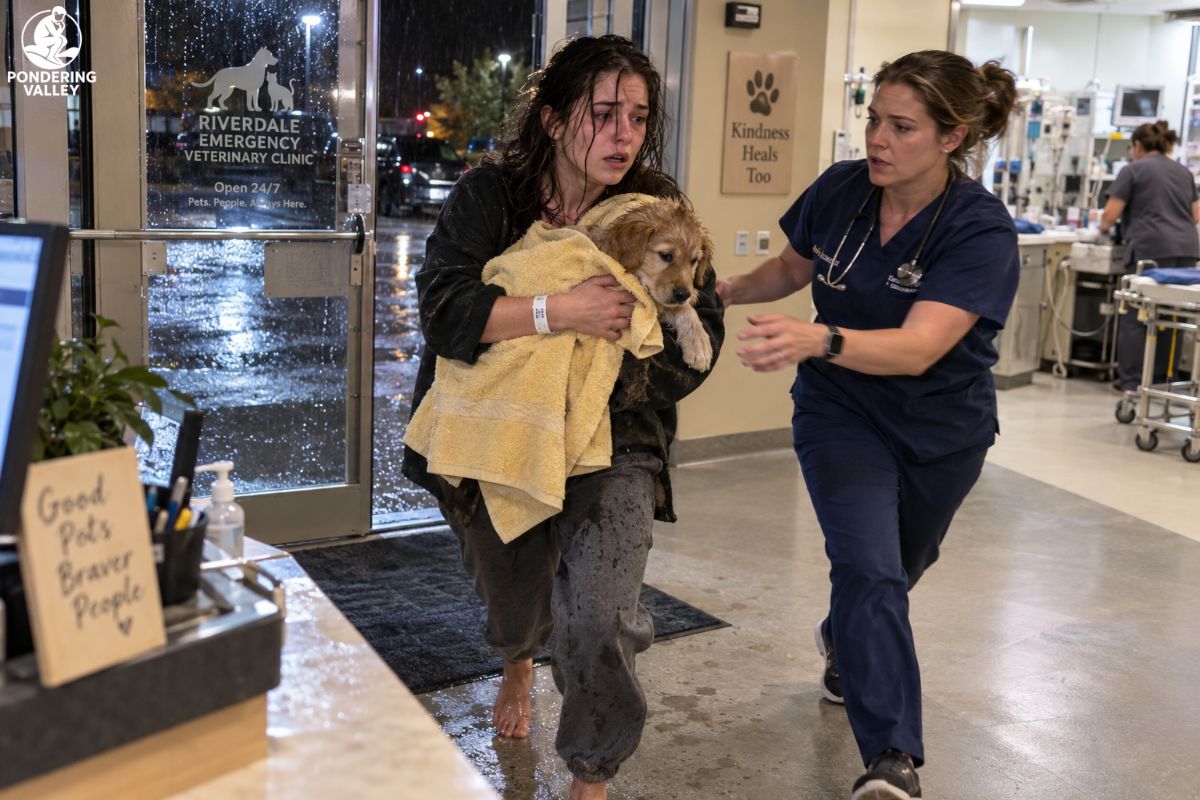
The doors of Cedar Hollow Emergency Animal Clinic flew open so hard that the little brass bell above them struck the glass.
“Please!”
The young woman standing in the doorway was barefoot.
Rainwater ran from her dark hair onto the shoulders of an oversized gray sweatshirt. One knee of her jeans was muddy. She was holding something wrapped against her chest in a yellow kitchen towel.
“Please, somebody help him!”
Dr. Hannah Brooks was halfway down the hall before the receptionist could stand up.
“What happened?”
“He stopped breathing in the car.”
The woman pulled back the towel.
A golden retriever puppy lay limp in her arms.
He was tiny—three months old at most—with floppy ears, wet fur, and the soft oversized paws of a dog that had not yet grown into himself.
His mouth hung slightly open.
His gums were frighteningly pale.
Hannah took him immediately.
“How long?”
“I don’t know. Two minutes? Three? I was driving. I kept talking to him. Milo, come on, baby, come on—”
“What was he doing before this?”
“Playing. He was playing in my kitchen and then he started coughing.”
Hannah turned toward the treatment room.
“Luis!”
A veterinary technician appeared from around the corner.
“One puppy. Severe respiratory distress. Get oxygen ready.”
The young woman followed.
Hannah stopped her at the swinging doors.
“I need you to wait here.”
“No.”
“I need room to work.”
“Please don’t make me leave him.”
“I’m not leaving him.”
Something in Hannah’s voice made the woman stop.
Hannah pushed through the doors with Milo in her arms.
Behind her, the young woman whispered one sentence.
“He’s all I have.”
Hannah heard it.
She just didn’t have time to understand it.
At 11:47 p.m., Cedar Hollow Emergency Animal Clinic had been nearly silent.
Outside, an autumn storm had rolled across southern Missouri, bending the maples along Main Street and knocking leaves against the clinic windows.
Inside, Connie Weller, the fifty-eight-year-old night receptionist, had been filling out insurance paperwork while Luis Ortega restocked syringes.
Hannah had been drinking coffee that had gone cold forty minutes earlier.
It had been an ordinary Wednesday night.
Then Emily Carter came through the door.
Hannah placed Milo on the table.
“Come on, little guy.”
She listened quickly to his chest, checked his mouth, and watched the weak movement of his ribs.
Something was blocking his airway.
“Light.”
Luis handed it to her.
Hannah opened the puppy’s mouth carefully.
“There.”
He could barely see it.
A dark rubber object was lodged deep in his throat.
Luis leaned closer.
“Toy?”
“Looks like it.”
Hannah reached for the proper instrument.
Milo’s heartbeat was already slowing.
“Stay with me.”
Luis glanced at the monitor.
“Hannah.”
“I see it.”
She adjusted her grip.
The rubber piece shifted.
For one terrible second, nothing happened.
Then Hannah pulled it free.
It hit the metal tray with a tiny, almost ridiculous sound.
A piece of blue rubber.
No bigger than the end of her thumb.
Milo still didn’t breathe normally.
“Come on.”
They gave him oxygen.
Luis rubbed his chest.
Hannah listened again.
The heartbeat was there.
Weak.
Fast.
Then slower.
Too slow.
“Come on, Milo.”
From the hallway came a muffled sob.
Emily was watching through the narrow glass window in the treatment-room door.
Connie stood beside her with one hand on her shoulder.
Hannah blocked everything else out.
She had learned to do that seventeen years earlier during her emergency residency in Kansas City.
You did not think about the family watching.
You did not think about how young the patient was.
You did not think about the bill.
You did not think about what happened if you failed.
You handled the next thirty seconds.
Then the next thirty.
Then the next.
Milo’s chest rose.
Once.
Stopped.
Rose again.
Luis looked at Hannah.
“Did you see that?”
“Yes.”
Another breath.
Then the puppy coughed.
It was weak and raspy.
But it was a cough.
His front paw twitched against the table.
Hannah let out the breath she had been holding.
“That’s it.”
Milo coughed again.
His eyelids fluttered.
Through the door, Emily covered her mouth with both hands.
She did not scream.
She did not rush in.
She simply leaned her forehead against the glass.
And cried without making a sound.
Twenty minutes later, Milo was lying inside an oxygen enclosure.
His breathing had improved, but not enough for Hannah to relax.
The immediate obstruction was gone.
The danger wasn’t.
“He inhaled some fluid or material while he was choking,” Hannah explained. “His lungs sound rough. I want to keep him here overnight on oxygen and monitor him closely.”
Emily sat on the edge of a plastic chair.
She had finally accepted a pair of paper shoe covers because her bare feet were leaving rainwater across the floor.
Now Hannah noticed how young she really was.
Twenty-three, twenty-four perhaps.
No makeup.
Red eyes.
Dark circles beneath them that looked older than the rest of her face.
Her sweatshirt sleeves covered most of her hands.
Around her right wrist was a hospital identification bracelet.
The plastic was bent and faded, as though she had been wearing it for days.
“Is he going to die?” Emily asked.
“I don’t know.”
The answer made Emily look up.
Hannah did not soften it.
“But he’s breathing on his own now. That matters. And you got him here quickly.”
“I almost didn’t.”
“What do you mean?”
“I thought maybe he had something stuck in his mouth. I tried to check. Then he fell over.”
Her voice broke.
“I couldn’t find my keys.”
Hannah waited.
“I couldn’t find my stupid keys.”
“You found them.”
“Eventually.”
“You brought him here.”
“But what if I’d been thirty seconds later?”
Hannah had heard versions of that question hundreds of times.
What if I had noticed sooner?
What if I had checked the gate?
What if I had put the medicine higher?
What if I hadn’t gone to work?
What if I had known?
She gave Emily the answer she gave everyone when it was true.
“You weren’t thirty seconds later.”
Emily looked down at her hands.
On the far side of the glass, Milo moved his head.
Emily stood immediately.
“Can he see me?”
“Probably.”
She walked to the enclosure.
“Hey, baby.”
Milo’s eyes opened a fraction.
His tail did not move.
He was too tired.
Emily placed two fingers against the clear door.
“You scared me.”
Hannah stepped away.
She was heading back to the treatment desk when Connie appeared with a clipboard.
Connie did not speak.
She simply held it out.
Hannah read the estimate.
Initial emergency stabilization.
Imaging.
Oxygen hospitalization.
Overnight monitoring.
Medications.
Possible additional procedures if Milo’s breathing deteriorated.
The low estimate was $2,180.
The high estimate was $3,460.
Hannah looked toward Emily.
Connie lowered her voice.
“She asked me how much.”
“And?”
“She has two hundred and nineteen dollars in her checking account.”
Hannah closed her eyes briefly.
“Credit?”
“Declined.”
“Care financing?”
“Declined.”
“Family?”
“She said no.”
Hannah looked again through the glass.
Emily was kneeling in front of Milo’s enclosure.
Still wearing the hospital bracelet.
Connie sighed.
“She asked whether we could just send him home now.”
“No.”
“I told her you’d need to discuss that.”
“He could crash again.”
“I know.”
Hannah stared at the estimate.
Then she noticed something on the intake form.
Owner: Emily Carter.
Patient: Milo Carter.
Age: 13 weeks.
Emergency contact:
Blank.
Hannah looked at Connie.
“She really put nobody?”
Connie shook her head.
“Wouldn’t even give me a second number.”
Emily did not argue when Hannah showed her the estimate.
That worried Hannah more than anger would have.
People yelled sometimes.
They accused clinics of caring only about money.
They demanded guarantees no doctor could give.
They cried.
They bargained.
Emily simply read the page.
Then she folded it in half.
“How soon can I take him?”
“You shouldn’t.”
“But I can?”
“Hospitals can’t imprison your dog. But medically, I strongly recommend he stay.”
“How much if I take him now?”
“Emily.”
“How much?”
“Tonight’s emergency care would still be several hundred dollars.”
She nodded.
“I can sell my laptop tomorrow.”
“That isn’t the issue.”
“I have a television too.”
“Stop.”
Emily looked at her.
Hannah pulled a chair over and sat across from her.
“If you take Milo home and his breathing worsens, you may not have enough warning to get him back here.”
Emily stared at the folded estimate.
“I don’t have three thousand dollars.”
“I understand.”
“No, you don’t.”
Hannah’s expression changed slightly.
Emily immediately looked ashamed.
“Sorry.”
“You don’t need to apologize.”
“I just…”
She rubbed the edge of the hospital bracelet with her thumb.
“I’ve had a bad week.”
Hannah looked at it.
“Were you in the hospital?”
Emily pulled her sleeve down.
“Doesn’t matter.”
“It might.”
“It doesn’t have anything to do with Milo.”
Hannah did not push.
Instead she said, “We have an emergency assistance fund.”
Emily looked up.
“It won’t necessarily cover everything.”
“No.”
“You haven’t even heard—”
“I said no.”
“Why?”
“Because somebody else probably needs it more.”
The answer irritated Hannah.
Not because Emily was wrong.
Because Hannah had heard that sentence from people who had spent their entire lives believing need was something other people were allowed to have.
“You have two hundred dollars.”
“Two nineteen.”
“And an animal who needs oxygen.”
Emily looked toward Milo.
“I’ll figure it out.”
“How?”
No answer.
“Emily.”
“I always figure it out.”
There was something sharp in the way she said it.
A practiced sentence.
A defensive sentence.
Hannah recognized those too.
Emily stood.
“Can you give me five minutes with him?”
“Of course.”
Hannah went to find Connie.
Cedar Hollow’s emergency assistance program was called Maggie’s Fund.
It had been started thirteen years earlier by the clinic’s founder, Dr. Owen Hale, after an elderly widower brought in a beagle named Maggie with a broken leg and tried to pay with an envelope full of twenty-dollar bills he had been saving for property taxes.
The fund was not unlimited.
That was the part people outside veterinary medicine rarely understood.
Compassion did not pay an oxygen supplier.
Kindness did not cover staff salaries.
And a clinic that said yes to everybody eventually became a clinic that could help nobody.
Maggie’s Fund had $4,870 remaining for the quarter.
Hannah knew because she sat on the committee.
She also knew three other cases had already been approved that month.
Connie folded her arms.
“She qualifies.”
“Probably.”
“Then why are you making that face?”
“I’m not making a face.”
“You’ve been making that face since 2009.”
Hannah looked at her.
Connie had worked at Cedar Hollow longer than anyone except Owen.
She had also reached an age where she treated hierarchy as a mild inconvenience.
“Something is off,” Hannah said.
“With Emily?”
“Yes.”
“Like what?”
“No emergency contact. No shoes. Hospital bracelet. Won’t call family. Won’t accept help.”
“That sounds less like something is off and more like somebody’s having a terrible week.”
Hannah leaned against the desk.
“I need Owen’s approval for anything above fifteen hundred.”
“He’s asleep.”
“He’s the owner.”
“You’re the doctor on duty.”
“And this clinic nearly closed two years ago.”
Connie’s voice softened.
“You still think that was your fault?”
Hannah looked away.
There it was.
The old wound.
Two years earlier, Hannah had approved treatment for far too many clients who promised to pay later.
Most meant it when they promised.
Some couldn’t.
A few vanished.
By December, the clinic was carrying nearly $90,000 in unpaid balances.
Owen had never blamed Hannah alone.
But Hannah had.
Since then, she had learned boundaries.
Estimates.
Deposits.
Forms.
Protocols.
She still cared.
She had simply learned that caring without limits could break the place where caring happened.
Connie tapped the clipboard.
“You don’t have to save everybody.”
“I know.”
“But you do have to decide about this one.”
Emily was sitting on the floor beside Milo’s enclosure when her phone began vibrating.
She looked at the screen.
Declined the call.
Twenty seconds later, it rang again.
She declined it again.
On the third call, Hannah happened to be standing nearby.
The screen showed:
NATE.
“You can take that.”
Emily turned the phone facedown.
“No.”
“Is Nate family?”
“My brother.”
“You said you didn’t have anyone to call.”
“I said I didn’t have anyone who could pay.”
“That’s different.”
Emily said nothing.
The phone buzzed again.
Hannah leaned against the counter.
“You know he’s going to keep calling.”
“That’s what he does.”
“Maybe he’s worried.”
“He likes fixing things.”
“That sounds useful tonight.”
“No, it isn’t.”
Milo shifted inside the enclosure.
Emily moved closer.
Her phone rang again.
This time she answered.
“What?”
A man’s voice was loud enough that Hannah heard the tone but not the words.
“I’m fine.”
More words.
“No.”
Pause.
“Nate, don’t.”
Longer pause.
“I said don’t come here.”
Emily hung up.
Hannah raised an eyebrow.
“He coming?”
“Yes.”
“Good.”
“It’s not good.”
“Why?”
Emily stood.
“Because my brother thinks everything gets better if you put it in a box, label it, and move it somewhere else.”
Hannah waited.
Emily’s eyes flashed.
“Our mother died six days ago.”
The clinic seemed to become quieter.
Emily looked down at the bracelet.
“I was discharged three days ago.”
Hannah stared at her.
Emily pulled the plastic band out from beneath her sleeve.
Her name was printed across it.
EMILY CARTER.
“I collapsed at the hospital the night Mom died. Dehydration. Exhaustion. Apparently you can forget to eat for two days if nobody makes you.”
Her laugh contained no humor.
“They kept me overnight.”
Hannah glanced toward Milo.
Emily followed her eyes.
“He was supposed to be the thing I came home to.”
Hannah said nothing.
Emily’s mouth tightened.
“My mother gave me Milo.”
Linda Carter had been fifty-seven years old when doctors told her the treatments were no longer working.
Emily told Hannah this slowly, in pieces, while they waited for Nate.
Linda had been a bookkeeper for a plumbing company for almost twenty-nine years.
She loved crossword puzzles, black coffee, thrift stores, and telling grocery cashiers when they had accidentally undercharged her.
She had raised Emily and Nate mostly by herself after their father left when Emily was nine.
“She wasn’t dramatic,” Emily said.
“What do you mean?”
“She hated dramatic goodbyes. If you cried too much around her, she’d ask whether you were planning to flood the room.”
Despite herself, Hannah smiled.
Emily noticed.
“She would’ve liked you.”
“You don’t know me.”
“You told me the truth when I asked if Milo was going to die.”
“That’s a low standard.”
“Not lately.”
Milo coughed softly inside the oxygen enclosure.
Emily flinched.
Hannah looked at his monitor.
Still stable.
“When did your mother give you Milo?”
“Three weeks ago.”
“She was still alive?”
Emily nodded.
“She was home then. We had hospice coming in.”
Hannah sat beside her.
“I came back from the grocery store and there was this cardboard box in the living room.”
“A puppy in a box?”
“No. Milo had already escaped.”
That almost produced another smile.
“He was chewing Mom’s slipper.”
“What did she say?”
“She said, ‘I ordered you a problem.’”
Hannah laughed quietly.
Emily did too.
For two seconds she sounded twenty-four.
Then grief returned to her face.
“I told her it was a terrible idea.”
“Was it?”
“Yes.”
“Why?”
“I was taking care of her. I hadn’t been to work in almost a month. I had bills. The house was a mess. She could barely get from the bedroom to the living room.”
Emily touched the bracelet again.
“I was angry.”
“At her?”
“Yes.”
The admission seemed to cost her.
“I told my dying mother she was irresponsible for buying me a puppy.”
Hannah looked through the glass.
Milo had fallen asleep.
“You were exhausted.”
“That doesn’t make it okay.”
“No.”
Emily looked surprised.
Most people, Hannah knew, rushed too quickly to forgive grieving people.
Sometimes grief needed mercy.
Sometimes it needed honesty.
Often it needed both.
“What did she say?” Hannah asked.
Emily swallowed.
“She said, ‘Good. Now there’ll be somebody in this house more stubborn than you.’”
Hannah smiled.
“And then?”
“She told me I’d need somebody waiting for me when I came home.”
The words stayed between them.
Emily looked toward Milo.
“I didn’t understand what she meant.”
Nate Carter arrived at 12:38 a.m.
He came through the clinic doors wearing work boots, a navy jacket, and the expression of a man who had been angry all the way across town because anger was easier to manage than fear.
He was thirty-one.
Tall.
Broad-shouldered.
Rain on his glasses.
“What happened?”
Emily stood.
“I told you not to come.”
“And I ignored you.”
“Obviously.”
Nate looked toward Milo.
His anger disappeared.
“Oh, God.”
“He’s stable right now,” Hannah said.
Nate turned to her.
“You the vet?”
“Dr. Hannah Brooks.”
“What does he need?”
“Overnight oxygen and monitoring.”
“How much?”
Emily stepped between them.
“No.”
Nate stared at her.
“I asked the doctor.”
“And I said no.”
“You called me four hours ago because you couldn’t figure out how to reset Mom’s thermostat.”
“That was different.”
“You don’t have to do this alone.”
“I’m not doing anything.”
“You’re barefoot in an emergency vet at one in the morning.”
Emily looked down at the paper coverings over her feet.
“I had socks when I left.”
“Great. That clears it up.”
“Nate.”
“What?”
“Don’t.”
He removed his glasses and wiped rain from them with his shirt.
Hannah watched.
Brother and sister.
Same exhausted eyes.
Different methods of surviving.
Nate noticed the estimate on the chair and picked it up.
Emily grabbed it.
“No.”
He stared at her.
“Why are you acting like this?”
“Because I don’t need you to fix it.”
“I’m not trying to fix it.”
“You’ve been trying to fix me for six days.”
“I’m trying to keep you from falling apart.”
“I’m not falling apart.”
Nate looked at the hospital bracelet.
Neither of them spoke.
The silence said enough.
Then Nate noticed Milo again.
“What did he swallow?”
Hannah showed him the blue rubber piece inside a specimen cup.
Nate’s face changed.
He picked it up.
Emily saw his expression.
“What?”
Nate turned it in his hand.
“That’s from Lucy’s toy.”
Emily went still.
“What?”
“The stacking rings. The blue one cracked last week.”
Lucy was Nate’s four-year-old daughter.
“She had it at Mom’s house yesterday,” he said.
Emily stared at him.
“You brought that over?”
“She brought toys while we were packing.”
“You were packing.”
“We were helping.”
“I told you not to touch Mom’s things.”
“Emily—”
“I told you.”
“It was a toy.”
“It was in my kitchen because you brought your whole family into Mom’s house and started putting her life into boxes before she’d been gone a week.”
“That is not what happened.”
Milo coughed again.
Emily turned toward him immediately.
Nate lowered his voice.
“I’m sorry about the toy.”
“You should go.”
“I’m not leaving.”
“Then I will.”
Hannah stepped between them.
“No.”
Both looked at her.
“Milo stays.”
Emily’s face hardened.
“I haven’t agreed to that.”
“I know.”
“You said I could take him.”
“I said legally I couldn’t stop you. Medically, I’m telling you again that taking him home tonight could be dangerous.”
Nate pulled out his wallet.
“I’ll pay.”
Emily spun around.
“No.”
“Would you stop saying that?”
“I don’t want your money.”
“It isn’t my money.”
She froze.
Nate looked at her.
“It’s Mom’s.”
For the first time that night, Emily looked genuinely angry.
“Don’t.”
“There’s money in the household account.”
“That’s for the mortgage and utilities.”
“There’s enough.”
“No.”
“Emily.”
“No.”
Nate exhaled.
“You know what Mom told me two weeks ago?”
“I don’t care.”
“She said if you ever needed help after she was gone, you would turn it into a courtroom argument.”
Emily’s face changed.
“That sounds like her.”
“It does.”
“Then maybe you should’ve listened when she told you not to push me.”
Nate looked down.
That one landed.
Hannah moved away.
Some conversations did not need a veterinarian.
Connie brought Nate coffee.
He accepted it, although he never drank it.
After several minutes, he sat beside his sister.
Emily remained standing.
“You think I wanted to pack the house?” Nate asked.
“You started the morning after the funeral.”
“I started with the medical equipment because the company was coming to pick it up.”
“You boxed her sweaters.”
“Because you were sleeping in them.”
Emily looked at him.
Nate’s voice softened.
“You were wearing Mom’s clothes and sleeping on the couch because you wouldn’t go into your own bedroom.”
“That wasn’t your business.”
“You’re my sister.”
“That doesn’t make everything your business.”
“No. But you disappearing does.”
“I didn’t disappear.”
“You stopped answering everybody.”
“I was busy.”
“With what?”
Emily pointed at Milo.
“With him.”
Nate looked toward the puppy.
Something complicated passed over his face.
Hannah saw guilt there.
But not resentment.
“Em,” he said quietly, “I don’t want you to get rid of the dog.”
Emily frowned.
“You said he was too much.”
“I said you were exhausted.”
“You said Mom had no business buying him.”
“I was angry at Mom.”
That surprised her.
Nate stared at the untouched coffee in his hands.
“She got to make plans with you.”
Emily’s expression shifted.
“What?”
“You were there every day. You heard everything she wanted. Funeral songs. Which dishes went to Aunt Beth. What to do with the house.”
“You could’ve come more.”
“I was working.”
“You always say that.”
“Because I was.”
His voice sharpened, then lowered again.
“I have Lucy. I have a mortgage. I have twelve guys on my crew who don’t get paid if jobs don’t get finished. I couldn’t sit beside Mom every afternoon.”
“I didn’t ask you to.”
“No. You just made sure I felt guilty for not doing it.”
Emily opened her mouth.
Stopped.
Nate looked toward the floor.
“I was jealous of you.”
That was not what Emily expected.
Nate continued.
“I hated that you got all that time.”
Emily’s face crumpled for one second before she controlled it.
“You think I wanted it?”
“No.”
“You think watching her get weaker was some privilege?”
“No.”
“You think I wouldn’t have traded every conversation to have her healthy and yelling at both of us?”
“No, Emily.”
“Then don’t tell me you were jealous.”
“I was.”
His voice remained calm.
“And I hated myself for it.”
That ended the argument.
Not because either sibling had won.
Because grief had finally said its real name.
At 1:26 a.m., Milo’s oxygen level dipped.
Hannah moved quickly.
Emily stood outside the treatment room again.
This time Nate stood beside her.
No argument.
No money.
No boxes.
Just two siblings staring through glass.
Luis adjusted the oxygen flow while Hannah listened to Milo’s lungs.
His breathing sounded worse.
They took chest images.
The results showed inflammation consistent with aspiration.
Not catastrophic.
Not harmless.
“He needs time,” Hannah told them.
“How much?” Emily asked.
“Possibly twenty-four to forty-eight hours.”
Emily closed her eyes.
Nate reached toward her.
Stopped before touching her.
Hannah noticed.
Emily noticed too.
After a moment, she reached for his hand herself.
It was the first thing she had accepted all night.
At 2:10 a.m., Owen Hale answered his phone.
He was sixty-six and semi-retired, though everyone at Cedar Hollow knew “semi-retired” meant he worked four days a week instead of six.
Hannah explained Milo’s case.
Then the finances.
Then Emily.
Owen was quiet.
“How much are you asking Maggie’s Fund to cover?”
“Up to twenty-two hundred.”
“That’s nearly half what’s left this quarter.”
“I know.”
“We’ve got three weeks left.”
“I know.”
“Any contribution from the owner?”
“She can pay two hundred. Her brother offered more.”
“Then why isn’t he paying?”
“Family complications.”
Owen sighed.
“We’re an animal hospital, Hannah. Not family court.”
“I know.”
“You always say you know when you’re about to ignore something I’ve said.”
Hannah looked through the office window.
Emily and Nate sat side by side.
A chair between them.
Not touching now.
But no longer fighting.
“Do you remember what you told me after Maggie’s Fund almost went under?” Hannah asked.
Owen was silent.
“You said compassion needed structure.”
“It does.”
“You also said structure wasn’t supposed to become an excuse.”
Another silence.
“You really want this one?”
“Yes.”
“Why?”
Hannah looked at the hospital bracelet on Emily’s wrist.
Then at Milo sleeping under oxygen.
“Because she came through the door before she knew how she was going to pay.”
“That happens every week.”
“She came anyway.”
Owen exhaled.
“Approve fifteen hundred from Maggie’s Fund. We’ll convert the remainder to a no-interest payment plan if the family can handle it.”
“Thank you.”
“Hannah?”
“Yes?”
“You don’t get to personally absorb the balance.”
She almost smiled.
“I wasn’t going to.”
“You were thinking about it.”
“I’m hanging up now.”
“Hannah.”
“What?”
“You can help people without proving you’re willing to drown with them.”
The line went quiet.
Hannah stared at the phone after he disconnected.
That sentence had not been meant for Emily.
It had been meant for her.
Emily resisted the assistance fund for another twelve minutes.
Then Hannah became impatient.
“This is not charity.”
“What is it, then?”
“A community fund.”
“That sounds like charity.”
“It’s money donated for emergencies involving animals whose families cannot afford immediate care.”
Emily folded her arms.
“That’s exactly what charity is.”
“Fine. Then accept charity.”
Nate almost smiled.
Emily glared at him.
Hannah continued.
“One day you may donate to it.”
Emily looked at her.
“One day you may help someone else. Or maybe you won’t. Help is not a bank loan from the universe. You don’t have to earn tonight before you’re allowed to receive it.”
Emily looked away.
Hannah lowered her voice.
“Your puppy needs oxygen more than your pride needs protection.”
That did it.
Emily signed.
Her signature shook.
When she put down the pen, she looked ashamed.
Hannah pushed the paperwork aside.
“Don’t.”
“Don’t what?”
“Make accepting help the worst thing you did tonight.”
Emily looked at her.
“What was the worst thing?”
“Driving barefoot in a thunderstorm.”
Nate laughed.
Emily tried not to.
Failed.
It was a tiny sound.
But it changed the room.
At three in the morning, Cedar Hollow became quiet again.
Nate left briefly to check on Lucy, who was sleeping at his mother-in-law’s house.
Emily refused to leave.
Connie found her a blanket.
Luis brought her crackers.
She ate two.
Hannah checked Milo every twenty minutes.
At 3:42, she found Emily asleep sitting upright, chin against her chest.
The hospital bracelet showed beneath the blanket.
Hannah stared at it longer than she meant to.
Seventeen years in emergency medicine had taught her that people often carried the strangest things after losing someone.
Voicemails.
Receipts.
Old sweaters.
Medication lists.
A grocery list written in familiar handwriting.
One man had kept his wife’s final parking stub in his wallet for six years because it proved there had once been a normal Tuesday before everything changed.
Grief could turn trash into treasure.
Hannah understood that more than she usually admitted.
Her own father had died nine years earlier.
She still had his last voicemail.
It contained nothing profound.
“Hannah, it’s Dad. Your mother says you left your good casserole dish here. Call when you get a chance.”
She had never deleted it.
Not because of what he said.
Because his voice existed in it.
At 4:03, Emily woke suddenly.
“Milo?”
“Stable.”
She looked embarrassed.
“I fell asleep.”
“That’s generally considered useful.”
Emily sat straighter.
Then she noticed Hannah looking at her bracelet.
“I should take this thing off.”
“You don’t have to.”
“It’s gross.”
“That wasn’t a medical recommendation.”
Emily rubbed the plastic band.
“Mom held this.”
Hannah waited.
“When I collapsed at the hospital, they put me in a bed downstairs.”
Emily stared at the bracelet.
“I kept trying to get back upstairs.”
“To your mother?”
She nodded.
“A nurse finally took me back in a wheelchair.”
Emily swallowed.
“Mom was barely awake.”
Her thumb moved across her printed name.
“She reached over and touched this bracelet.”
Hannah said nothing.
“She said, ‘Now you’re the patient for once.’”
A faint smile appeared.
“She was always complaining that I took care of everybody except myself.”
“What did you say?”
“I told her she was annoying.”
“Reasonable.”
Emily laughed once.
“Then she fell asleep.”
Her voice grew softer.
“She never really woke up again.”
Hannah sat beside her.
“That’s why you kept the bracelet.”
“I know it sounds stupid.”
“No.”
“I keep thinking if I take it off…”
Emily stopped.
Hannah understood.
“So don’t take it off yet.”
Emily looked relieved.
People sometimes needed permission for strange things.
Especially grief.
The sun came up behind gray clouds.
At seven, the storm moved east.
Milo’s breathing was still labored, but improving.
By nine, Hannah allowed Emily to sit beside the oxygen enclosure while he ate a small amount of food.
He managed three bites.
Emily treated each bite like a victory.
At 9:17, Nate returned carrying a backpack, shoes, clean clothes, and Emily’s phone charger.
He placed everything beside her.
“You brought my shoes?”
“You’re welcome.”
“I had shoes yesterday.”
“So I’ve heard.”
He also brought a white envelope.
Emily saw it.
Her expression changed.
“Where did you get that?”
“Mom’s desk.”
“I told you not to go through her desk.”
“I didn’t.”
“Then how—”
“It was on top.”
Emily looked at the writing.
Her mother’s handwriting.
For Emily.
She did not touch it.
Nate placed it on the chair between them.
“She told me about it.”
“When?”
“Three days before she died.”
Emily stared at him.
“And you didn’t give it to me?”
“You were in the hospital.”
“I’ve been home three days.”
“I know.”
“Why didn’t you give it to me?”
“Because you wouldn’t open the door.”
That silenced her.
“I left groceries twice,” Nate continued. “You texted me to put them on the porch.”
“I wasn’t ready.”
“I know.”
“No, you don’t.”
“You’re right.”
Nate sat down.
“I don’t.”
The envelope stayed between them.
Finally Emily picked it up.
She did not open it.
Not yet.
“What did she say about it?”
“Just that it was yours.”
“Did you read it?”
“No.”
“Really?”
“Yes, Emily.”
She studied his face.
Then put the envelope in her sweatshirt pocket.
By that afternoon, Milo was breathing without supplemental oxygen for short periods.
Luis carried him out wrapped in a towel while the enclosure was cleaned.
Emily stood.
“Can I?”
Luis smiled.
“Sit first.”
She sat.
He placed Milo carefully in her lap.
The puppy looked smaller than ever.
But alive.
His eyes opened.
His nose moved.
Then his tail tapped once against Emily’s thigh.
She stopped breathing.
“Milo.”
Another weak tap.
Emily lowered her face toward him.
“Hey, baby.”
Milo licked the bottom of her chin.
That was when she cried.
Not loudly.
She simply bent over him, one hand covering the back of his tiny body.
Nate turned away.
Connie pretended to organize forms.
Luis suddenly became very interested in the towel cabinet.
Hannah stood in the doorway.
Emily looked at her.
“Thank you.”
Hannah shook her head.
“He’s not ready to go home yet.”
“I know.”
“You got him here.”
“You saved him.”
“We both did our parts.”
Emily looked down at Milo.
For the first time since midnight, she seemed to believe there might actually be a tomorrow.
Then her hand went to the envelope in her pocket.
She opened it at 5:16 that afternoon.
Nate was getting coffee.
Hannah was checking Milo.
Emily sat alone near the window.
Inside the envelope were two sheets of lined notebook paper.
No money.
No legal documents.
No grand secret.
Just Linda Carter’s handwriting.
Emily read the first line.
Then stopped.
She pressed the page against her chest.
Hannah saw her from across the room.
She almost walked away.
Then Emily said, “Dr. Brooks?”
Hannah came over.
Emily held out the paper.
“I can’t finish it.”
“You don’t have to.”
“Would you?”
Hannah hesitated.
“This is from your mother.”
“I know.”
“You sure?”
Emily nodded.
Hannah sat.
The letter began without ceremony.
Emily,
If you’re reading this, your brother finally found a way to get you to open an envelope. Please congratulate him. It may be his greatest achievement.
Emily laughed through her tears.
Hannah continued.
I know you’re mad about the puppy.
You were right about some of it. He is expensive. He will chew things. He will wake you up when you don’t want to get out of bed. He will probably ruin at least one thing you love.
That is part of why I chose him.
Emily covered her mouth.
Hannah kept reading.
You have spent too many years believing love means being useful.
You helped me with appointments. Medicine. Laundry. Bills. Food. You learned things no twenty-four-year-old should have needed to learn because you wanted to make things easier for me.
You did.
But somewhere along the way, you started believing you had to earn your place in a room by taking care of everyone in it.
I need you to stop.
Hannah’s voice softened.
Milo does not need you to be impressive.
He will not care whether the dishes are done.
He will not care whether you answered every email or made everybody happy.
He will care that you come home.
Emily bent forward.
The hospital bracelet slid down her wrist.
Hannah continued.
There will be mornings after I’m gone when this house feels too quiet.
On those mornings, he will need breakfast.
There will be afternoons when you don’t want to talk to anybody.
He will still need a walk.
There will be nights when you think there is nothing waiting for you.
He will be.
That is why I bought you a dog.
Not so you would have one more thing to take care of.
So you would finally have something that reminds you to take care of yourself too.
Hannah stopped.
There was one paragraph left.
Emily whispered, “Keep going.”
And forgive your brother.
He is going to become unbearable after I die.
This will happen because he loves you and because he is frightened.
Nate had returned.
He stood several feet away holding two coffees.
Hannah looked at him.
Emily turned.
Nate closed his eyes.
“Of course she wrote that.”
Emily laughed.
A real laugh this time.
Hannah read the final lines.
Let him help even when he does it badly.
And when you are ready, take off the hospital bracelet.
You do not have to keep hurting in order to prove that you loved me.
Love,
Mom
Nobody spoke.
Emily looked at her wrist.
For six days, the bracelet had felt like proof.
Proof that she had been there.
Proof that her mother had touched her.
Proof that there had been a final night.
Now, for the first time, it felt different.
Not less important.
Just heavier.
Nate sat beside her.
“I didn’t know what she wrote.”
Emily stared at the letter.
“She knew us pretty well.”
“Unfortunately.”
Emily handed him the second page.
He read it.
Halfway through, he removed his glasses.
Not because he was crying, Hannah thought.
Though he was.
He simply had the habit of removing his glasses whenever he needed a few seconds before answering.
Emily watched him.
“I’m sorry,” she said.
“For what?”
“The funeral.”
Nate looked confused.
“I made every decision.”
“You were the one who knew what she wanted.”
“I never asked you.”
He looked down.
“I should’ve been there more.”
“You were there.”
“Not like you.”
“Nate.”
He looked at her.
“You had Lucy. You had work. Mom knew you loved her.”
“I know.”
“Do you?”
He did not answer.
Emily reached for his hand.
It was the second time in less than a day.
This time he took it immediately.
Milo stayed another night.
Emily went home.
That was Hannah’s condition.
“Sleep in a bed.”
“I can sleep here.”
“No.”
“I’ll be fine.”
“That phrase has lost credibility.”
Nate volunteered to drive her.
Emily almost refused.
Then she looked at her mother’s letter.
“Okay.”
At the door, she turned back.
“Call me if anything changes.”
“We will.”
“Even if it’s two in the morning.”
“Yes.”
“Even if—”
“Emily.”
She stopped.
“He’s safe here.”
Emily nodded.
Then left.
Hannah watched her walk across the parking lot wearing the shoes Nate had brought.
The hospital bracelet was still on her wrist.
The Carter house looked different after midnight.
Emily had lived there since she was nine.
A small white house with green shutters, a maple tree in front, and a porch her mother insisted on repainting every three summers whether it needed it or not.
For the last year, medical equipment had occupied part of the living room.
Now it was gone.
The empty spaces seemed louder than the equipment ever had.
Nate stood in the doorway.
“You want me to stay?”
Emily almost said no.
Instead she said, “For a little while.”
They sat at the kitchen table.
A plastic bin rested beside the wall.
MEDICAL, Nate had written across the top.
Emily stared at it.
“You really do label everything.”
“I told you.”
“You labeled a box ‘miscellaneous.’”
“It was accurately labeled.”
She smiled.
On the floor beneath the table sat Lucy’s toy basket.
Emily saw the stacking rings.
Red.
Yellow.
Green.
No blue.
Her stomach tightened.
Nate saw what she was looking at.
“Don’t.”
“What?”
“Start blaming yourself.”
“I should’ve cleaned under the table.”
“You had just buried Mom.”
“Milo could’ve died.”
“Yes.”
The word hurt.
Nate did not take it back.
Then he said, “And Lucy could’ve dropped that piece at my house. Or a hundred other things could happen tomorrow. You can’t make the world completely safe.”
Emily stared at the missing blue ring.
“How do you have a kid?”
“What?”
“How do you stand it?”
Nate laughed quietly.
“Badly.”
“I’m serious.”
“So am I.”
He leaned back.
“You check the outlets. You cut grapes. You lock cabinets. You lie awake wondering whether the fever is too high. Then one day they climb a bookshelf while you’re standing three feet away.”
“That happened?”
“Twice.”
Emily almost smiled.
“You do what you can,” Nate said. “Then you forgive yourself for being human.”
Emily looked toward the empty living room.
“Mom wasn’t very good at that.”
“No.”
“Neither am I.”
“I noticed.”
They sat there for a while.
Then Emily said, “Don’t pack her bedroom yet.”
“I won’t.”
“But we can do the kitchen tomorrow.”
Nate looked at her.
“Together?”
“Together.”
He nodded.
It was not reconciliation.
Not completely.
There were years between them that one conversation could not repair.
But it was a beginning.
Sometimes that was all families got.
Sometimes it was enough.
Milo came home Friday afternoon.
He walked out of Cedar Hollow wearing a small green harness and the expression of a puppy mildly offended by the entire institution of medicine.
His tail worked perfectly now.
Emily knelt.
Milo launched himself the last two feet into her arms.
“Easy,” Hannah warned.
Emily laughed.
“I know.”
Nate stood behind her carrying the medication instructions.
Connie had written feeding times in large letters.
Luis had drawn a tiny paw print at the bottom.
The bill had been reduced through Maggie’s Fund.
Nate paid part.
Emily paid her $219.
The rest went onto a manageable payment plan.
She insisted on paying something every month.
Hannah did not argue.
Before leaving, Emily stopped at the reception desk.
“Can I ask something?”
Connie looked up.
“Sure.”
“When I’m working again… can I donate to Maggie’s Fund?”
Connie smiled.
“You can.”
“Even if it’s small?”
“Especially if it’s small.”
Emily nodded.
Then she looked at Hannah.
“My mom would’ve liked that.”
Hannah leaned against the counter.
“Your mother sounds difficult.”
Emily smiled.
“She was.”
“Those are often the memorable ones.”
Emily looked down at Milo.
“He ruined one of her slippers.”
“So the letter was accurate.”
“Apparently.”
She started toward the door.
Then stopped.
“Dr. Brooks?”
“Yes?”
“When I came in…”
Hannah waited.
“I said he was all I had.”
“I remember.”
Emily glanced at Nate.
He was standing beside the door, pretending not to listen.
“I was wrong.”
Nate looked at her.
Neither sibling said anything.
They didn’t need to.
Three weeks later, a plain white envelope arrived at Cedar Hollow.
Inside was a twenty-dollar bill.
And a note.
For Maggie’s Fund.
It isn’t much yet.
—Emily & Milo
Connie taped the note inside the staff cabinet.
Hannah told her that was unnecessary.
Connie ignored her.
The following month another envelope arrived.
Twenty dollars.
Then another.
Some months it was ten.
Once it was only five.
In January, Emily found part-time work at a local accounting office.
In February, she increased the donation to twenty-five.
Hannah noticed every time.
She never mentioned it.
Grief did not leave Emily because Milo survived.
That was not how grief worked.
There were mornings she woke and reached for her phone before remembering there was nobody to text about what groceries they needed.
There were afternoons when she heard a woman laugh in a store and turned too quickly.
There were nights when the house still seemed impossibly large.
Milo did not cure any of that.
He chewed two shoes.
He knocked over a floor lamp.
He developed a passionate dislike of the vacuum cleaner.
He once dragged an entire roll of toilet paper from the bathroom into the living room and sat proudly in the middle of it.
He needed breakfast.
He needed walks.
He needed vaccinations.
He needed to go outside at inconvenient times.
He needed Emily to come home.
And slowly, almost without noticing, Emily began coming home to a life rather than an absence.
Nate and Lucy visited every Sunday.
At first Emily watched Lucy obsessively around Milo, picking up every toy the moment it touched the floor.
Then one afternoon Lucy dropped a plastic block.
Milo ran toward it.
Emily intercepted him.
Her heart raced.
Nate noticed.
“You okay?”
Emily looked at the block.
Then at Milo.
Then at her brother.
“Yeah.”
She put the block in a basket.
“I’m okay.”
This time she meant it.
Six months after the emergency, Emily returned to Cedar Hollow.
Milo was no longer a tiny golden bundle.
He had become a lanky, cheerful teenager with paws too large for his legs and a tail capable of clearing a coffee table.
Connie heard him before she saw him.
“Milo Carter!”
His entire body seemed to wag.
Emily laughed as he pulled toward the desk.
“He remembers you.”
“He remembers the treats.”
“That too.”
Hannah came out of an exam room.
Milo immediately tried to jump on her.
“Absolutely not.”
He sat.
For approximately half a second.
Then jumped anyway.
Hannah crouched and scratched his ears.
“You look different.”
Emily smiled.
“So does he.”
“I meant you.”
Emily’s hair was shorter.
She looked rested.
Not perfectly.
Just more present.
Then Hannah noticed her wrist.
The hospital bracelet was gone.
Emily saw her looking.
“I took it off.”
“When?”
“Mom’s birthday.”
Hannah stood.
“What did you do with it?”
“For a while I carried it in my purse.”
She smiled.
“Which is probably not much healthier.”
“No judgment.”
“Then I put it in a box with her letter.”
Hannah nodded.
Emily looked down at Milo.
“I thought taking it off would feel like losing something.”
“Did it?”
“For about ten minutes.”
“And after?”
Emily considered the question.
“After that, my wrist just felt lighter.”
Milo leaned against her leg.
Emily rested one hand on his head.
“I still miss her.”
“I know.”
“I think I always will.”
“Probably.”
Emily smiled.
“You really never lie to people, do you?”
“I try not to.”
“That’s why Mom would’ve liked you.”
They stood quietly for a moment.
Then Emily reached into her bag.
She handed Hannah an envelope.
“For the fund.”
Hannah opened it.
Inside was a check for $500.
She looked up.
“Emily.”
“I got promoted.”
“You don’t have to—”
“I know.”
That mattered.
Emily smiled.
“I know I don’t have to.”
Hannah looked at the check again.
“Then thank you.”
Emily crouched beside Milo.
“There’s one condition.”
Hannah raised an eyebrow.
“Oh?”
“If some terrified idiot comes through those doors barefoot at midnight and says she’ll figure everything out herself…”
Connie laughed from the desk.
Emily continued.
“…tell her somebody already helped pay.”
Hannah looked at her.
“Deal.”
That evening, after the clinic closed, Hannah found Connie replacing Emily’s old twenty-dollar note inside the staff cabinet.
She had added the new check copy beneath it.
“You’re sentimental,” Hannah said.
“At my age, it’s called institutional memory.”
Hannah smiled.
She looked at the first note.
It isn’t much yet.
—Emily & Milo
“Leave that one,” Hannah said.
Connie glanced at her.
“I planned to.”
Hannah stood there another moment.
Then reached for her phone.
She scrolled through old messages until she found the voicemail she had saved for nine years.
Dad.
She had listened to it hundreds of times.
Tonight she did not.
Instead, she opened a drawer in her office and placed the phone down.
Not deleting the message.
Not letting go of her father.
Just leaving it where it belonged.
In the past.
Still loved.
Still real.
But no longer something she needed to touch every day to prove it had happened.
A year after the night Milo nearly died, Emily drove past Cedar Hollow during another autumn storm.
Milo sat in the passenger seat wearing a harness.
He was seventy pounds now.
Healthy.
Happy.
Completely unaware that he had once fit inside a yellow kitchen towel.
Emily slowed near the clinic.
For a moment she remembered that night exactly as it had been.
The rain.
Her bare feet.
The doors flying open.
Milo limp in her arms.
Her own voice screaming for somebody to help him.
She remembered believing that if he died, the final piece of her mother would disappear too.
She knew better now.
Her mother was not inside the puppy.
She was not inside the hospital bracelet.
She was not inside the house or the slippers or the handwriting on the letter.
Those things mattered.
But Linda Carter had left something harder to lose.
She had left instructions for living hidden inside an act of love Emily had originally mistaken for irresponsibility.
The puppy had never been meant to replace her mother.
He had been meant to outlast the silence.
Emily reached across the console.
Milo put one enormous paw in her hand.
The traffic light turned green.
“All right,” she said. “Let’s go home.”
His tail thumped against the seat.
And Emily drove on.
Because her mother had been right.
Someone was waiting for her to come home.
And, finally, Emily understood that she was one of them.
Thank you so much for reading this story!
I’d really love to hear your comments and thoughts about this story — your feedback is truly valuable and helps us a lot.
Please leave a comment and share this Facebook post to support the author. Every reaction and review makes a big difference!
This story is a work of fiction created for entertainment and inspirational purposes. While it may draw on real-world themes, all characters, names, and events are imagined. Any resemblance to actual people or situations is purely coincidental.