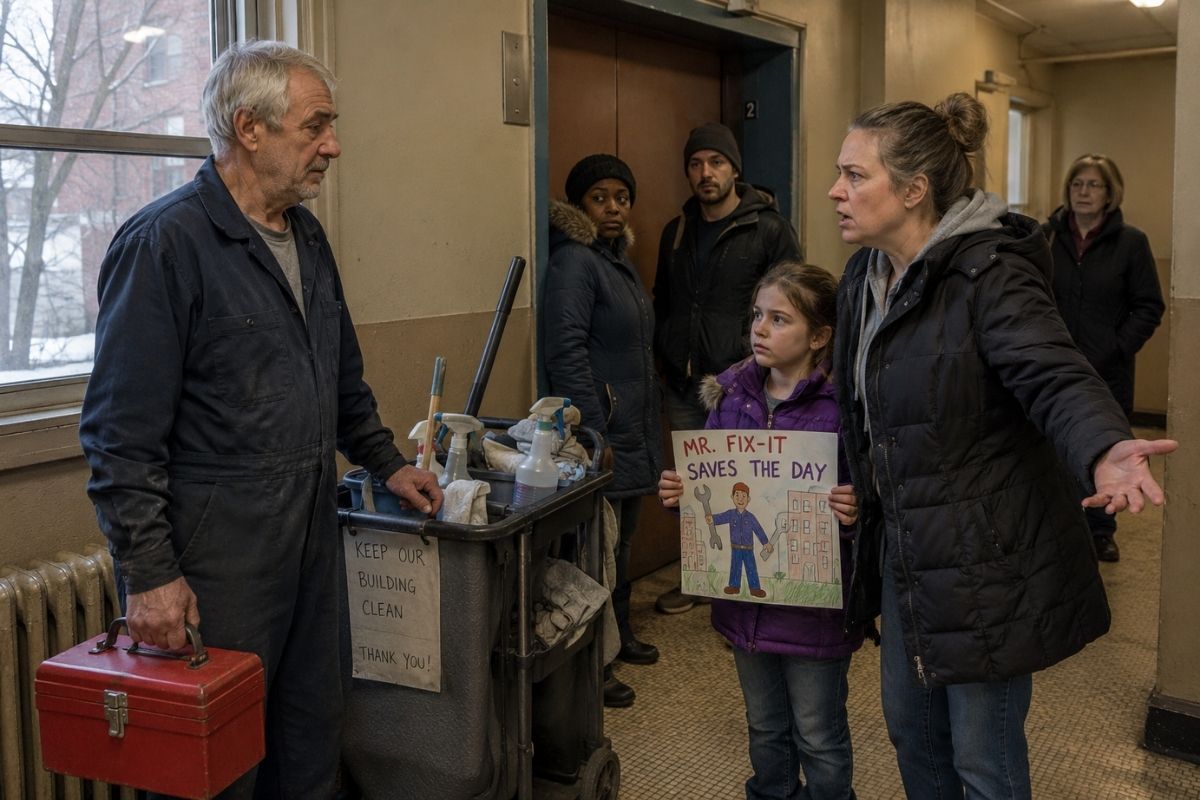
“Stay away from my daughter.”
Dana Kirkland said it loudly enough that three people waiting for the elevator turned to look.
Morris Vale stopped beside his gray maintenance cart, one hand resting on the handle of a battered red toolbox.
At sixty-four, Morris had the kind of face people often mistook for anger. Deep lines ran from his nose to the corners of his mouth. His silver hair was clipped short. His shoulders had begun to slope after four decades of lifting things heavier than anyone should lift alone.
He looked at Dana.
Then at the nine-year-old girl standing behind her.
Maya was holding a sheet of construction paper.
She had drawn Morris wearing an enormous tool belt and holding a wrench almost as tall as he was.
Across the top she had written in purple marker:
MR. FIX-IT SAVES THE DAY
Morris’s expression changed for less than a second.
Dana saw it anyway.
Something softened behind his eyes.
Then it disappeared.
“She wasn’t bothering me,” he said.
“I didn’t say she was bothering you.”
Maya tugged at her mother’s sleeve.
“Mom.”
“Not now.”
“But I made it for him.”
Dana lowered her voice.
“Maya, we talked about this.”
The elevator doors opened.
Nobody stepped inside.
Everyone was watching.
That made Dana angrier.
She had spent eleven months learning how quickly an apartment building could turn a private moment into community property.
Morris finally released the handle of his cart.
“Your mother asked you to leave me alone,” he told Maya. “You should listen to her.”
The girl’s face fell.
Morris pushed his cart away.
He did not take the drawing.
Dana should have felt relieved.
Instead, she found herself watching him disappear toward the stairwell, his work boots squeaking faintly against the old tile.
Maya folded the picture in half.
“He likes my drawings.”
“You don’t know that.”
“Yes, I do.”
“How?”
Maya shrugged.
“He keeps them.”
Dana stared at her.
“What do you mean, he keeps them?”
Before Maya could answer, a metallic sound traveled through the wall beside the elevator.
Knock.
Knock.
Knock.
Morris stopped at the far end of the hall.
He turned his head.
And listened.
That was the thing people hated most about him.
Not the silence.
Not the staring.
Not even the fact that he seemed to know when everyone came home.
It was the listening.
Morris Vale would stop in the middle of a hallway, basement, stairwell, laundry room, or parking garage and simply stand there.
Head tilted.
Eyes narrowed.
Listening to things nobody else could hear.
That afternoon, Dana decided she had finally had enough.
By dinner, her name was the first one on a petition asking Hawthorne Arms to fire him.
Two weeks later, on the coldest night Cleveland had seen in years, Dana would have given almost anything to take her signature back.
Hawthorne Arms stood fourteen miles southwest of downtown Cleveland, a six-story brick building erected in 1958.
The name made it sound grander than it was.
There were no hawthorn trees.
There were no arms.
There were 112 apartments, two elevators that complained between floors, radiators that clanged in January, basement pipes wrapped in aging insulation, and a lobby carpet that had been replaced so many years ago that no resident could remember its original color.
The building had once been St. Agnes Rest Home, a privately operated nursing facility.
Most residents didn’t know that.
Those who did considered it trivia.
Morris did not.
He worked from 10 p.m. to 6 a.m., officially as overnight maintenance and janitorial staff.
Unofficially, he did whatever nobody else wanted to do.
He cleared snow before dawn.
He unstuck garbage chutes.
He reset breakers.
He changed hallway bulbs.
He tightened loose handrails.
He carried grocery bags for residents who pretended they didn’t need help.
He also kept notebooks.
That bothered people.
“He writes down when we come home,” said Curtis Bell, a thirty-three-year-old salesman in 4C.
“He knew my sister was visiting before I told him,” said another tenant.
“He asked if my mother still used oxygen,” said Mrs. Pelletier from the third floor.
“He told my son not to play in the east stairwell,” said one mother. “How does he even know where my son plays?”
The complaints accumulated.
Some were misunderstandings.
Some were not.
Morris could be rude.
He had once knocked on Curtis Bell’s door at 2:15 in the morning because Curtis had left his motorcycle battery charging in a hallway outlet.
When Curtis opened the door, Morris did not apologize for waking him.
He simply pointed at the cord and said, “Move it.”
He had told twelve-year-old twins from 5A, “If I catch you blocking a fire door again, I’m taking the chair downstairs myself.”
When their father complained, Morris replied, “Good.”
He had stood outside Mrs. Pelletier’s apartment for almost a minute one night without knocking.
She opened the door herself.
“What are you doing?”
“Listening to your oxygen concentrator.”
Her face changed.
“You have no business listening outside my door.”
Morris nodded once.
“Machine sounds normal.”
Then he walked away.
He was not charming.
He rarely explained himself.
And in an apartment building, unexplained behavior became whatever story people needed it to become.
Dana’s story about Morris began three months after she and Maya moved into 2F.
She had arrived at Hawthorne Arms after a divorce that had drained nearly every reserve she had.
Her former husband, Eric, had moved to Columbus after taking a new sales position. Their divorce was civil by the standards of divorce and painful by every other standard.
Dana received no dramatic betrayal to hate him for.
That almost made it worse.
They had simply become two tired people who could no longer make the same house feel like home.
She sold their suburban split-level, paid legal bills, divided what remained, and found Hawthorne Arms because the rent was manageable and Maya could stay in the same school district.
Dana worked as a claims processor for a regional insurance company.
Her job could be done partly from home, which was useful because Maya spent weekdays with her and alternating weekends with Eric.
Dana carried the permanent exhaustion of a parent trying to prove to herself that downsizing was not the same as failing.
The apartment’s kitchen was small.
The bathroom faucet whistled.
Their downstairs neighbor watched television too loudly.
But Maya had a bedroom with a window over the courtyard.
They were safe.
That was what Dana told herself.
Safe mattered.
Then she noticed Morris.
He seemed to know things.
The first time he made her uncomfortable was when she came home at 11:20 after a school fundraiser.
“You’re late,” he said from beside the mailboxes.
Dana froze.
“What?”
“Parking lot light’s out again. Use the front entrance after ten.”
She bristled.
“I can decide which entrance I use.”
“Yes.”
He returned to replacing a ceiling panel.
Nothing else happened.
But the next morning Dana told herself it had been strange.
The second incident was stranger.
Maya had forgotten her key after school.
Dana was twenty minutes away.
When she rushed into the lobby, she found Maya sitting at a small table with crayons.
Morris was ten feet away fixing a loose wheel on his cart.
Dana felt heat rise in her neck.
“Why is my daughter down here?”
“She couldn’t get in.”
“You could have called me.”
“She did.”
Dana checked her phone.
Two missed calls.
Her stomach dropped.
Still, she looked at Morris.
“You shouldn’t be sitting with children alone.”
Morris stared at her.
“I wasn’t.”
Only then did Dana notice seventy-eight-year-old Evelyn Parker sitting in an armchair near the lobby window with a crossword puzzle.
Evelyn lifted one hand.
“I’ve been here the whole time, honey.”
Dana apologized to Evelyn.
She did not apologize to Morris.
That bothered her later.
But not enough.
The final incident came when Maya began leaving drawings beside Morris’s toolbox.
At first, Dana thought they disappeared into the trash.
Then Maya told her Morris had taped one inside the maintenance office.
“Why were you in his office?”
“I wasn’t. The door was open.”
Dana’s fear arrived faster than reason.
She imagined a dozen possibilities, each worse than the one before.
Morris was old enough to be harmless.
Old enough to be dangerous.
Quiet enough to be mysterious.
Strange enough to be anything.
Dana hated that she could not decide what he was.
So she decided on caution.
Caution felt responsible.
The petition appeared three days later.
Curtis Bell wrote it.
Dana signed first.
Morris found the petition beneath the management office door at 11:07 on a Wednesday night.
Someone had photocopied it.
Thirty-two signatures.
Concerns regarding inappropriate monitoring of residents, unsettling interactions with children, unauthorized observation of tenant routines, and conduct creating an uncomfortable living environment.
Morris read the entire page.
Then he folded it into quarters.
His supervisor, Trent Maddox, arrived at 7:30 the next morning.
Trent was forty-eight, broad in the shoulders, with a permanently loosened tie and a talent for speaking as though every problem had already annoyed him before anyone mentioned it.
“You’ve seen it?” Trent asked.
Morris nodded.
“Corporate’s asking questions.”
“Corporate asks questions when it wants an answer it already picked.”
Trent sighed.
“This is what I’m talking about.”
“What?”
“The attitude.”
Morris opened his locker.
Inside were two work shirts, gloves, a flashlight, a thermos, and a faded photograph of a dark-haired woman in a white nurse’s uniform.
Trent leaned against the doorframe.
“People are uncomfortable around you.”
“Buildings don’t care if I’m friendly.”
“People live in the building.”
“They care when pipes burst.”
“Morris.”
He turned.
Trent lowered his voice.
“Give me something to work with.”
Morris looked toward the maintenance office door.
“What do you want?”
“Stop tracking residents.”
“I don’t track residents.”
“You keep lists.”
“Emergency needs.”
“You know everyone’s schedule.”
“I know who isn’t home at night.”
“That is exactly the kind of sentence you cannot keep saying.”
Morris stared at him.
Trent rubbed both hands over his face.
“Mrs. Pelletier says you listen outside her door.”
“I listen to her concentrator.”
“You’re not a doctor.”
“No.”
“Then stop.”
Morris closed his locker.
“Generator test this week?”
Trent’s expression shifted.
Barely.
But Morris saw it.
“We’re discussing complaints.”
“Generator test.”
“Facilities handled it.”
“Facilities didn’t handle it last month.”
“They signed off.”
“Who?”
Trent hesitated.
Then he reached into his briefcase and placed three inspection forms on the desk.
“You need to initial these.”
Morris did not touch them.
The first form concerned the emergency generator.
The second concerned fire-door inspections.
The third concerned replacement batteries for corridor emergency lights.
Each line had been marked completed.
Morris looked up.
“The batteries are still in shipping boxes.”
“They’ve been ordered.”
“Ordered isn’t installed.”
“The work is scheduled.”
“Then the form gets signed when the work is done.”
Trent’s jaw tightened.
“This is standard documentation.”
“No.”
“Gavin wants the files current before the quarterly review.”
Gavin Reese owned Northline Residential Holdings, the fictional property company that had purchased Hawthorne Arms six years earlier.
Morris had met him twice.
Both times Gavin had worn a wool coat that probably cost more than Morris’s first car.
Morris pushed the papers back.
“Tell Gavin to sign them.”
Trent stared at him for several seconds.
“You have thirty-two tenants saying they don’t want you here.”
“Thirty-two tenants don’t maintain the generator.”
“No. But they pay rent.”
Morris put on his coat.
At the door, Trent called after him.
“You don’t make this easy.”
Morris looked back.
“Neither does smoke.”
Then he left.
Maya didn’t understand the petition.
Dana had not told her.
She only knew Morris stopped taking her drawings.
Not completely.
She left one beside his toolbox on a Friday afternoon.
It vanished.
Two days later she found it taped to the inside wall of the maintenance cart.
She smiled.
Morris caught her looking.
“You’re not supposed to bother me.”
“I didn’t say anything.”
“You’re bothering me quietly.”
Maya grinned.
“You’re talking to me.”
Morris almost smiled.
Almost.
Maya pointed to a metal object hanging inside his open shirt collar.
“What’s that?”
He covered it instinctively.
“Nothing.”
“It looks like a badge.”
“It was.”
“Police?”
“No.”
“Firefighter?”
“No.”
“Ninja?”
Morris gave her a flat look.
Maya laughed.
The badge was old, rectangular, and worn smooth around the edges.
LENORA VALE, RN
Morris tucked it beneath his shirt.
“Go upstairs.”
“Why?”
“Because your mother’s right.”
“About what?”
“You shouldn’t talk to people just because you think they’re lonely.”
Maya blinked.
“I don’t think you’re lonely.”
That surprised him.
“No?”
“I think you’re busy.”
“With what?”
She pointed upward.
“Listening.”
Morris’s face changed.
Maya noticed.
She always noticed things adults assumed children missed.
“What do you hear?”
“Old building.”
“Like ghosts?”
“No.”
“Monsters?”
“No.”
“People?”
Morris looked toward the radiator pipe running up the wall.
“Sometimes.”
Maya studied him.
Then she knocked three times on the pipe with one knuckle.
Morris reached out sharply.
“Don’t.”
She jumped.
He immediately stepped back.
His voice softened.
“Don’t do that unless you need help.”
Maya frowned.
“Why?”
Morris opened his mouth.
Closed it.
“Just don’t.”
That afternoon, Dana came downstairs and found them near the basement door.
She saw Maya.
She saw Morris.
She saw his hand near her daughter’s shoulder.
She did not see that Maya had almost stepped backward into a bucket.
Dana crossed the lobby in seconds.
“Stay away from my daughter.”
That was the day she signed the petition.
The storm arrived eleven days later.
Weather reports had warned about freezing rain, but Cleveland winters taught people to become skeptical of forecasts.
By 4 p.m., trees were coated in glass.
By 5:30, traffic crawled.
By 6:10, ice had collected on the power lines.
Morris arrived for work early.
He always did during storms.
He parked his faded green Ford pickup beside the loading entrance and carried two plastic storage bins inside.
Evelyn Parker saw him.
“What’s all that?”
“Supplies.”
“For what?”
“Cold.”
Evelyn glanced through the lobby windows.
“You expect Armageddon?”
“No.”
“That’s disappointing.”
He looked at her.
Evelyn smiled.
She had lived at Hawthorne Arms for eighteen years and was one of the few people who never interpreted Morris’s silence as an insult.
“You know they’re trying to fire you,” she said.
“Yes.”
“You know Dana signed it.”
“Yes.”
“You know Curtis is collecting more signatures.”
“Yes.”
“You ever consider that saying more than one word at a time might help your cause?”
“No.”
Evelyn chuckled.
“Hopeless.”
Morris picked up the bins.
“Charge your phone.”
Her smile faded.
“You worried?”
“Yes.”
That answer was enough.
Evelyn went upstairs.
At 6:42, the first transformer failed.
Half the neighborhood went dark.
The lights at Hawthorne Arms blinked once.
Twice.
Then vanished.
A collective sound rose through the building.
Doors opening.
People calling out.
Children yelling from apartments.
The emergency lights flickered on.
Morris was already moving.
He crossed the lobby and opened the generator panel.
A green indicator flashed.
Then red.
The generator tried to start.
Once.
Twice.
Nothing.
Morris swore under his breath.
Trent called from home.
“What’s happening?”
“Generator failed.”
“Reset it.”
“I did.”
“Try again.”
Morris held the phone away from his ear.
“Trent.”
“What?”
“It wasn’t serviced.”
Silence.
“Morris, this is not the time.”
“No.”
“Can you get it running?”
“Maybe.”
He hung up.
At 6:47, he began climbing stairs.
Second floor.
Mrs. Hooper, 82, apartment 2B. Walker.
Dana and Maya, 2F.
Third floor.
Mrs. Pelletier, oxygen concentrator. Backup cylinder in bedroom closet.
Fourth floor.
Infant in 4A.
Curtis Bell in 4C.
Fifth floor.
Mr. Nazario, diabetic, limited mobility.
Sixth floor.
Two toddlers in 6D.
Morris carried the list in his head.
That was why he knew their schedules.
Not because he cared when people stayed out late.
Because emergencies did.
By 7:05, freezing rain hammered the windows.
The elevators had stopped between floors.
Morris pried one door open far enough to confirm the car was empty.
“Everybody stays in their apartments unless you have a reason to move,” he told residents.
Someone shouted from above.
“What about the heat?”
“Boilers are still warm. Keep doors shut.”
“When’s power coming back?”
“I don’t know.”
“What are you doing about it?”
“Working.”
The emergency lights began fading.
One by one.
Exactly as Morris had warned.
Exactly as management’s signed reports said they would not.
Dana lit six candles before remembering Morris had once posted a notice asking residents not to use open flames during outages.
She blew out five.
Maya sat by the window with her cat, Pepper, curled in her lap.
Pepper was a small black-and-white rescue with one torn ear and a hatred of vacuum cleaners.
“Can Dad come get us?” Maya asked.
“Not in this weather.”
“What if the heat goes off?”
“We have blankets.”
“What if it gets really cold?”
“Morris is working on it.”
Dana regretted the words the moment they left her mouth.
Maya looked at her.
“You said he’s creepy.”
“I said I didn’t want you bothering him.”
“You signed the paper.”
Dana stared.
“How do you know about that?”
“Curtis told Mrs. Parker in the elevator.”
Of course he had.
“Maya—”
A heavy metallic bang sounded somewhere below.
Pepper bolted.
The apartment door had not latched completely after Dana checked the hallway.
The cat squeezed through.
“Pepper!”
Maya jumped up.
Dana caught the door.
“Stay here.”
“He’ll hide!”
“I said stay.”
Dana stepped into the hallway.
The emergency light at the far end flickered weakly.
“Pepper.”
No cat.
She walked toward the stairs.
Behind her, the apartment door moved.
Only an inch.
Dana didn’t hear it.
She didn’t see Maya slip out.
At 7:21 p.m., Morris was in the basement generator room with a flashlight clenched between his teeth.
The fuel line was intact.
Battery voltage was low.
One connector had corroded badly enough that he could see it even in the beam.
Maintenance logs claimed it had been replaced six months earlier.
Morris had written NOT COMPLETED across his own copy.
He tried a temporary reset.
The generator coughed.
Failed.
Then he smelled something.
Burning insulation.
Not from the generator.
East side.
He stood very still.
Another smell came through the corridor.
Hot plastic.
Morris grabbed the extinguisher and radio.
The radio crackled uselessly.
He moved toward the old storage wing.
That section had been sealed when St. Agnes became apartments.
Most tenants didn’t know it existed.
Morris did.
He knew every door.
Every pipe.
Every place smoke could travel.
The fire was small at first.
An electrical panel inside a storage corridor had overheated.
Flame climbed along the wall.
Morris discharged the extinguisher.
Smoke thickened.
Then he heard something above him.
A scrape.
A faint cry.
“Hello?”
Nothing.
He moved back.
“Anybody there?”
A cat shot through the smoke.
Black and white.
Morris’s stomach dropped.
“Pepper.”
He knew the cat.
Which meant—
“Maya!”
No answer.
He grabbed the heating pipe.
Then he heard it.
Faint.
Metal against metal.
Knock.
Knock.
Knock.
Twenty-seven years disappeared.
For one terrible second, Morris Vale was thirty-seven again.
Smoke.
Darkness.
A nurse in a white uniform.
His wife shouting somewhere beyond a locked fire door.
Three knocks.
Someone is still here.
Morris closed his eyes.
Then opened them.
“Maya!”
Three knocks answered.
Upstairs, Dana returned to apartment 2F.
“Maya?”
Silence.
The blanket was on the floor.
The door was open wider.
“Maya?”
Her voice sharpened.
She checked the bedroom.
Bathroom.
Closet.
Then she saw the empty space beside the window.
Pepper was gone.
Dana ran into the hall.
“Maya!”
Doors opened.
Evelyn Parker emerged carrying a flashlight.
“What happened?”
“I can’t find her.”
“What do you mean?”
“She was right here.”
Within four minutes, twenty people were searching.
Within eight, someone called 911.
Within twelve, Dana was running barefoot through the second-floor corridor because she had forgotten she’d taken off her wet boots.
“Maya!”
Curtis Bell grabbed her shoulders.
“Dana, police are coming.”
“She hates the dark.”
“We’ll find her.”
“She went after the cat.”
“Then she’s somewhere in the building.”
A teenager from 3D spoke from the stairs.
“I saw her earlier.”
Dana turned.
“Where?”
“Near the basement door.”
“With Morris.”
The hallway seemed to change.
Curtis looked at Dana.
Dana felt every fear she had ever had about Morris rise at once.
“When?”
“Before the lights went out. I think.”
“Was she alone?”
“I don’t know.”
Another resident spoke.
“I haven’t seen Morris for twenty minutes.”
Curtis’s mouth tightened.
Dana’s heart began hammering.
“Morris!”
No answer.
She ran downstairs.
The basement door stood open.
Morris found Maya behind a partly collapsed shelving unit.
She was conscious.
Barely.
Pepper crouched beside her.
Morris dropped to his knees.
“Maya.”
Her eyes opened.
“Mr. Fix-It?”
“Yeah.”
“I did three.”
“I heard you.”
“I remembered.”
“I know.”
Smoke drifted across the corridor ceiling.
Morris pulled his work jacket over her nose and mouth.
He needed to move her.
The shortest route back was blocked by heat and debris.
The alternate route led behind the old boiler room.
To the room he had kept locked for years.
Morris lifted Maya.
She weighed almost nothing.
That scared him more than if she had screamed.
“Pepper,” she whispered.
“I’ll get him.”
“You can’t leave him.”
“Maya.”
“You can’t.”
Morris looked at the cat.
Pepper stared back.
“Fine.”
He tucked the cat against his side with one arm and carried Maya with the other.
Somewhere above, sirens approached through the storm.
Morris disappeared into the old corridor.
The police reached Hawthorne Arms at 7:48.
Fire crews arrived minutes later.
Road conditions slowed everyone.
Dana stood in the lobby wrapped in Evelyn’s coat.
An officer named Melissa Grant took Maya’s description.
“Nine years old. Brown hair. Purple sweatshirt. Gray pajama pants.”
“Shoes?”
Dana stared.
“I don’t know.”
“You don’t know?”
“I told her to stay in the apartment.”
“That’s okay. Think.”
“She may have sneakers. White ones.”
Curtis came running from the basement.
“Morris is gone.”
Officer Grant turned.
“Who is Morris?”
“Night janitor.”
“Maintenance,” Evelyn corrected.
Curtis ignored her.
“He was talking to Maya this afternoon near the basement. People have complained about him.”
Dana closed her eyes.
The petition.
Her signature.
The hallway.
Stay away from my daughter.
Officer Grant’s voice remained calm.
“Has he ever threatened her?”
“No.”
“Touched her?”
Dana hesitated.
“No.”
“Taken her anywhere?”
“No.”
“Has your daughter said she’s afraid of him?”
Dana looked at the floor.
“No.”
“What has she said?”
“That she likes him.”
Curtis interrupted.
“He knows everyone’s schedules.”
Evelyn snapped, “Because half this building is old enough to forget our own.”
“Evelyn—”
“He checks on people.”
“He stands outside doors listening.”
Officer Grant raised one hand.
“We’ll sort that out later.”
A firefighter emerged from the basement.
“We’ve got smoke in a sealed east corridor. Small electrical fire. We need the building cleared from that side.”
Dana felt her knees weaken.
“Could Maya be down there?”
“We’re checking.”
Then Curtis pointed at the floor.
“Look.”
Wet footprints crossed the basement landing.
Large work boots.
Morris’s.
They continued toward a gray steel door marked:
AUTHORIZED MAINTENANCE ONLY
Curtis pushed past the officer.
“That’s where he went.”
“Sir, stop.”
“He took her down there.”
“You do not know that.”
But fear had already become certainty.
That was how quickly it happened.
A strange man.
A missing child.
A dark basement.
All the pieces seemed to fit.
Because everyone had already decided what picture they belonged to.
The maintenance corridor narrowed past the boiler room.
Firefighters led.
Officer Grant followed.
Dana was ordered to remain back.
She didn’t.
Curtis didn’t either.
Neither did Evelyn, though nobody understood how a seventy-eight-year-old woman managed to keep up.
Smoke lingered near the ceiling.
Then someone found the reinforced door.
It had once been part of St. Agnes Rest Home’s emergency shelter area.
Morris had repaired its hinges himself.
The door opened.
Flashlight beams swept across shelves.
Bottled water.
Blankets sealed in plastic.
Battery lanterns.
A first-aid kit.
Portable radios.
Disposable emergency masks in adult and child sizes.
Hand warmers.
Old building maps.
Copies of tenant emergency information.
Curtis stopped.
“What the hell is this?”
Then Dana heard her daughter’s voice.
“Mom?”
She pushed through.
Maya lay on a narrow cot beneath two blankets.
A clear emergency mask covered her nose and mouth.
Morris sat beside her, one hand supporting her shoulder.
His face and hair were streaked with soot.
Pepper was wrapped in a towel near his boots.
Dana crossed the room.
“Maya.”
Her daughter reached for her.
Dana dropped beside the cot.
“I couldn’t find you.”
“I went after Pepper.”
“I told you to stay.”
“I know.”
Dana pressed her forehead against Maya’s hair.
A firefighter knelt.
“We need to move her upstairs.”
“She breathed smoke,” Morris said. “Was confused when I got to her.”
The firefighter looked at the equipment.
“You have oxygen?”
“Small emergency cylinder. Old nursing room had connections. I keep one current.”
Curtis stared.
“You keep this room?”
Morris looked at him.
“Yes.”
“Why?”
No answer.
Dana turned.
For weeks she had wanted Morris to explain himself.
Now he seemed even more unwilling.
A firefighter lifted Maya.
As they moved toward the door, Maya reached back.
“Mr. Fix-It.”
Morris stepped closer.
She pointed weakly to the pipe beside the cot.
“I did three.”
He nodded.
“I know.”
Dana looked between them.
“Three what?”
Neither answered.
Maya spent the night under observation at a fictional hospital, Lakeview Community Medical Center.
Doctors told Dana she was fortunate.
Smoke inhalation could be serious, but Maya had been found quickly.
The cold air had complicated the rescue, and she was exhausted, coughing, frightened, and embarrassed that she had disobeyed her mother.
Pepper spent the night at an emergency veterinary clinic.
He was released the next morning.
Maya complained more about Pepper’s absence than her own hospital stay.
By noon, the story inside Hawthorne Arms had changed.
Morris was no longer the janitor who might have taken Maya.
He was the man who had found her.
But people did not yet understand how.
That distinction mattered.
Dana returned to the building the following afternoon to collect clothes.
Morris was in the lobby replacing batteries in portable emergency lanterns.
She stopped twenty feet away.
He kept working.
Dana approached.
“Morris.”
He looked up.
“Maya’s okay.”
“I heard.”
“They said another ten or fifteen minutes might have made things worse.”
Morris nodded.
Dana swallowed.
“I thought you had taken her.”
“I know.”
The words hit harder because he did not accuse her.
“I told the police that.”
“I know.”
“I should have—”
Morris picked up another lantern.
“You were scared.”
“That doesn’t make it right.”
“No.”
There it was.
Not cruelty.
Not forgiveness.
Just truth.
Dana looked toward the basement.
“How did you find her?”
Morris tested the lantern.
“Pipe.”
“What pipe?”
“She knocked.”
“How would you hear her knocking on a pipe during a storm?”
Morris stopped.
“Because I listen.”
Dana felt something inside her shift.
Not disappear.
Shift.
“Why?”
Morris’s eyes moved toward the old radiator near the mailboxes.
For several seconds he said nothing.
Then he pulled a chain from beneath his work shirt.
Lenora’s nursing badge rested against his palm.
“Building used to be a nursing home.”
“I know.”
“My wife worked here.”
Dana looked at the badge.
“You were married?”
“Twenty-nine years.”
“Where is she?”
Morris closed his fingers around the badge.
“She died here.”
Her name was Lenora Vale.
She had been thirty-nine.
Morris met her in 1978 when he came to St. Agnes to repair a broken commercial dryer.
Lenora had complained that his toolbox blocked the laundry-room door.
Morris told her he would be gone in ten minutes.
She said, “Then you’ll only be inconsiderate for ten minutes.”
He married her two years later.
That was how Morris told the story.
No romance.
No embellishment.
Dana could somehow hear the romance anyway.
Lenora worked nights.
Morris worked maintenance.
They had one son, Daniel, born in 1983.
For years, St. Agnes was their second home.
They knew residents by name.
They knew who hid cookies under pillows.
Who hated tapioca pudding.
Who rang the bell every night because she wanted someone to talk to.
Who could walk but pretended not to when a handsome orderly was working.
Then came the fire.
January 18, 1999.
An electrical fault started inside a utility area.
Part of the alarm system failed.
Power went out in one wing.
Smoke entered the corridor before staff understood what was happening.
Morris was downstairs.
Lenora was on the third floor.
The intercom failed.
Portable radios barely worked through the building’s concrete walls.
But the heating pipes carried sound.
Maintenance workers had used knocks for years.
One knock: heard you.
Two knocks: need help.
Three knocks:
Someone is still here.
Lenora and Morris used the pipes to coordinate while staff moved residents toward the stairwells.
Morris heard three knocks from the third-floor east wing.
He went up.
Found Lenora helping two residents.
They got them out.
Then she realized one room had not been checked.
“Don’t,” Morris told her.
She went back anyway.
She found the resident.
Another nurse reached them from the opposite stairwell.
The resident survived.
Lenora did not.
Morris did not describe how she died.
He only said smoke.
Then he stopped talking.
Dana sat opposite him in the maintenance office.
A photograph stood beside the phone.
Lenora wore her nurse’s uniform.
Morris stood beside her in a work shirt, younger and thin, smiling so broadly Dana almost didn’t recognize him.
“You stayed here?” Dana asked.
“Building closed two years later.”
“And you came back when it became apartments?”
“Eventually.”
“Why?”
Morris looked around the tiny office.
“Work.”
Dana knew that wasn’t the entire answer.
She waited.
Morris did not continue.
On the wall behind him hung several children’s drawings.
Dana recognized Maya’s.
There were more than she expected.
Mr. Fix-It repairing a sink.
Mr. Fix-It carrying a ladder.
Mr. Fix-It fighting a cartoon snowstorm with a shovel.
Dana felt ashamed.
“You really did keep them.”
Morris followed her eyes.
“She draws me too tall.”
Dana laughed once despite herself.
Then she looked at the emergency maps.
“You built that room because of Lenora?”
“I maintained it because emergencies don’t improve just because people stop planning for them.”
“Did management know?”
“They knew it existed.”
“Did they know you stocked it?”
“No.”
“Why would you pay for that yourself?”
Morris shrugged.
“Blankets aren’t expensive.”
Dana stared at him.
“You bought all of it?”
“Some.”
“And the masks?”
“Some donated.”
“Radios?”
“Yard sales.”
“The water?”
“Rotated twice a year.”
She shook her head.
“Why didn’t you tell people?”
Morris looked genuinely puzzled.
“Tell them what?”
“That you’re watching out for them.”
“That would make it safer?”
“It might make them stop thinking you’re creepy.”
He looked down at Lenora’s badge.
“I wasn’t hired to be liked.”
Dana thought about the petition.
“No,” she said. “But maybe you should’ve been allowed to be understood.”
Morris’s eyes lifted.
That sentence stayed between them.
Then Trent Maddox walked into the office.
He looked at Dana.
Then at Morris.
And the kindness disappeared from the room.
“Morris, corporate needs to speak with you.”
“About what?”
Trent glanced at Dana.
“Privately.”
Dana stood.
Morris didn’t.
“You can say it here.”
Trent’s mouth tightened.
“Gavin will be here tomorrow.”
“Good.”
“This isn’t about the complaints anymore.”
“I know.”
Trent closed the door.
“The city inspector is asking for generator records.”
Dana looked between them.
Morris said nothing.
Trent continued.
“The fire department documented failed emergency lighting in multiple corridors.”
“Because the batteries weren’t replaced.”
“We know.”
“No. You signed a paper saying they were.”
Dana turned toward Trent.
He froze.
Morris opened a drawer.
Inside were folders.
Neat.
Dated.
Years of them.
He removed three photocopied forms.
The same forms Trent had brought days earlier.
Except these carried handwritten notes.
NOT COMPLETED.
PARTS NOT INSTALLED.
GENERATOR SERVICE DELAYED.
Dana stared.
“What is that?”
Trent stepped forward.
“Morris.”
Morris handed the pages to Dana.
She read the signature lines.
Several had initials belonging to managers.
Some had Morris’s name typed beneath inspections he had refused to certify.
“Are these fake?”
Trent answered too quickly.
“They’re internal maintenance documents.”
“That wasn’t my question.”
“Dana, this is company business.”
“My daughter was in that basement.”
Trent exhaled.
“Nobody wanted this to happen.”
Morris’s voice remained flat.
“That’s what people say when they mean they didn’t think it would happen yet.”
Trent looked at him.
“You think you’re innocent in all this?”
Morris leaned back.
“Didn’t say that.”
“You knew there were issues.”
“I reported them.”
“And stayed.”
“Yes.”
“You kept working in a building you believed was unsafe.”
Morris’s face hardened.
“Because people still lived here.”
Dana saw the problem immediately.
So did Morris.
He had spent years making small repairs around larger failures.
Management could say he was part of the system.
Maybe not equally responsible.
But close enough to muddy the story.
Trent knew it.
“You signed some older sheets,” Trent said.
“Before I learned work wasn’t being completed.”
“Still signed.”
“Yes.”
Dana looked at Morris.
For the first time since Maya’s rescue, she saw guilt in his face.
Real guilt.
Not secret heroism.
Not misunderstood goodness.
A mistake.
“How long?” she asked.
Morris didn’t answer immediately.
“How long did you know?”
“Four years.”
Dana’s stomach tightened.
“Four years?”
“I reported the failures.”
“But you knew.”
“Yes.”
“And children lived here.”
“Yes.”
“Elderly people.”
“Yes.”
“Why didn’t you call the city?”
“I threatened to.”
“Threatened?”
Trent cut in.
“He was told upgrades were scheduled.”
Morris looked at him.
“Repeatedly.”
Dana pushed back her chair.
“You should have told us.”
Morris nodded.
“Yes.”
That answer stopped her.
No excuse.
No defense.
Just yes.
For the next week, Hawthorne Arms became a place where everyone spoke in lowered voices.
City inspectors came.
Fire officials came.
Electricians came.
Northline Residential Holdings sent representatives.
Temporary generators were parked outside.
Emergency lighting was installed floor by floor.
Tenants received printed instructions.
The old east storage corridor was sealed pending repairs.
Maya returned home three days after the blackout.
Everyone wanted to see her.
Maya wanted Pepper and macaroni and cheese.
Dana kept her home from school for the rest of the week.
At night, Maya woke twice calling for her.
Dana slept on the floor beside her bed.
On Friday, Maya asked, “Are they firing Mr. Morris?”
“I don’t know.”
“Because of me?”
“No.”
“Because of the fire?”
“No.”
“Because of the petition?”
Dana looked at her daughter.
Maya already knew.
Children always knew more than adults wanted.
“I was wrong about some things,” Dana said.
“About him?”
“Yes.”
Maya considered this.
“Are you going to tell him?”
“I already did.”
“What did he say?”
“Not much.”
Maya smiled slightly.
“That sounds like him.”
The following Monday, Dana found an envelope pushed beneath her door.
Inside was a photocopy of the petition.
Her signature was circled.
No note.
For a moment, anger returned.
Who had sent it?
Curtis?
Management?
Someone trying to shame her?
Then she turned the page over.
On the back, someone had written:
Tenant meeting Wednesday, 7 p.m. We need people willing to speak.
Evelyn Parker’s handwriting.
Dana attended.
So did seventy-one other residents.
Gavin Reese arrived at Hawthorne Arms the next morning in a black SUV.
He was fifty-six, polished, careful, and tired in a way expensive clothing could not conceal.
He was not the villain Dana expected.
That almost made the situation harder.
He did not threaten anyone.
He did not sneer.
He apologized.
He called the blackout “a catastrophic failure of internal oversight.”
He promised cooperation.
He said Northline took resident safety seriously.
Then he asked Morris to meet privately.
Morris brought a lawyer.
That surprised Gavin.
The lawyer was not mysterious, wealthy, or famous.
Her name was Alicia Moreno.
She was fifty-two and worked for a small employment practice recommended by Evelyn’s nephew.
Morris had paid her consultation fee himself.
A week later, Northline made an offer.
Morris did not tell anyone the amount.
Dana learned later it was $185,000 before taxes and legal fees.
More money than Morris had ever seen at once.
The agreement required him to resign.
It included standard language denying wrongdoing by either party.
And it required confidentiality regarding internal documents and employment disputes, subject to applicable law.
Alicia explained it carefully.
“You don’t have to decide today.”
Morris looked at the number.
His checking account contained $6,412.
His retirement savings were modest.
His truck needed a transmission.
His son Daniel lived in Arizona and had asked Morris twice to move closer.
At sixty-four, Morris’s knees hurt every morning.
He had no guarantee another company would hire a maintenance man publicly associated with an investigation.
$185,000 mattered.
Alicia knew that.
“Taking a settlement doesn’t make you a coward,” she said.
Morris nodded.
“I know.”
“You preserved records.”
“Yes.”
“You reported concerns internally.”
“Yes.”
“You also signed some older inspections.”
“Yes.”
“That creates risk.”
“I know.”
“If this goes forward, Northline’s attorneys will examine everything.”
“Yes.”
“They’ll question why you stayed.”
“Yes.”
“Why you didn’t report externally sooner.”
“Yes.”
“They may argue you contributed.”
“Yes.”
Alicia closed the folder.
“You keep saying yes like you want me to talk you out of it.”
Morris looked through the conference-room window.
Across the parking lot, temporary generators hummed.
Workers carried new emergency lights inside.
“What happens to the building if I sign?”
“Repairs are already being ordered.”
“All of them?”
“I can’t promise that.”
“Generator?”
“Yes.”
“Fire doors?”
“Likely.”
“Alarm system?”
“Likely.”
“Old wiring?”
Alicia hesitated.
“That could become a much larger issue.”
“Emergency communication?”
“I don’t know.”
Morris stared at the table.
“There’s always something expensive enough to become next year.”
Alicia did not disagree.
Dana visited Morris that evening.
He was packing.
Northline had placed him on paid administrative leave.
His maintenance office looked unfamiliar without tools.
Maya’s drawings remained on the wall.
Lenora’s photograph was gone.
Dana leaned against the doorway.
“I heard they offered you money.”
Morris looked up.
“Building has ears.”
“Apparently.”
He folded a work shirt.
“I’m not asking how much.”
“Good.”
“I am asking what you’re going to do.”
“Don’t know.”
Dana nodded.
She had rehearsed a speech upstairs.
It disappeared now.
“You should take care of yourself.”
Morris continued folding.
“You’ve spent years taking care of everyone else.”
“Not everyone.”
“No.”
“You’re angry with me.”
Dana thought about Maya in the hospital.
“Yes.”
Morris nodded.
“You knew those systems weren’t being maintained.”
“Yes.”
“You knew management was covering things.”
“Some things.”
“And you didn’t tell us.”
“No.”
“Why?”
Morris put the shirt down.
“Because I thought I could keep ahead of it.”
Dana waited.
He finally continued.
“Fix a door before it fails. Replace a battery myself. Stock the room. Check the generator. Keep lists. Make sure Mrs. Pelletier has backup oxygen. Make sure the kids don’t block stairs.”
“You thought you could personally keep a 112-unit building safe?”
“No.”
“You acted like it.”
Morris looked away.
There was no anger in Dana’s voice now.
That seemed to affect him more.
“Lenora used to tell me I thought every problem could be fixed with a wrench,” he said.
“What did you tell her?”
“That most could.”
Dana almost smiled.
“What did she say?”
“That people aren’t boilers.”
Morris sat.
His shoulders looked older than they had during the blackout.
“After she died, I kept thinking if I’d checked one more panel, one more alarm, one more door…”
“Morris.”
“I knew it wasn’t my fault.”
He paused.
“Knowing isn’t the same as believing.”
Dana understood that better than she wanted to.
After her divorce, she had spent months replaying every argument, every silence, every decision.
The mind could acknowledge what the heart refused to release.
“So when this building became apartments,” she said, “you came back.”
“Needed work.”
“That’s not the whole truth.”
“No.”
“You thought you could make sure it never happened again.”
Morris looked at his hands.
Dana saw the shape of his life suddenly.
Not a heroic watchman.
Not a creepy janitor.
A grieving husband who had turned responsibility into penance.
A man who had convinced himself that staying close to danger meant he could control it.
“You listened for twenty-seven years,” she said.
“Long time.”
“For three knocks.”
He didn’t answer.
Dana looked at Maya’s drawings.
“Maybe Lenora wasn’t asking you to spend the rest of your life standing in hallways.”
Morris’s jaw tightened.
“You didn’t know her.”
“No.”
“That room saved your daughter.”
“Yes.”
“Those supplies saved time.”
“Yes.”
“My listening saved time.”
“Yes.”
Dana stepped closer.
“And management used that.”
Morris looked up.
“You kept patching things. They learned Morris would catch it. Morris would stay late. Morris would buy batteries. Morris would notice.”
He said nothing.
“They let you turn guilt into free labor.”
His eyes hardened.
“I got paid.”
“You know what I mean.”
Silence.
Dana picked up one of Maya’s drawings from the desk.
Mr. Fix-It stood alone under a leaking pipe.
“You thought being responsible meant doing everything yourself.”
Morris looked at the picture.
Dana set it down.
“That may have saved Maya.”
She swallowed.
“But it also helped people who should’ve been responsible avoid being responsible.”
For once, Morris had no answer.
The residents formed the Hawthorne Tenants Safety Committee two days later.
Curtis Bell surprised everyone by volunteering.
He surprised Dana more by apologizing.
“I made things worse,” he said.
They were stacking folding chairs before the first meeting.
Dana glanced at him.
“You were scared.”
“That’s what Morris said about you.”
Dana looked over.
“He told you?”
“He doesn’t tell anybody anything. Evelyn told me.”
Curtis unfolded another chair.
“I talked too much.”
“Yes.”
He laughed without humor.
“I thought I was protecting people.”
“So did I.”
He stopped.
“You know what’s embarrassing?”
“What?”
“The stuff I complained about.”
“Morris?”
“He told me not to charge that battery in the hallway. I made it sound like he was harassing me.”
“Why?”
“Because he embarrassed me.”
Dana understood.
Curtis rubbed his neck.
“My dad was a maintenance guy. Hotels. Twenty-six years. People talked to him like furniture.”
“Did you?”
“Sometimes.”
He looked ashamed.
“I think Morris reminded me of him.”
There it was.
Not every judgment came from ignorance.
Sometimes it came from recognition.
The committee collected testimonies.
Residents listed failed lights.
Broken door closers.
Delayed repairs.
Repeated generator problems.
Mrs. Pelletier brought a notebook showing dates when emergency hallway lights had flickered.
Evelyn produced emails.
Curtis found photographs.
Dana organized everything.
Not because she believed Morris was blameless.
He wasn’t.
That mattered.
She wanted the truth, not a replacement myth.
Morris had hidden too much behind silence.
Management had hidden too much behind paperwork.
The tenants had hidden too much behind assumptions.
There was enough responsibility to go around.
But not equal responsibility.
That mattered too.
Three weeks after the blackout, Morris gave Dana an envelope.
They stood beside the mailboxes.
“What is it?”
“Copies.”
“Of what?”
“Everything.”
Dana stared at him.
Inspection forms.
Emails.
Work orders.
Notes.
Photographs.
Dates.
Years of them.
“Why me?”
“You’re organized.”
“That is the least emotional compliment anyone has ever given me.”
“You want an emotional one?”
“No.”
“Good.”
She smiled despite herself.
Then she noticed a photocopy of one old fire-safety report from St. Agnes.
January 1999.
Lenora’s name appeared on the staff list.
Dana looked up.
“You kept this too?”
“Yes.”
“Why?”
Morris hesitated.
“There was a review after the fire.”
“Did they blame you?”
“No.”
“Lenora?”
“No.”
“Then why keep it?”
He looked at the paper.
“Because one recommendation was never implemented.”
Dana read the highlighted line.
Emergency communication redundancy recommended for utility and resident wings.
Her chest tightened.
“That was twenty-seven years ago.”
“Different owners. Different codes. Different use.”
“But the same building.”
“Yes.”
“And the heating pipes became your communication system because the real one failed.”
“Yes.”
Dana looked at him.
“Three knocks.”
“Yes.”
“Someone is still here.”
Morris’s eyes moved away.
For the first time, Dana understood the room beneath the boiler room.
It wasn’t merely an emergency shelter.
It was an answer to a sentence Morris had been hearing for twenty-seven years.
Someone is still here.
Someone needs help.
Someone hasn’t been found.
And Morris had built his life around making sure he never failed to hear it again.
Northline increased its offer.
$240,000.
Alicia called Morris into her office.
“They want this resolved.”
“What changed?”
“The city inspection expanded.”
“How bad?”
“Bad enough that your records matter.”
Morris stared at the settlement agreement.
“What happens if I testify?”
“You may still recover something depending on the claims and process, but there are no guarantees. It could take time.”
“How much time?”
“Potentially years.”
“I’ll be sixty-five in September.”
“I know.”
“My son wants me in Arizona.”
“I know.”
“My truck’s dying.”
Alicia smiled faintly.
“I know more about your truck than I expected when I went to law school.”
Morris almost smiled.
She became serious.
“This money could change your retirement.”
“Not my life.”
“It could make your life easier.”
“That’s different.”
“Yes.”
Morris looked at the pages.
A settlement would not erase the city investigation.
Some safety repairs would happen regardless.
He could take the money and leave.
Nobody reasonable would blame him.
That was the problem.
For weeks, everyone had transformed him into something larger than himself.
First menace.
Then hero.
Morris felt comfortable as neither.
He was a maintenance man who had been right about some things and wrong about others.
A husband who missed his wife.
A father who had not seen his son enough.
A stubborn old fool, Lenora would have called him, who thought he could hold an entire building together with inspections, spare parts, and vigilance.
“What would you do?” he asked Alicia.
She leaned back.
“I’m your attorney.”
“That’s not what I asked.”
She thought for a moment.
“I’d decide which regret I could live with.”
Morris looked at her.
“That’s expensive legal advice.”
“No. The expensive legal advice is in the folder.”
That evening Daniel called from Phoenix.
Morris had not told his son about the settlement.
Daniel already knew.
“Dana called me.”
Morris closed his eyes.
“Why does Dana have your number?”
“You gave it to management as your emergency contact.”
“She shouldn’t have called you.”
“She thought someone in this family should ask whether you’re out of your mind.”
“I’m not.”
“You’re considering walking away from a quarter-million dollars.”
“Before taxes.”
“Oh, good. You’re being financially practical.”
Morris sat at his kitchen table.
Daniel was forty-three now.
Divorced once.
Two teenage daughters.
A foreman for a commercial HVAC company.
He sounded more like Morris every year, which irritated both of them.
“Dad, take the money.”
Morris said nothing.
“Come out here.”
“I don’t like Arizona.”
“You don’t like anywhere.”
“Too hot.”
“It has air conditioning.”
“Machines break.”
Daniel laughed once.
Then his voice softened.
“I’m serious.”
“So am I.”
“Mom’s been gone twenty-seven years.”
Morris’s hand tightened around the phone.
“Don’t.”
“No. I’m saying it.”
“Daniel.”
“You’ve spent my entire adult life in that building.”
“Not the entire time.”
“Close enough.”
“I worked elsewhere.”
“You always went back.”
Morris looked at Lenora’s badge on the kitchen counter.
Daniel continued.
“You think I don’t understand?”
“Understand what?”
“Why.”
Morris did not answer.
“I was sixteen when Mom died. You think I don’t remember the pipes?”
Morris stared at the wall.
Daniel’s voice cracked slightly.
“You taught me the knocks.”
“I don’t remember.”
“I do.”
Silence.
“You taught me because you thought it was smart. One knock, two knocks, three knocks.”
Morris closed his eyes.
“Daniel.”
“Someone is still here.”
Neither spoke.
Then Daniel said something Morris had not expected.
“Dad, she got out once.”
Morris opened his eyes.
“What?”
“Mom. She got to the stairwell.”
Morris’s chest tightened.
“You weren’t there.”
“I heard Aunt Marie talking about it after the funeral.”
“Talking about what?”
“She said Mom reached the safe side. Then went back when they realized Mrs. Hanley was missing.”
Morris knew that.
He had always known it.
But Daniel’s next words landed differently.
“Mom didn’t die because nobody was listening.”
Morris gripped the phone.
“She died because she chose to go back.”
“Daniel.”
“And you spent twenty-seven years acting like if you’d listened harder, she would’ve lived.”
Morris looked down at Lenora’s badge.
His son continued, quieter now.
“I used to be mad at you.”
Morris swallowed.
“For what?”
“For making her death your job.”
The room seemed very small.
Daniel breathed slowly.
“I lost my mom too.”
Morris removed his glasses.
“I know.”
“No. I don’t think you did.”
That hurt because it was true.
Morris pressed two fingers to his eyes.
After a moment Daniel said, “Take the money. Don’t take the money. I don’t care.”
“You just said—”
“I care about you coming here.”
Morris gave a tired laugh.
“That sounds like caring about the money.”
“No. It’s me telling you to finally make a decision because you’re alive, not because Mom isn’t.”
Morris said nothing for a long time.
Then:
“I should’ve called more.”
“Yes.”
“I should’ve visited more.”
“Yes.”
“You could make this easier.”
“No.”
Morris smiled despite himself.
Daniel did too.
Morris could hear it.
“Your mother used to say that.”
“I know.”
The hearing took place six weeks later.
Not a courtroom spectacle.
No crowd gasped.
No judge gave a speech.
It was a municipal administrative proceeding tied to safety violations and housing compliance.
Fluorescent lights.
Plastic water bottles.
Stacks of documents.
Residents sat in rows.
Northline’s attorneys sat at one table.
City officials at another.
Morris waited in the hallway with Alicia.
The settlement remained available until that morning.
$240,000.
He had declined it at 8:17 a.m.
At 8:22, he went to the restroom and threw up.
At 8:35, Dana found him sitting on a bench.
“You okay?”
“No.”
“Good.”
He stared at her.
She sat.
“I’d be worried if you weren’t scared.”
Morris looked toward the hearing-room doors.
“They’re going to ask why I stayed.”
“Yes.”
“They should.”
“Yes.”
“They’re going to ask about forms I signed.”
“Yes.”
“You’re not very encouraging.”
“You don’t need encouragement.”
“What do I need?”
Dana thought.
“The truth without editing.”
Morris nodded.
When called, he testified for nearly two hours.
He explained the generator.
The emergency lights.
The delayed repairs.
The inspection sheets.
The pressure to sign.
He also admitted his own failures.
He had signed incomplete forms years earlier because supervisors said work would be finished the following week.
He had accepted temporary fixes too long.
He had tried to compensate personally rather than alert residents.
He had confused vigilance with accountability.
A Northline attorney asked the obvious question.
“If you believed conditions were unsafe, Mr. Vale, why did you continue working at Hawthorne Arms?”
Morris looked toward the residents.
Dana.
Curtis.
Mrs. Pelletier.
Evelyn.
Then he answered.
“Because people lived there.”
The attorney paused.
“That doesn’t answer why you failed to report outside the company.”
“No.”
“Then answer that.”
Morris looked down at his hands.
“Pride.”
The room remained quiet.
“I thought I could keep the problems from becoming emergencies.”
“Were you qualified to make that determination?”
“No.”
“Did you believe you knew the building better than management?”
“Yes.”
“Better than licensed contractors?”
“Some days.”
A few people smiled.
The attorney did not.
“Mr. Vale, isn’t it true that you made yourself the building’s unofficial safety authority?”
Morris considered the question.
“Yes.”
“Without authorization.”
“Yes.”
“And residents had no idea.”
“No.”
“Would you agree that was inappropriate?”
Morris breathed in.
“Yes.”
Dana lowered her eyes.
That was the moment she became certain he had made the right choice.
Not because he destroyed Northline.
He didn’t.
Not because he made himself look innocent.
He didn’t.
Because when given the chance to protect his reputation, he refused.
The attorney changed direction.
“And yet you expect this panel to trust your allegations?”
Morris looked toward the folders.
“No.”
The attorney blinked.
“No?”
“Trust the records.”
That was all.
The consequences came slowly.
Real consequences usually did.
Northline was ordered to complete extensive life-safety repairs under city oversight.
Additional electrical deficiencies were identified.
The generator system was replaced.
Emergency lighting was upgraded.
Fire doors were repaired.
A modern alarm and communication system was installed.
The old maintenance corridor was reconstructed.
Northline disputed some findings and accepted others.
Gavin Reese was not arrested.
No dramatic handcuffs appeared.
The company did not collapse.
Several managers lost their positions.
Trent Maddox resigned three months later.
The city assessed penalties.
Insurance carriers became involved.
Attorneys argued.
Paperwork multiplied.
Residents grew tired.
But repairs continued.
Morris lost his job.
Officially, Northline eliminated his position as part of restructuring after the investigation.
Alicia challenged the circumstances.
Eventually, Morris received a much smaller employment settlement that did not prevent him from discussing safety matters already part of the public process.
It was enough to repair his truck.
Not enough to retire.
For the first time in years, Morris had nowhere to report at 10 p.m.
He hated it.
Then he discovered something worse.
People visited.
Curtis came by with coffee.
Mrs. Pelletier asked him to look at her kitchen faucet.
Morris told her she needed to call building maintenance.
She said, “I did. I want you to tell me if they’re lying.”
Evelyn brought soup.
Dana brought nothing.
She simply knocked one afternoon and asked if he wanted to walk.
“Why?”
“Because normal people do that.”
“Seems inefficient.”
“Put on a coat.”
He did.
Maya joined them.
So did Pepper, briefly, until the cat objected to the harness and refused to move beyond the front steps.
On those walks Maya asked Morris approximately four hundred questions.
“Did you ever have a dog?”
“Yes.”
“What kind?”
“Beagle.”
“What was his name?”
“Wrench.”
Dana stopped.
“You named your dog Wrench?”
“Daniel did.”
“That makes it worse.”
Maya laughed so hard she had to lean against Morris’s arm.
Morris looked down at her.
This time, he smiled.
Not almost.
Actually smiled.
Dana realized it made him look younger.
Spring came late.
By April, scaffolding had disappeared from the courtyard.
Fresh emergency signs hung on every floor.
New battery lights glowed above stairwell doors.
Each apartment received printed evacuation procedures.
Residents complained about the inconvenience of drills.
Morris attended every one as a tenant guest.
He did not lead them.
That was important.
Other people learned.
Other people became responsible.
Mrs. Pelletier’s daughter installed a proper backup power system for her oxygen equipment after consulting her medical provider.
Curtis became floor captain for the fourth level and took the job with an enthusiasm everyone found annoying.
Evelyn claimed this proved power corrupted even minor officials.
Dana joined the permanent tenant advisory committee.
She had once signed a petition to remove Morris.
Now she kept the original in a folder.
Not from shame.
From memory.
One evening she showed it to Maya.
“Why keep that?” Maya asked.
“Because I don’t want to pretend I never believed it.”
Maya studied her mother’s signature.
“Do you still think he was creepy?”
Dana considered the word.
“I think he was bad at explaining himself.”
Maya nodded seriously.
“He still is.”
“And I think I was scared.”
“Because of the divorce?”
Dana looked at her.
“What?”
Maya traced a finger along the edge of the paper.
“You got more scared after Dad left.”
Children.
Always noticing.
Dana sat beside her.
“I think I was trying very hard to keep you safe.”
“You do.”
“Sometimes trying hard isn’t the same as doing it well.”
Maya leaned against her.
Dana folded the petition.
“I saw danger in someone who looked strange to me.”
“Mr. Morris is strange.”
Dana laughed.
“He is.”
“So you weren’t completely wrong.”
“No.”
Maya smiled.
“But you were mostly wrong.”
“Yes.”
“That happens.”
Dana kissed the top of her head.
“It does.”
In May, Hawthorne Arms held a meeting in the renovated basement.
Residents expected another safety presentation.
Instead, they found chairs arranged around the old emergency room.
The room no longer looked hidden.
The reinforced door had been cleaned and repainted.
Shelving had been replaced.
Supplies were cataloged.
Emergency radios had charging stations.
Water was stored according to a formal rotation schedule.
The room was now integrated into the building’s official emergency plan.
Morris stood at the doorway.
He seemed uncomfortable.
That made Dana suspicious.
“What did they do?” she asked.
“Nothing.”
“Morris.”
“Ask Evelyn.”
That was never reassuring.
Evelyn appeared carrying a folded cloth.
“Everybody settle down.”
Curtis whispered, “She’s been waiting her whole life to run a meeting.”
“I heard that,” Evelyn said.
Curtis sat.
Gavin Reese did not attend.
A Northline representative did, along with the new property manager.
Dana appreciated that nobody tried to turn the moment into corporate redemption.
Some things did not need branding.
The new manager spoke briefly.
“After consultation with residents, city safety officials, and the Vale family, this room will remain a dedicated community emergency space.”
Morris looked at Daniel.
Dana turned.
She had not noticed him enter.
Daniel stood against the back wall.
He was taller than Morris, with the same serious eyes.
Two teenage girls stood beside him.
Morris stared.
“You said June.”
Daniel shrugged.
“I lied.”
One of the girls waved.
“Hi, Grandpa.”
Morris removed his glasses.
That was all.
No collapse.
No speech.
Just a man taking off his glasses because suddenly he could not trust his eyes.
The manager continued.
“We also wanted to recognize the history of this building and one person whose service here has remained part of that history.”
Evelyn pulled the cloth away from a bronze plaque.
THE LENORA VALE COMMUNITY SAFETY ROOM
Below it:
In memory of a nurse who listened, returned, and helped others find their way to safety.
Morris stared at the plaque.
His face did not move.
Daniel stepped beside him.
For several seconds, neither spoke.
Then Morris said, “You approved this?”
Daniel nodded.
“You’re impossible.”
“Genetic.”
Morris looked again at his wife’s name.
Dana expected tears.
He didn’t cry.
Instead, he reached beneath his shirt.
Lenora’s old nursing badge was there.
He held it in his palm.
Daniel touched it with one finger.
“I haven’t seen that since I was a kid.”
“Kept it.”
“I know.”
Morris looked at him.
“How?”
Daniel smiled.
“You keep everything.”
That finally broke something open in Morris’s face.
Not grief exactly.
Not relief.
Recognition.
The strange realization that sometimes the people you thought you had failed had been remembering your love all along.
Daniel stayed for a week.
He and Morris argued twice about Arizona.
Three times about Morris’s truck.
Once about whether a man approaching sixty-five should be climbing ladders.
Morris won none of those arguments and admitted defeat in none of them.
On Friday, Daniel made an offer.
His company needed a part-time safety and facilities consultant.
“Remote paperwork, occasional site visits, training younger guys.”
“I don’t train.”
“You lecture.”
“I explain.”
“You lecture slowly.”
Morris frowned.
Daniel continued.
“Come out for six weeks.”
“Too hot.”
“September.”
“Still hot.”
“My girls want you there.”
Morris looked across the courtyard where Maya was drawing with chalk.
“Six weeks.”
Daniel smiled.
“Six.”
“No promises after.”
“None.”
Morris nodded.
It was not reconciliation wrapped in a bow.
It was a plane ticket.
Sometimes that was enough.
The final renovation finished in October.
Nine months after the blackout.
Hawthorne Arms looked almost the same from the street.
Same brick.
Same narrow windows.
Same stubborn radiators.
Same lobby carpet, because apparently some suffering was beyond the reach of municipal enforcement.
But inside, things had changed.
Emergency lights.
Updated alarms.
New communication panels.
Clearly marked refuge areas.
Resident contact procedures.
Fire-safety training.
And people talked to one another differently.
Not perfectly.
Curtis still annoyed people.
Mrs. Pelletier still complained.
Evelyn still knew everyone’s business.
Dana still checked the front-door lock twice every night.
Morris still listened.
That habit never disappeared.
He simply explained it now.
Sometimes.
On the first cold evening of the season, he returned from Arizona.
Maya was waiting in the lobby.
She had grown nearly an inch.
“You’re late,” she told him.
Morris stopped.
Dana laughed from the mailboxes.
“Careful. That’s creepy.”
Morris looked at her.
“Parking lot light’s out again.”
Dana stared.
Then he smiled.
It was a joke.
An actual joke.
Dana shook her head.
“Arizona ruined you.”
“Too much sun.”
Maya held something behind her back.
“I made you another picture.”
Morris looked at Dana.
“Am I allowed?”
Dana folded her arms.
“I’ll consider it.”
Maya rolled her eyes.
Then she handed him the drawing.
Morris took it.
At first, he didn’t understand what he was looking at.
The earlier pictures had always shown him alone.
Mr. Fix-It with the giant wrench.
Mr. Fix-It beside the boiler.
Mr. Fix-It pushing the gray cart.
This one showed Hawthorne Arms at night.
Every window was yellow.
People stood in them.
Mrs. Pelletier.
Curtis.
Evelyn.
Dana.
Maya.
Daniel and his daughters.
Even Pepper was drawn impossibly large in one window.
Near the basement entrance stood Morris.
No giant wrench.
No toolbox.
Just Morris.
Beside him was a woman in a white nurse’s uniform.
Lenora.
Morris stared.
Dana had told Maya what she looked like from the old photograph.
At the bottom of the page, in careful purple letters, Maya had written:
MR. MORRIS LISTENS WHEN NOBODY ELSE DOES.
Morris read it twice.
Then a third time.
Maya shifted nervously.
“Do you like it?”
Morris cleared his throat.
“Yes.”
“You always say that.”
“I don’t always say anything.”
“That’s true.”
Dana watched him fold the drawing.
Very carefully.
Once.
Then again.
He put it inside his coat.
“Where are you going to keep it?” Maya asked.
Morris looked toward the basement.
Not the maintenance office.
Not anymore.
“Home.”
Later that night, in his small apartment, Morris opened the drawer beside his bed.
Lenora’s nursing badge lay inside.
For twenty-seven years, it had been alone.
Morris placed Maya’s folded drawing beside it.
He started to close the drawer.
Then stopped.
From somewhere inside the wall came three soft knocks.
Morris froze.
His old instincts rose.
He listened.
Three more.
Then laughter from the apartment next door.
A child playing.
Nothing wrong.
Nobody trapped.
Nobody waiting to be found.
Morris rested his hand on the drawer.
For once, he did not get up.
He looked at Lenora’s badge.
Then at the folded picture of a building filled with light.
And after twenty-seven years of listening for someone who was still there, Morris Vale finally allowed himself to hear the people who were.
Thank you so much for reading this story!
I’d really love to hear your comments and thoughts about this story — your feedback is truly valuable and helps us a lot.
Please leave a comment and share this Facebook post to support the author. Every reaction and review makes a big difference!
This story is a work of fiction created for entertainment and inspirational purposes. While it may draw on real-world themes, all characters, names, and events are imagined. Any resemblance to actual people or situations is purely coincidental.