At Midnight, an 82-Year-Old Woman Left Her Nursing Home for One Last Night on the Porch—and Found a Letter Dated Last Week
The knock hit the front door hard enough to make the old brass knocker jump.
“Mrs. Hale! The nursing home reported you missing.”
Eleanor Hale looked toward the porch steps without getting up.
At eighty-two, she had learned that remaining seated could be its own form of defiance.
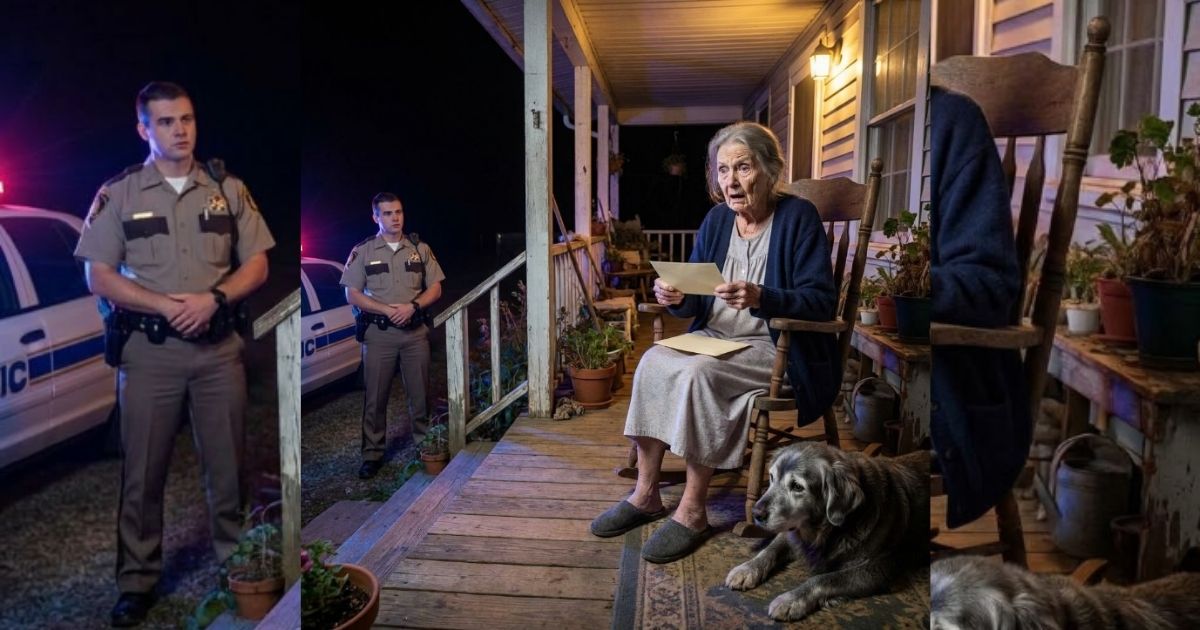
Beside her, Rusty, her elderly Golden Retriever, lifted his gray muzzle from her slipper. Red and blue light swept across the porch boards, across the rocking chair, and across Eleanor’s faded navy cardigan.
Deputy Ben Carter stood at the bottom step with a flashlight pointed safely toward the ground.
“I’m not missing,” Eleanor said. “I came home.”
Ben stared at her.
“You hitchhiked here at midnight?”
“Not the whole way.”
“That does not make it better.”
“It makes it accurate.”
For half a second, Ben looked like he was trying not to smile.
Then he remembered why he was there.
Maple Grove had discovered Eleanor’s empty room shortly before eleven. Rusty was gone too. A nurse found the side entrance unlatched, and someone remembered Eleanor asking that afternoon whether the county bus still stopped near Route 16.
By midnight, the sheriff’s department had been notified.
Eleanor had accepted a ride from a woman leaving a late shift at the county hospital, then another from a farmer hauling feed home. The final half-mile she had walked with Rusty slowly beside her.
Ben had spent twenty minutes expecting to find an injured elderly woman somewhere along a dark road.
Instead, he found her sitting on her own porch like someone waiting for Sunday company.
“Why tonight?” he asked.
Eleanor rubbed the soft fur behind Rusty’s ear.
“Tomorrow strangers get this house. I wanted one last night.”
That took some of the authority out of Ben’s face.
The farmhouse had been Eleanor’s home for fifty-six years.
She and her husband, Thomas, had bought it when the porch leaned badly to one side and rain came through the kitchen ceiling. They had spent most of their first winter repairing things they couldn’t afford to replace.
Thomas had rebuilt the porch himself.
He was not a carpenter, though he had always insisted that being stubborn was nearly the same qualification.
The first railing he installed tilted. Eleanor teased him about it for forty years.
He never fixed it.
“Gives the place character,” he always said.
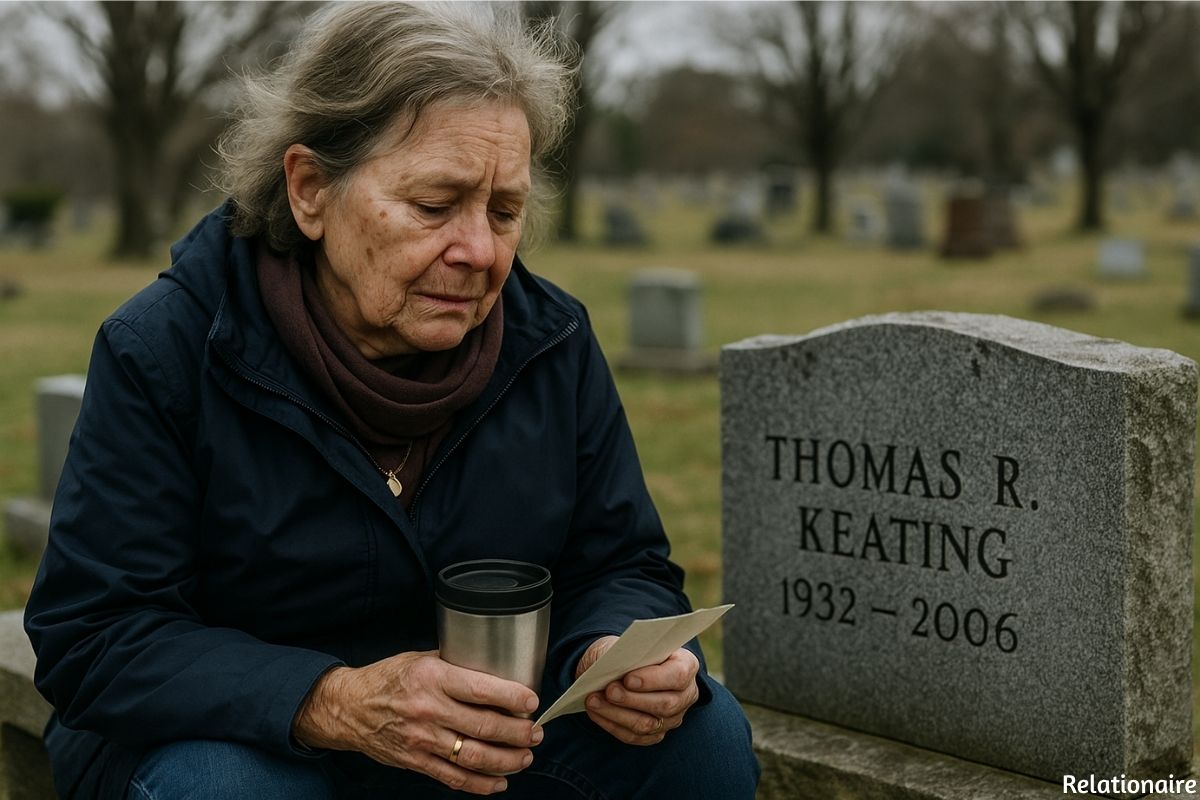
Thomas had been gone twelve years now.
Eleanor had remained in the farmhouse with Rusty, managing just fine by her own standards. Her daughter, Linda, had a somewhat different definition of fine.
The disagreement had become serious the previous winter, after Eleanor slipped on ice behind the house and fractured her wrist.
Nothing catastrophic happened. She recovered. She still cooked, drove during daylight, paid her bills, and remembered every birthday in the family without a calendar.
But the fall frightened Linda.
It frightened Eleanor too, though she never admitted it.
She spent six weeks in rehabilitation and then agreed to stay temporarily at Maple Grove while her wrist regained strength.
Temporary became spring.
Spring became summer.
Meanwhile, Linda drove ninety minutes each way almost every weekend to check the farmhouse, mow what she could, collect mail, and worry about everything Eleanor refused to worry about.
Eventually Eleanor agreed to sell.
That was the word she used whenever anyone asked.
Agreed.
But sitting on the porch that night, she understood that agreement and readiness were not always the same thing.
“The closing is tomorrow morning?” Ben asked.
Eleanor nodded.
“Ten o’clock.”
“And you planned to spend the night out here?”
“I spent forty-six summers sleeping on this porch whenever the house got too hot. I figured I could manage one more.”
Ben glanced at the nightgown beneath her cardigan.
“It’s fifty-one degrees.”
“I brought a blanket.”
“Of course you did.”
“It’s in the grocery bag.”
Ben noticed it beside the porch swing.
Inside were a blanket, two bottles of water, a flashlight, three dog biscuits, and half a turkey sandwich wrapped in wax paper.
Eleanor had planned her escape more carefully than some adults planned vacations.
Ben climbed the steps.
“I still need to call Maple Grove.”
“You can tell them I’m alive.”
“I think they’ll want slightly more information.”
“Tell them I’m annoyed.”
“I suspect they already know that.”
Rusty suddenly pushed himself to his feet.
His old hips made the movement slow and awkward, but his nose had caught something beneath Thomas’s rocking chair.
He sniffed, scratched once at the floorboard, then nosed at a small object wedged underneath.
Ben crouched.
“What’s this?”
He reached beneath the rocker and pulled out a cream-colored envelope secured with a strip of clear tape.
Eleanor frowned.
“I’ve never seen that.”
Ben handed it toward her.
Then she saw the writing.
Her hand stopped.
“Thomas wrote that.”
Ben looked at the envelope, then back at her.
“You’re sure?”
“I was married to that handwriting for forty-four years.”
Thomas had written in heavy block letters because his ordinary cursive was almost impossible to read. Grocery lists, birthday cards, notes on the refrigerator—all of them had the same square T, the same crooked capital E.
Eleanor’s fingers trembled as she opened the envelope.
Inside was a single folded sheet.
She read the first line silently.
Then aloud.
“Don’t sign the transfer. The house is yours.”
For several seconds, the only sound was Rusty breathing.
Ben took the page gently.
“Eleanor…”
She was still staring at it.
Ben turned the envelope over.
A date had been written in one corner.
His expression changed.
“Thomas died twelve years ago, right?”
“Yes.”
“This was written last week.”
Eleanor’s eyes lifted toward him.
Rusty suddenly stared at the dark living-room window.
Ben followed his gaze.
For one strange second, nobody moved.
Then Eleanor said, “Well, unless Thomas has become much better at climbing stairs, I suggest we turn on the lights.”
Ben did.
Nobody was inside.
The explanation arrived forty minutes later, and it was far less mysterious than a ghost.
It was also, Eleanor would later say, much more useful.
Ben called the real-estate agent whose number Eleanor still had in her purse. The agent, awakened and thoroughly confused, called the man who had inspected the property the previous week.
Yes, the inspector remembered the envelope.
While examining loose boards beneath the rocking chair, he had found an old folded note trapped between the chair brace and the wall.
Afraid it would disappear before Eleanor received it, he had put the note into an envelope from his truck, written that day’s date on the outside, taped it beneath the chair, and intended to tell the agent.
Then his phone rang.
He forgot.
The note itself was not twelve days old.
It was nearly twenty years old.
Eleanor remembered the story the moment Ben read the rest of it.
In 2007, a developer had offered to buy several acres behind the farmhouse. Thomas had considered it because they needed money for a new roof.
Eleanor had hated the idea.
They argued for two days.
On the morning they were supposed to sign the land-transfer papers, Thomas changed his mind.
He left Eleanor a note before going to work.
Don’t sign the transfer. The house is yours too. I forgot that for a minute.
Somewhere over the years, the second half of the sentence had been folded behind the first.
Now Eleanor read the whole thing.
She laughed.
Not loudly.
Just one tired little laugh that sounded as though twenty years had briefly stepped onto the porch beside her.
“He was such a stubborn man,” she said.
Ben looked at the crooked railing.
“I’ve noticed some evidence.”
By two in the morning, Linda arrived.
She came up the porch steps still wearing sweatpants and the jacket she had thrown over her pajamas.
She looked first at Eleanor.
Then Rusty.
Then the deputy.
Then the grocery bag containing the blanket and sandwich.
“You hitchhiked?”
Eleanor braced for the lecture.
Instead, Linda sat down on the porch.
For a while, she said nothing.
Finally she looked at her mother.
“Do you actually want to sell?”
Eleanor opened her mouth with the answer she had been giving everyone for months.
It’s practical.
The house is too much work.
Maple Grove is easier.
You can’t keep driving out here.
Instead she said, “Eventually.”
Linda nodded slowly.
“But not tomorrow.”
“No.”
That was all.
No dramatic argument followed.
Linda did not apologize for worrying.
Eleanor did not apologize for being difficult.
Both women had been acting from fear, and both had mistaken their fear for certainty.
Linda was afraid her mother would fall again when nobody was nearby.
Eleanor was afraid of becoming another responsibility on her daughter’s calendar.
So Linda had pushed.
And Eleanor had surrendered before she was ready.
At nine the next morning, the closing was postponed.
The buyers were disappointed but understanding. Nothing illegal or miraculous had happened. No secret deed appeared. No hidden fortune saved the farm.
Eleanor simply had not signed the final transfer yet.
The house was still hers because, until ten o’clock that morning, it had always still been hers.
She remained at Maple Grove for another three months while she and Linda worked out something less convenient and much more honest.
Eleanor returned to the farmhouse four afternoons each week. A neighbor checked on her. Linda stopped coming every weekend and hired local help for the yard instead.
Eleanor complained about the cost.
Then admitted the yard had never looked better.
By autumn, she decided she did want to sell.
But this time she chose the buyers herself.
They were a young couple with two children who spent nearly an hour on the porch during their first visit. Their eight-year-old son noticed the crooked railing.
“Is that supposed to be like that?” he asked.
Eleanor looked at it.
“Yes,” she said. “Apparently it gives the place character.”
At the final closing, she signed without hesitation.
She kept Thomas’s rocking chair.
And the note.
The buyers kept the crooked railing.
Months later, Ben stopped by Maple Grove while delivering paperwork nearby.
He found Eleanor outside with Rusty, who was asleep in a patch of afternoon sun.
“So,” Ben asked, “planning any more midnight escapes?”
Eleanor considered it.
“Depends.”
“On what?”
“Whether people keep remembering to ask me what I want.”
Ben laughed.
Then he noticed the framed note sitting on the table beside her chair.
Eleanor had added one sentence beneath Thomas’s old words in her own handwriting.
Not yet doesn’t mean never.
She never returned to live permanently at the farmhouse.
That surprised people who thought her midnight journey had been about refusing to let go.
It wasn’t.
She had simply wanted the goodbye to belong to her.
Sometimes dignity is simply being allowed to decide when a goodbye is truly yours.
Thank you so much for reading this story!
I’d really love to hear your comments and thoughts about this story — your feedback is truly valuable and helps us a lot.
Please leave a comment and share this Facebook post to support the author. Every reaction and review makes a big difference!
This story is a work of fiction created for entertainment and inspirational purposes. While it may draw on real-world themes, all characters, names, and events are imagined. Any resemblance to actual people or situations is purely coincidental